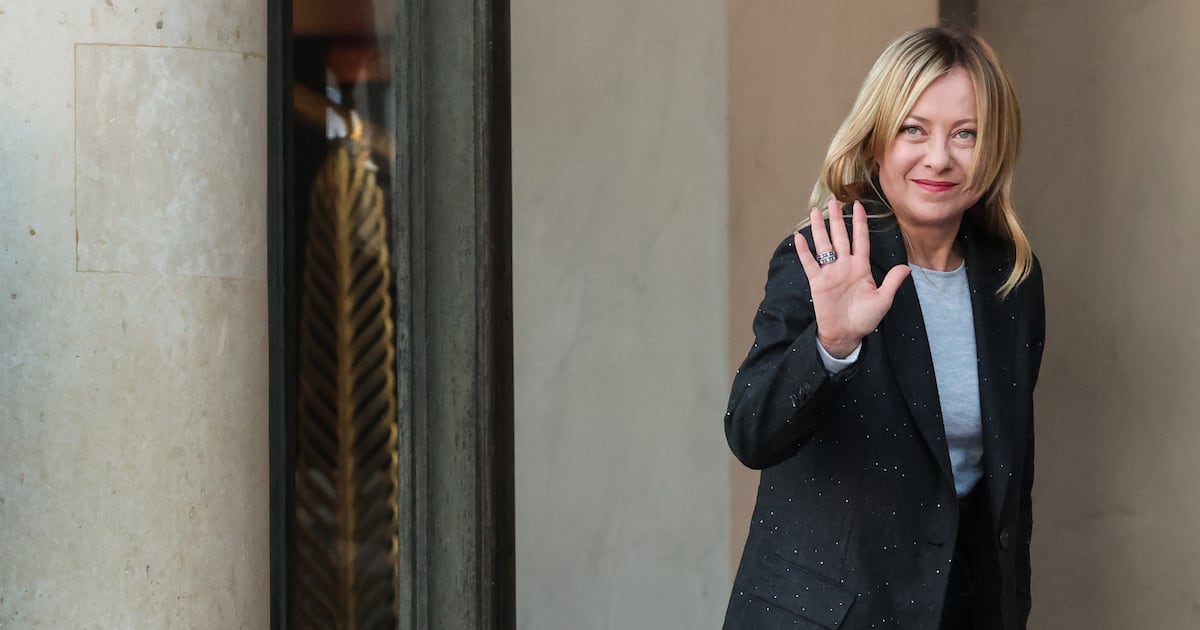
In Giorgia Meloni’s busy 2026 calendar, September 4th is a day of special significance. That will be the day Italy’s first female prime minister, if still in office, surpasses the late Silvio Berlusconi’s record for the longest continuous term in office since the second World War.
Such political endurance would be no small achievement in a country that has had 68 governments – lasting on average just over a year – since its republic was born in 1946. Meloni’s own election, in September 2022, followed the collapse of a technocratic national unity government led by Mario Draghi, the respected former European Central Bank president.
Few foresaw at the time that the fiery former opposition leader – whose Brothers of Italy party is rooted in postwar neo-fascism – would preside over Italy’s longest period of political calm in decades. Less surprising is that Meloni and her allies routinely trumpet their administration’s stability.
“We’ve been given a historic opportunity to make Italy the country we’ve always dreamt of,” Meloni told supporters at Atreju, the Brothers of Italy’s annual political festival, in Rome last month. “We’re establishing an Italy that’s completely different from the one the world knew – and the one to which Italians themselves had seemed resigned.”
But for all her aspirations to be a transformative leader, Meloni has struggled to articulate a clear vision for Italy’s future – especially for its sputtering economy, with its rapidly ageing workforce.
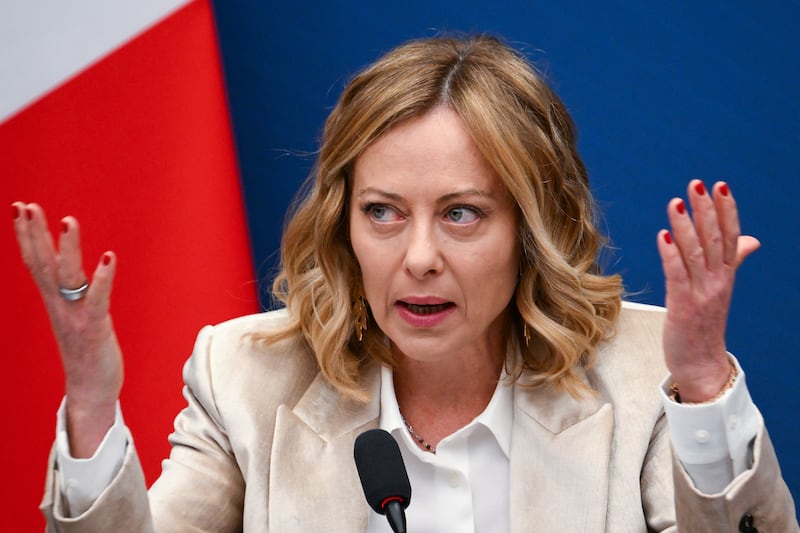
Giorgia Meloni is scheduled to face general elections in Italy next year. Photograph: Alberto Pizzoli/AFP via Getty Images
Many Italians are questioning what her government, a coalition of her party with the far-right League and conservative Forza Italia, has actually accomplished beyond survival. For many – from ordinary workers to members of the business community – the answer so far is: disappointingly little.
Now, with the next general elections looming in 2027, Meloni has a little over a year left to demonstrate that she is more than just a cautious caretaker, and can offer meaningful policy solutions to Italy’s pressing economic challenges.
“It’s a fantastic coalition because Meloni is able to impose discipline, and so the long-term endurance of the government is guaranteed,” says former European Commission president Romano Prodi, a centre-left stalwart who also had two short stints as Italy’s prime minister. “But the price is no innovation in a country that has already been paralysed for a long time.”
Losing momentum
Meloni’s government has impressed credit ratings agencies and foreign debt investors with its fiscal prudence, but the Italian economy is nevertheless losing momentum despite a cash infusion – about €140 billion so far – from Europe’s post-Covid recovery fund. Consumers and businesses are gloomy.
Growth slowed to an estimated 0.4 per cent in 2025, and is forecast to remain below 1 per cent for the next two years – far below the pace of expansion of other Mediterranean economies such as Spain and Greece, and one of the slowest in the Eurozone.
Yet her team has shown little appetite or ability for the kind of productivity-enhancing structural reforms that economists believe are required to boost growth – but which could upset powerful vested interests.
On the international stage, the prime minister has sought to raise both Italy’s international stature and her own. “We are working to build a nation that is a leading player in the west first and foremost,” she said at Atreju, insisting Rome had a “duty to be influential at the international level – and also to help resolve disputes in a very difficult international context.”
A long-time admirer of US president Donald Trump, who has praised her leadership and even promoted the English edition of her autobiography on his Truth Social platform, she has often played intermediary between the White House and the EU as frictions between the two mount.
But her efforts to stay in Trump’s good books without alienating European allies are set to become more difficult. “Her heart beats with Maga, but geography can’t be changed,” says Nathalie Tocci, director of Rome’s Institute for International Affairs.
At home, Meloni faces a high-stakes referendum expected in March on an overhaul of Italy’s justice system, a cause she has personally championed and which she says “will strengthen the impartiality of judges”. Polls point to a potentially close and unpredictable contest on a complex issue that still bewilders many Italians.
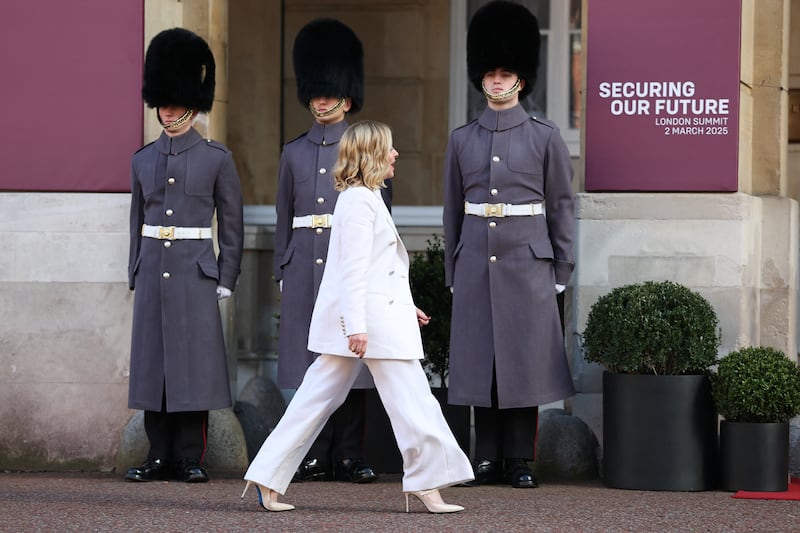
Giorgia Meloni arriving at a European leaders’ summit in London last March. Photograph: Toby Melville/PA Wire
Meloni and her coalition partners have repeatedly declared that a rejection of her proposed judicial reform would not undermine the stability of her government. But political analysts say a defeat would dent Meloni’s aura of invincibility and embolden her critics, including political rivals and business and industry groups unhappy with what they see as the government’s lacklustre economic performance.
“It’s clear that if the referendum fails, it’s a significant blow for her leadership,” says Lorenzo Pregliasco, founding partner of YouTrend, a political pollster. “She would be seen for the first time as a loser. Once you lose what we call ‘the magic touch’, it’s hard to recover.”
Hard lessons
Meloni, who entered politics as a teenage activist with a party started by the surviving comrades of Benito Mussolini, has undoubtedly defied the anxiety and gloomy predictions that greeted her swearing-in just over three years ago.
During her years as a far-right, populist activist and lawmaker, she was a vocal critic of the European Commission and international capital markets, raising fears that Rome’s relations with Brussels, along with the global investors who hold Italy’s vast debt pile, could deteriorate under her leadership.
But Meloni learned hard lessons from watching her erstwhile mentor Berlusconi, who was forced to resign in 2011 amid a debt crisis and market panic. She was elected during the ill-fated 49-day premiership of Britain’s Liz Truss, a right-winger whose unfunded tax cuts and attacks on state institutions triggered unease in bond markets and precipitated her resignation.
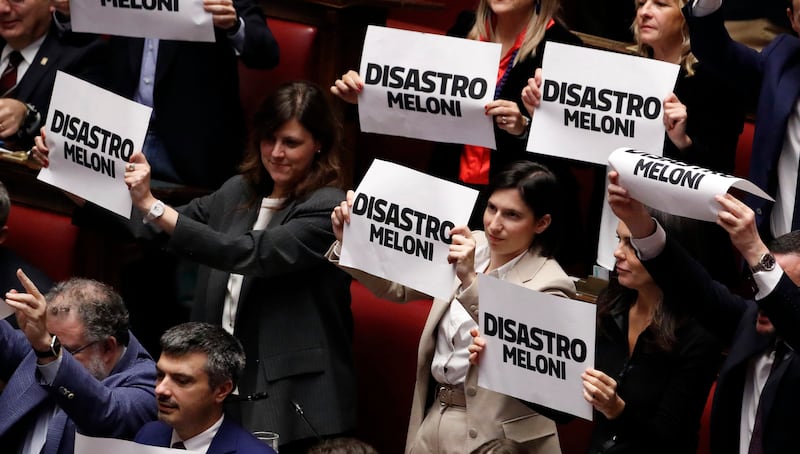
A protest by some Italian parliamentarians during a vote on a contentious budget law last month. Photograph: Massimo Di Vita/Archivio Massimo Di Vita/Mondadori Portfolio via Getty Images
In office, Meloni and her League finance minister Giancarlo Giorgetti have displayed an unexpectedly zealous commitment to fiscal discipline. They have cut Italy’s budget deficit to the 3 per cent of GDP target set by the EU, from 8 per cent when they took charge.
The spread between 10-year Italian government bonds and their German equivalents has fallen to 16-year lows in recent months, reflecting growing market confidence in Meloni’s fiscal stewardship. The botched announcement of a 40 per cent tax on banks’ windfall profits in the summer of 2023, which briefly sent bank stocks tumbling, was a rare misstep.
“From the point of view of financial stability, she has achieved a lot,” says elder statesman Prodi, now 86. “From her experience in the Berlusconi government, she learned that if you have a financial crisis, you lose everything.”
Moody’s recently raised Italy’s unsecured sovereign debt rating to Baa2, from Baa3, its first such upgrade in 23 years and the latest in a series of such upgrades, or improvements in outlooks, from ratings agencies including Fitch and DBRS.
In its late November decision, Moody’s cited “a consistent track record of political and policy stability”, and said it expected Italy’s debt-to-GDP ratio, currently about 136 per cent, to start gradually declining in 2027.
But Italy’s fiscal consolidation has come at a cost to ordinary Italians, including public sector workers, whose purchasing power has been squeezed hard. As of September, Italy’s real wages were 8.8 per cent below their level in January 2021, according to Istat, the official statistics agency.
Taxes have risen; with the tax take rising to 42.8 per cent of GDP in 2024, up 1.2 percentage points from 2023, and far above the OECD average of 34 per cent. The growth in tax revenues as a share of GDP has far outpaced the growth of the economy.
In opposition, the right-wing parties in Meloni’s coalition said that “austerity was the worst thing that a government can do”, points out economist Veronica De Romanis, a former treasury official who is now a professor at Rome’s Luiss University. “But if you look, the current government has imposed the biggest dose of austerity, raising taxes and cutting expenditure.”
And while Italian debt has been re-rated, old economic problems such as low productivity and slow growth are resurfacing after a strong recovery from the pandemic. Meloni brags that Italy’s employment rate has hit an all-time high of 62.5 per cent, but economists say most newly-created jobs are poorly paid, precarious work in tourism and construction.
Confindustria, the main industry association, laments that Italy’s manufacturing sector, with its preponderance of small and medium-sized businesses, has been pushed to the brink by Europe’s highest energy prices – 30 per cent above the EU average. Industrial output is languishing and thousands of workers are on furlough schemes.
Italy’s productivity per worker is lower today than it was 20 years ago, Goldman Sachs recently noted, with well-paid, skilled manufacturing jobs accounting for a diminishing percentage of the total labour force.
Goldman Sachs also warned that Italy’s maximum potential growth – now just 0.8 per cent of GDP – risks dropping to 0.5 per cent by 2030 without significant reforms, particularly to boost Italy’s lagging educational attainment.
Meloni has not outlined a clear strategy to address these problems or to utilise available resources to bolster Italy’s long-term competitiveness, business associations and economists say, though open criticism remains muted due to fears of provoking a response from a prime minister who many regard as volatile and thin-skinned.
“Everyone is very quiet, not because they like what she is doing but they are fearful of criticising her when they think she is going to serve another term,” says a corporate executive who asked not to be identified.
Some are still willing to speak up. Stefano Firpo, director general of Assonime, Italy’s oldest business association, warns that near-zero growth and negative productivity data “can’t be swept under the carpet”. “The policy agenda on growth, on productivity and competitiveness has been neglected,” he says.
Industry minister Adolfo Urso spends much of his time battling immediate crises, trying to keep ailing factories open with short-term fixes, while take-up of the one scheme intended to provide support to businesses for productivity-enhancing investment was limited by its poor design and complexity. The government ended up reallocating the funds set aside for it.
Confindustria’s pleas for energy sector reforms to decouple the price of low-cost renewable power from expensive gas-fired generation have fallen on deaf ears in Rome, given stiff resistance from the powerful state-controlled energy giant, Enel, which reported net profits of €7.1 billion in 2024, up 9.6 per cent from 2023.
Economists say that while paring back public spending, Rome should be making strategic policy choices on reallocating funds to areas that would best increase Italy’s long-term term growth potential, especially modernising the education system and funding more research and development.
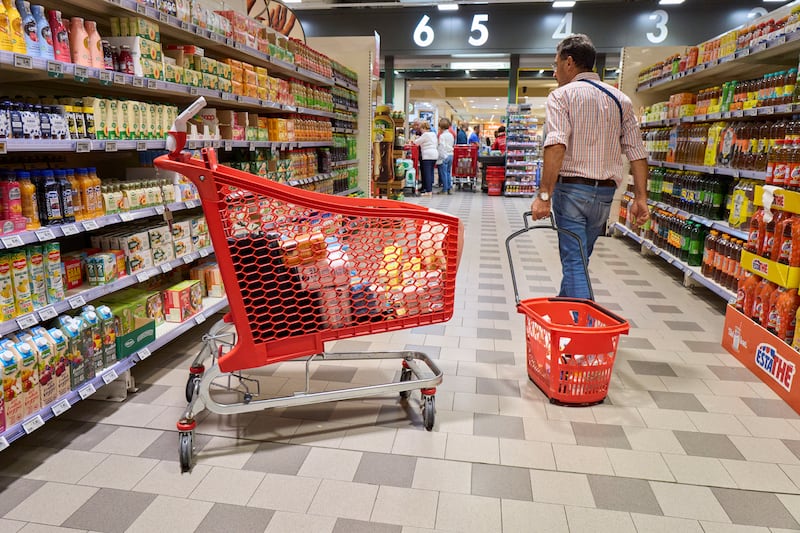
The purchasing power of most Italians has not improved under Giorgia Meloni’s leadership. Photograph: Matteo Della Torre/NurPhoto via Getty Images
But exercises in cutting wasteful expenditures would inevitably put special interest groups on the defensive. That helps explain why Meloni, despite her coalition’s comfortable parliamentary majority, has mostly opted for straight budget cuts after initially shutting down an unsustainable construction bonus, and suspending a controversial welfare scheme.
“You can intervene on the composition of expenditures – but they have done exactly the opposite,” says Luiss university’s De Romanis. “You have to have the courage to choose and take responsibility for your choice.”
Parliament member Carlo Calenda, a former industry minister and now leader of the small, centrist Azione party, says Meloni and her team have been “completely paralysed” in the face of Italy’s complex economic challenges. “Her approach is, ‘let’s not make a mistake, so I’ll do nothing’,” adds Calenda, who still has friendly relations with the premier and her party.
Protest vote
Simmering discontent over Italy’s stalling economy and the squeeze on real incomes could affect the referendum on judicial reform expected in March. Though the nuts and bolts of judicial reform is something that preoccupies the political classes more than ordinary Italians, voters unhappy with Meloni’s government could turn out to cast protest votes. “It’s becoming a referendum about yes or no to the government,” says Prodi.
Even if she secures victory on justice reform, Meloni’s other foreign policy and economic challenges will continue to weigh on her, as she counts down towards the September 4th milestone.
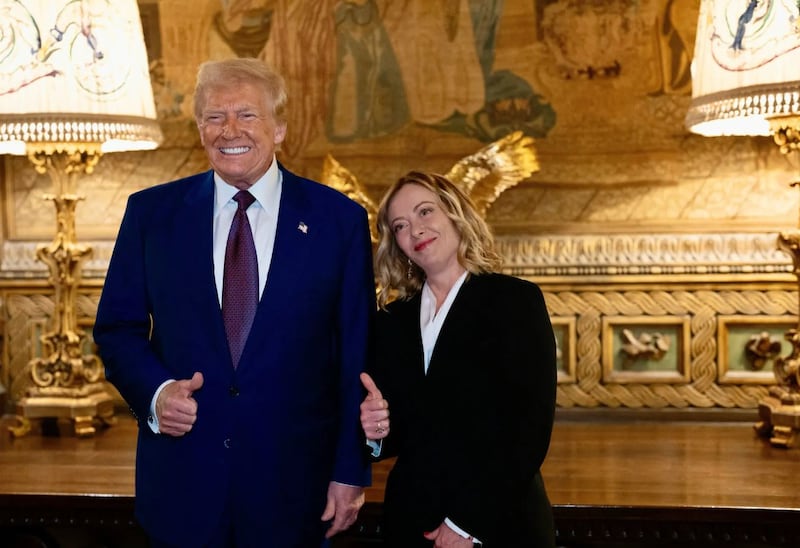
It’s not clear whether Italy has benefitted from Giorgia Meloni’s friendship with Donald Trump
Her friendship with Trump has so far brought few tangible benefits to Italy, which has been hit by his 15 per cent import tariffs on EU goods. That makes her highly visible ties to the volatile US president and her insistence on the alignment of American and European interests a potential political liability, especially if the current transatlantic rupture deepens further.
“She is in a tough spot,” YouTrend’s Pregliasco says. “If Trump does something crazy, unpleasant or unprecedented against Europe and Italy, people are definitely going to blame that partly on her … the more Trump appears disconnected from Europe, the more Meloni can be seen as someone who is blind to what is happening.”
Sluggish growth at home could also sour the mood of a public otherwise grateful for a dose of calm after a period of excessive political drama in recent years. “Stability in economics doesn’t say much,” says De Romanis. “You can grow or not grow. But if you don’t grow, you go backwards.”
Milan-based businessman Paolo Grimoldi, who is also a former lawmaker with the League, says he is “happy that the official balances are okay, and that international ratings agencies are saying we are not going to default tomorrow” but adds that “if I don’t have money to make it to the end of the month, it’s not my priority”.
“They are taking care more of the international institutions, and international appearances than about the real life of the people,” Grimoldi says. “What is not moral and not ethical, is that in the election campaign they say exactly the opposite.”
– Copyright The Financial Times Limited 2026