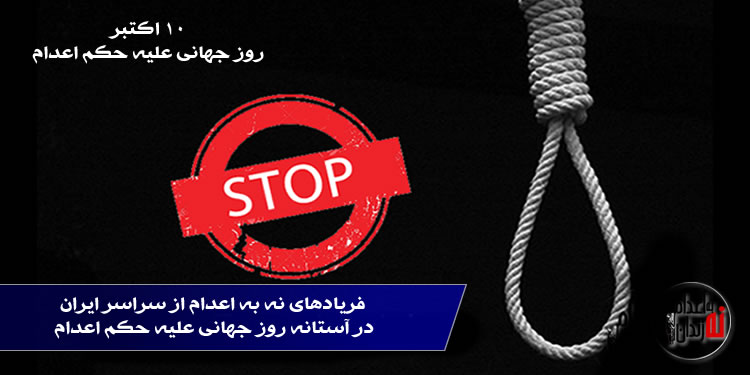
We are in the 102nd week of the ‘No to Execution Tuesdays’ campaign, while the execution government of Iran, over the past year (2025), has hanged more than 2,200 of our fellow citizens on the gallows.
***************************************************************************
The “No to Execution Tuesdays” campaign has entered its one hundred and second consecutive week, spanning 55 prisons across Iran, at a time marked by an unprecedented rise in executions during 2025. This escalation includes the issuance of death sentences against political prisoners—among them detainees in Sheiban Prison in Ahvaz—and dozens of executions in recent weeks. These developments have coincided with widespread public protests, strikes, and gatherings across the country in response to the Islamic Republic’s deepening economic and political crises, laying bare a systematic assault on the right to life and the regime’s deliberate strategy of repression. The campaign has issued the following statement in support and solidarity with the protests.
Statement of the Campaign:
“At the beginning of the year 2026, we are in the one hundred and second week of the ‘No to Execution Tuesdays’ campaign, while the execution government, over the past year (2025), has hanged more than 2,200 of our fellow citizens on the gallows, including 19 political and ideological prisoners. This week, the political prisoner Seyyed Mohammad Mousavi, from Shadegan, detained in Sheiban Prison in Ahvaz, has been sentenced to death, adding his name to the list of dozens of other political prisoners whose lives are in imminent danger. Since Dec. 22nd ( Iranian month of Day ), 167 individuals, including one woman have been executed in Iran.
This week, we are on hunger strike while the people of Iran, for the tenth consecutive day, have taken to the streets in protest, strike, and assembly against catastrophic economic and political conditions. Their primary demand is the overthrow of this authoritarian regime—one that has subjected the population to oppression and systematic violence against their lives and livelihoods for 47 years.
As members of this campaign, we honor the memory of those who have lost their lives in this nationwide uprising and declare our full solidarity with the courageous and freedom-seeking people of Iran. We stand alongside them to the end. Neither the direct shooting of young people, nor the arrest of schoolchildren, nor torture and the extraction of forced confessions from protesters can silence the call for justice. Undoubtedly, the culmination of these struggles—after decades of dictatorship and repression—will be the realization of freedom, equality, and democracy for all Iranians.”
On Tuesday, December 23, 2025, the “No to Execution Tuesdays” reached its 100th consecutive week, marked by coordinated hunger strikes across 55 prisons in Iran. Initiated and sustained under conditions of extreme repression, this unprecedented collective action represents one of the longest-running and most organized abolitionist protests to emerge from within Iran’s carceral system. The participation of the women’s ward of Yazd Prison right before the 100th week, further underscores both the expansion and the gendered dimensions of this resistance.
This milestone unfolds against a grim backdrop. In 2025 alone, Iran carried out the highest number of executions in over a decade (1,922), the Iranian human rights group Human Rights Activists (HRA) announced in its annual statistical report for 2025—almost double the number recorded in 2024—reinforcing its position as the country with the highest per capita reported execution rate in the world.
Iran also continues to hold the disturbing distinction of executing more women than any other country globally. Taken together, the scale of state violence and the persistence of prisoner resistance expose the death penalty not merely as a criminal justice measure, but as a central instrument of political repression and social control.
Iran’s contemporary prisoner-led abolitionist movement must be situated within a longer genealogy of carceral resistance that dates back to the early years of the Islamic Republic. Between 1981 and 1988, political prisoners held in facilities such as Evin, Gohardasht (Rajai Shahr), Adelabad in Shiraz, and Vakilabad in Mashhad engaged in collective resistance against systematic ideological coercion. Leftists, Mojahedin, Kurdish activists, and other dissidents refused forced “repentance” (tavvab-sazi), organized clandestine education circles, and practiced collective silence under torture. This sustained moral and political defiance culminated in the summer of 1988, when thousands of prisoners were summarily executed for refusing to submit to ideological interrogation by so-called “death committees.” Subsequent survivor testimonies became central to international human rights documentation, including United Nations investigations, Amnesty International reports, and the landmark 2021 universal-jurisdiction trial in Sweden against Hamid Nouri, establishing Iran as a paradigmatic case of crimes against humanity committed within prisons.
Following the mass executions, the 1990s witnessed a shift from overt collective resistance inside prisons to what may be understood as testimonial resistance. Former political prisoners documented torture regimes, execution procedures, and the gendered dimensions of incarceration and abuse, transforming memory itself into a form of political action. These testimonies laid the groundwork for the formation of prison archives that later informed the work of Human Rights Watch, UN Special Rapporteurs, and other international accountability mechanisms. While largely absent from global headlines at the time, this period was crucial in sustaining an intergenerational continuity of resistance, ensuring that the carceral violence of the 1980s was neither erased nor normalized.
Prisons reemerged as visible sites of protest during moments of broader political upheaval, most notably in the aftermath of Iran’s disputed 2009 presidential election. Detentions at Kahrizak and Evin were marked by widespread reports of torture, sexual violence, and deaths under interrogation, triggering internal prison protests and external outrage. The exposure of atrocities at Kahrizak—widely covered by international media outlets such as CNN, BBC, and The Guardian—led to its eventual closure under public pressure. A decade later, between 2018 and 2020, hunger strikes led by women political prisoners, including Narges Mohammadi, reframed incarceration explicitly as state violence against women. Protest actions against prolonged solitary confinement and denial of medical care were accompanied by public letters that linked penal practices to broader structures of gendered repression, drawing sustained attention from Amnesty International, PEN International, and UN human rights experts.
This trajectory intensified in the early 2020s, as deteriorating prison conditions intersected with nationwide crises. In August 2021, coordinated prison protests erupted across facilities such as Evin, Sheiban in Ahvaz, and Sepidar, triggered by overcrowding, COVID-19 deaths, and executions. Prisoners openly chanted anti-regime slogans, while leaked CCTV footage from Evin exposed systemic abuse, prompting global coverage by The New York Times, BBC, Al Jazeera, and Reuters. During the 2022–2023 “Woman, Life, Freedom” uprising, prisons were no longer peripheral but central arenas of resistance. Prisoners chanted the movement’s slogan from inside cells, women detainees issued collective feminist statements, and hunger strikes were launched in opposition to death sentences, firmly situating carceral spaces within the geography of the uprising.
It is within this historical continuum that the “Tuesdays Against Executions” campaign, launched in January 2023, must be understood. Spanning more than 55 prisons and continuing for over 100 consecutive weeks, the campaign represents the first sustained, nationwide abolitionist movement originating from within Iran’s prison system. Through weekly collective hunger strikes, prisoners explicitly frame executions as instruments of political repression, gendered violence, and class punishment. What distinguishes Iran’s prison resistance globally is its continuity rather than episodic character, its intergenerational transmission from 1980s survivors to contemporary activists, its feminist-abolitionist framing, and its reliance on moral confrontation rather than other forms of struggle. By declaring state laws unjust and executions illegitimate, prisoners challenge not only the penal system but the moral foundations of political authority itself.
Iran’s prison-led abolitionist movement also warrants analysis within a broader global history of carceral resistance, where prisons have functioned not merely as sites of repression but as arenas of political agency. In South Africa under apartheid, political prisoners—most notably members of the African National Congress—engaged in sustained collective resistance from the 1960s through the 1980s. Through refusals of forced labor, the creation of study groups, coordinated hunger strikes, and strict internal political discipline, prisoners asserted themselves as political actors rather than passive victims. Although this resistance was directed primarily against racial domination and political imprisonment rather than executions, it shares with the Iranian case a long-term moral legitimacy forged under isolation, as well as a capacity to reinforce and morally anchor movements beyond prison walls. Unlike Iran’s ritualized weekly protests, however, South African prison resistance was less publicly synchronized and less explicitly abolitionist in orientation.
The hunger strikes of republican prisoners in Northern Ireland between 1980 and 1981 offer another instructive comparison. The death of Bobby Sands and others transformed prison protest into a decisive moral confrontation with the British state, reshaping international discourse and reframing incarcerated militants as political subjects. As in Iran, the prison became a site where ethical defiance challenged state authority. Yet the Irish hunger strikes were acute and fatal rather than sustained, and their central demand concerned political status rather than the abolition of capital punishment. Iran’s case differs fundamentally in that prisoners collectively confront the state not through martyrdom alone, but through prolonged moral exposure of what they define as an illegitimate system of state killing.
This moral confrontation constitutes a defining feature of contemporary prison resistance in Iran. Prisoners challenge the Islamic Republic not through armed struggle or institutional power, but through ethical defiance grounded in collective dignity and truth-telling. By refusing coerced confessions, repentance rituals, and participation in sham judicial processes, prisoners invert the prevailing power dynamic: the state retains physical force, but prisoners claim moral authority. Open letters from prison, collective hunger strikes, and statements such as those issued under the “Tuesdays Against Executions” campaign function as acts of parrhesia—ethical truth-telling that exposes the contradiction between the regime’s claims of Islamic justice and its systematic reliance on cruelty, torture, and death. When prisoners act collectively across ideological, ethnic, gender, and religious lines, they directly undermine one of the regime’s core strategies: fragmentation through fear.
Comparable dynamics can be observed in other contexts, though rarely with the same continuity or abolitionist clarity. In Turkey, leftist political prisoners resisted the introduction of F-type isolation prisons between 2000 and 2007 through coordinated hunger strikes and so-called “death fasts,” sustaining collective discipline across multiple facilities at immense human cost. In the United States, death-row prisoners and incarcerated organizers have articulated abolitionist critiques through hunger strikes, legal writing, and alliances with external movements, linking capital punishment to racial and class injustice. Political prisoners in Belarus and Russia have likewise used collective statements and hunger strikes to sustain resistance under authoritarian conditions. Yet in each of these cases, prison-led protest has tended to be episodic, fragmented, or externally driven, lacking the sustained nationwide coordination and internally generated abolitionist framework that characterizes the Iranian movement.
What renders the Iranian case historically exceptional is the convergence of several elements rarely found together. The “Tuesdays Against Executions” campaign has maintained weekly continuity for more than one hundred weeks under extreme repression; it originated inside prisons rather than as symbolic solidarity actions outside; it coordinates participation across dozens of facilities nationwide; and it articulates a clear abolitionist critique of the death penalty as a system of governance rather than as a series of individual injustices. Its persistence despite the continuation of executions—an outcome that often fractures prison movements elsewhere—underscores a distinctive politics of dignity. When prisoners publicly oppose the death penalty while facing it themselves, they strip executions of their intended moral justification, declaring in effect: you may kill us, but you cannot make us complicit.
Historically, prison-led protests have often marked decisive moments in struggles against authoritarianism and state violence. Few, however, have matched the duration, coordination, feminist-abolitionist framing, and moral clarity of Iran’s “No to the Death Penalty” campaign. Its significance lies not only in opposing executions, but in redefining prisoners as collective political actors who confront the state at the very point where its power is most absolute: the claimed right to take life.
As the coalition of international organizations reminds us, “What do children, athletes, college students, parents, refugees, political dissidents, ethnic minorities, women’s human rights activists, child brides, survivors of gender-based violence, and people arrested on drug-related charges all have in common? They are trapped in Iran’s wide-reaching, unconscionable execution scheme.” This indictment underscores the indiscriminate and structural nature of the death penalty, yet the courage of imprisoned abolitionists demonstrates that moral authority can confront even the most repressive systems. Their sustained resistance transforms individual suffering into collective witness, proving that conscience and solidarity can outlast fear. As António Guterres, United Nations Secretary-General, has declared: “The death penalty has no place in the twenty-first century. The momentum toward abolition is irreversible, and together we can consign capital punishment to history.” In Iran, this movement embodies that hope, showing that even in the darkest prisons, the light of justice and human dignity endures, and a future without executions is possible.
January 6, 2026