In domestic politics, the upcoming year will be shaped by two overlapping forces: cohabitation as a political setup, and next year’s general election as the governing horizon.
Cohabitation between a Civic Platform-led government and a president aligned with Law and Justice (PiS) is not new. This time, however, it is proving more confrontational. President Karol Nawrocki has made unusually assertive use of his veto powers: in just five months, he has vetoed more legislation than his predecessor managed in a decade.
But the vetoes are only part of it. Nawrocki has also blocked military promotions, refused ambassadorial appointments and stalled judicial nominations. Poland still does not have an ambassador in Washington. This is creating genuine gaps in how the state functions.
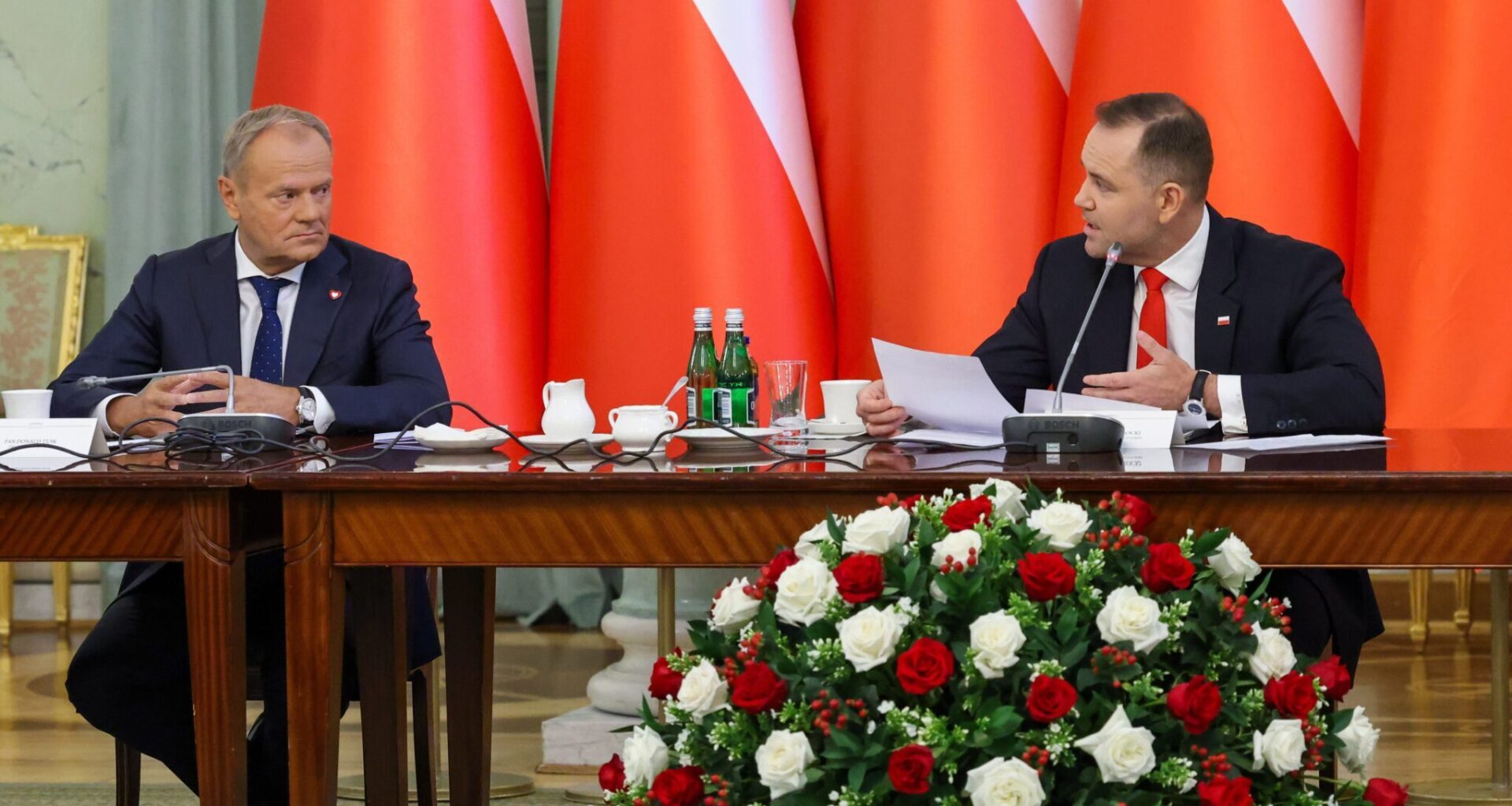
At the same time, the axis of political polarisation is shifting. For years, Polish politics revolved around Donald Tusk versus Jaroslaw Kaczynski. In 2026, the main rivalry increasingly runs between Tusk and Nawrocki. The change suits both men. Nawrocki is positioning himself as the dominant figure on the right, while Tusk benefits from a new adversary who helps consolidate his own centrist camp.
Nawrocki ended 2025 as Poland’s highest-rated politician, likely the predictable honeymoon bounce. Openly aligned with the MAGA wing of Western conservatism, he is seeking to move beyond blocking legislation and emerge as the political leader of a future right-wing majority. This ambition matters in the context of 2027, when a governing coalition between PiS and the far right is no longer a distant scenario.
Tusk appears energised by the renewed confrontation. His government – a broad and often uneasy coalition of liberals, centrists and the left – has regained some of its old momentum. Recent polling places Civic Platform and its allies in the low-to-mid 30 per cent range, ahead of PiS, stuck in the high 20s. Analysts attribute this recovery mostly to the unfreezing of EU funds, relative government stability and continued fragmentation on the right.
Yet the arithmetic of 2027 remains unforgiving. The challenge for the liberal camp will not be just about defeating PiS. While Civic Platform has strengthened its position, the far right has grown in parallel. That space now belongs to two separate populist formations – both with Confederation in their name, confusingly enough – which together attract a more radical electorate. By late 2025, the combined support of PiS and both Confederation parties – Konfederacja and Confederation of the Polish Crown (KPP) – was sufficient, on paper, to form a governing majority.
Paradoxically, the presidential campaign strengthened the far right more than PiS itself. While PiS retains organisational depth and an older base, it is losing ground among younger voters, particularly men drawn to Konfederacja’s blend of economic libertarianism, cultural backlash and anti-establishment posturing. Unless PiS renews its appeal, it risks entering 2027 as the largest party on the right – but dependent on Konfederacja as a coalition partner, despite the latter’s repeated declarations that such cooperation would never happen.
The rise of Grzegorz Braun’s KPP faction deserves particular attention. Braun, whose political brand mixes explicit antisemitism with pro-Russian framing and anti-establishment theatrics, was once a fringe figure. Now his party polls in double digits. Whether this represents a durable shift or temporary protest will become clearer in 2026.
What would a further swing to the right mean? It is likely to translate less into immediate policy change than into a coarsening of political language: sharper euroscepticism, harsher rhetoric on migration and culture, and persistent questioning of liberal democratic norms. Talk of leaving the EU remains largely rhetorical, but polling shows growing openness to the idea.
The real question for 2026 is whether Poland’s liberal and pro-democratic forces can move beyond defensive positioning and articulate a convincing political project of their own – before the permanent campaign consumes what remains of the governing middle ground.