Yet despite the excitement, the broader electricity mix looked about the same as ever. Natural gas provided by far the biggest share of the country’s electricity, followed by nuclear, followed by coal, per U.S. Energy Information Administration data released in December.
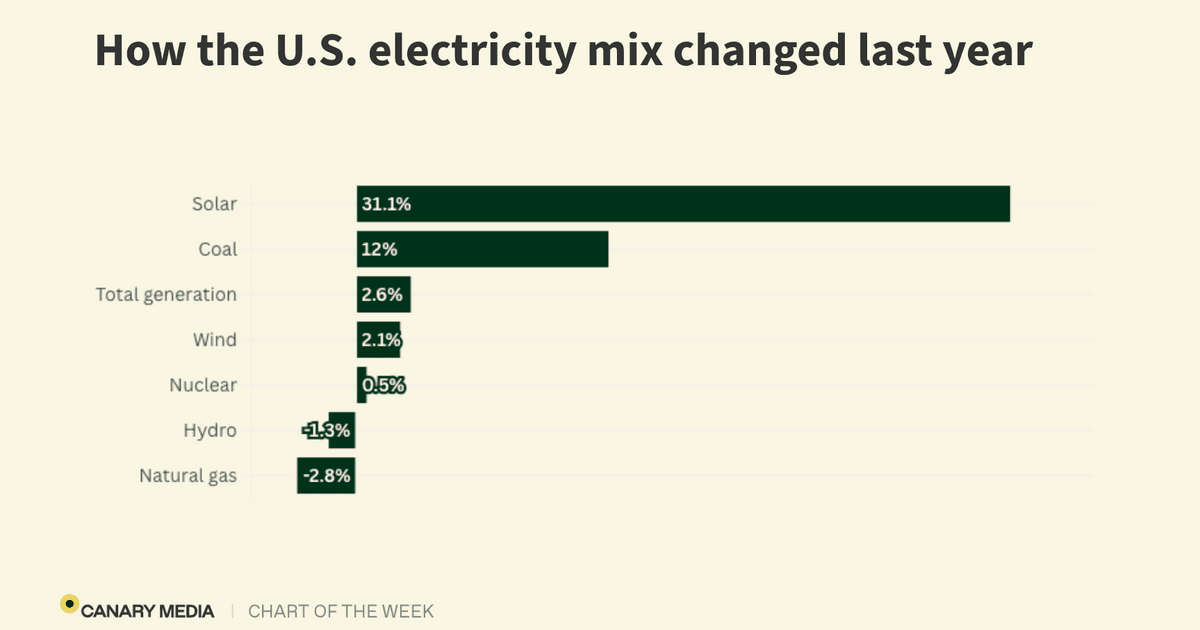
The story gets more interesting, however, when you zoom in. Last year, solar panels produced 31.1% more electricity than in 2024, while coal-fired power plants generated 12% more megawatt-hours, according to EIA data crunched by Michael Thomas at Distilled. Natural gas generation, meanwhile, fell by nearly 3%.
Overall, power demand ticked up by 2.6% — a seismic number for a sector that has been stagnant for over a decade.
Solar’s growth is easy enough to explain: We need more power, and no source of electricity is quicker or cheaper to deploy. The rise of cost-effective battery storage has made solar even more attractive. In fact, despite the considerable roadblocks created by the Trump administration last year, solar and batteries together accounted for more than 80% of new energy capacity added to the grid between last January and November.
The dynamics around coal and gas are a bit wonkier.
Yes, as Thomas points out, President Donald Trump made a show of celebrating “beautiful, clean coal” last year. His administration also used emergency powers to order a number of aging, expensive-to-run coal plants to stay open on the eve of their planned closures. But it’s not as if Trump isn’t also supportive of the U.S.’s natural gas industry. So why the rise for one and the fall for the other?
It boils down to market forces. Gas prices spiked last year, and so did electricity demand. That bolstered the financials for some coal plants, resulting in more coal generation — and, as Thomas points out, a dirtier grid. Power-sector emissions jumped by 4.4% from 2024 to 2025, per Thomas, a significant leap and the second year in a row of rising emissions after years of consistent declines. The EIA expects coal-fired power to shrink this year, however, as more renewables come online and once again erode the economic case for burning the dirty fuel.
And despite coal’s brief resurgence, it wasn’t all positive for the fossil fuel in 2025. In fact, a separate metric may be a better indicator of its long-term outlook: For the second year in a row, wind and solar together produced more U.S. electricity than did coal.