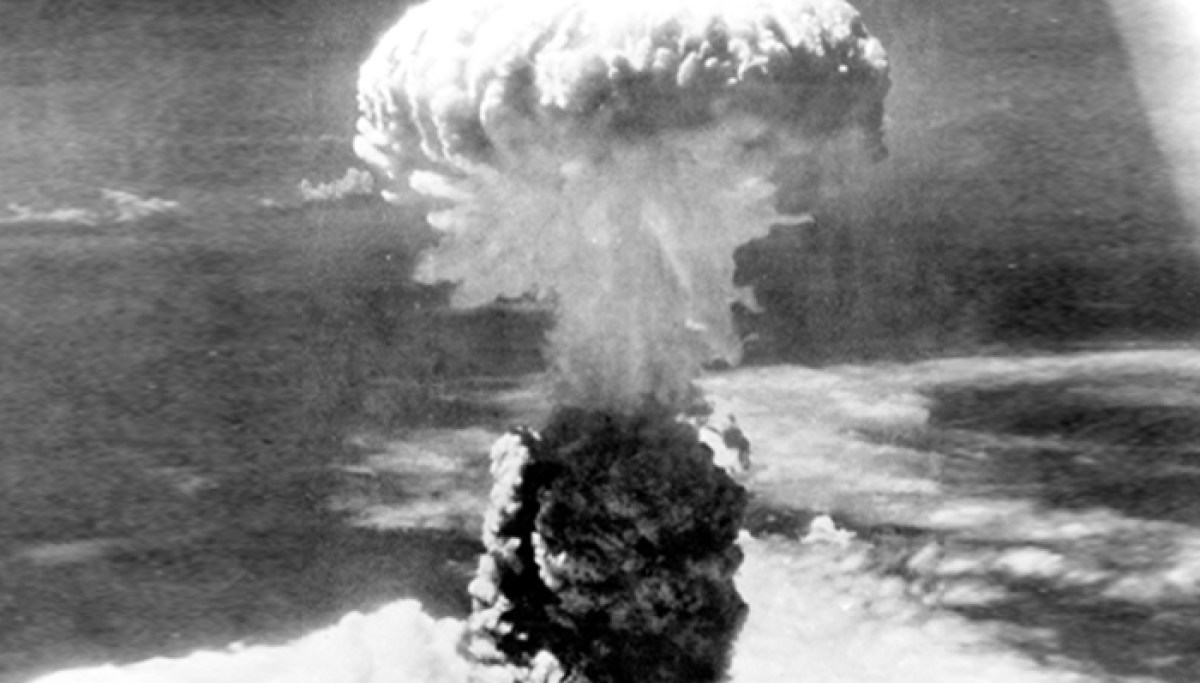
“Nuclear… We can’t let people throw around that word. I call it the N-Word. There are two N-words, and you can’t use either of them. And, frankly, if it does get to use, we have more than anybody else.”
President Donald Trump spoke these words on Sept. 30, 2025, at a gathering of top military brass in Virginia. At its core was a message of fear, juxtaposing the fear of social cancellation for uttering a racial slur alongside the fear of atomic annihilation. At the same time, Trump’s statement was one of American strength. The United States possesses more nuclear weapons than any other country and has the ability to deliver them anywhere on the globe.
The central theme of fear of nuclear weaponry during Trump’s speech undoubtedly resonated with Harvard University historian Serhii Plokhy. Plokhy, a prolific scholar, has written 18 books on the Second World War, the Cold War, and Ukrainian history. His most recent addition to this oeuvre is The Nuclear Age: An Epic Race for Arms, Power, and Survival, a broad overview of how and why nations have acquired atomic weapons from the Second World War to the present. Plokhy gives detailed attention not only to the American and Soviet atom bomb projects of the 1940s and Cold War era, but also traces national developments in Nazi Germany, the United Kingdom, France, China, Israel, South Africa, India, Pakistan, and North Korea.
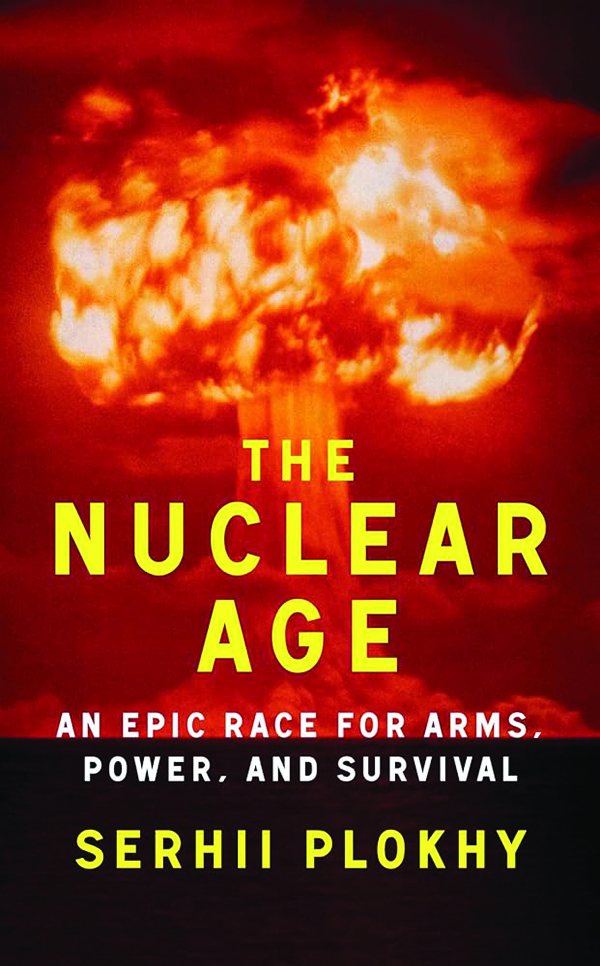 The Nuclear Age: An Epic Race for Arms, Power, and Survival; By Serhii Plokhy; W. W. Norton & Company; 422 pp., $31.99
The primary reason these countries developed such powerful weaponry was, as Plokhy demonstrates time and time again, fear. Fear of a Nazi atomic bomb spurred theoretical physicists Albert Einstein and Leo Szilard to write President Franklin Delano Roosevelt to make sure that America got the bomb first. At a meeting at the White House in October 1939 to press this issue, economist Alexander Sachs gave Roosevelt a historical account of American inventor Robert Fulton’s dealings with Napoleon Bonaparte in the early 1800s. Fulton offered to build steamships for the French emperor to ferry his army across the English Channel. Not believing that such an invention was feasible, Napoleon sent Fulton away. Roosevelt well understood the historical analogy at work, and the Manhattan Project was born.
After the bombings of Hiroshima and Nagasaki, the Soviet Union, fearful of an American first strike, developed its own bomb with the assistance of communist spies in the U.S. program. Edward Teller’s development of the hydrogen bomb in the mid-50s, a weapon an order of magnitude greater than the Fat Man and Little Boy dropped on Japan, laid bare the possibility of global nuclear annihilation. Despite a deep-rooted global fear of such an event, the early Cold War and President Dwight D. Eisenhower’s policies, alongside the development of intercontinental ballistic missiles, brought about an age of nuclear proliferation. During the 1950s and 1960s, Britain, France, and China all acquired similar weapons for their own ends. By the time of the Cuban Missile Crisis in 1962, it was apparent that one miscalculation could lead to a fiery holocaust.
The advent of mutually assured destruction in the mid-60s brought about, perhaps ironically, a lessening of global tensions over the potential use of nuclear weapons. President Richard Nixon’s diplomatic initiatives with the Soviet Union and China successfully reduced the threat. In the late 1970s and early 1980s, however, Soviet deployment of intermediate ballistic missiles in Eastern Europe brought about increased tensions as NATO nations sought an American response. The early years of Ronald Reagan’s presidency harkened back to the early days of the Cold War, but after a series of war scares, he too took the diplomatic track while strengthening American conventional forces. By the late 80s, the Soviet Union’s economy was near collapse, and with its dissolution in the early 1990s, the Cold War was over. The 1990s, in turn, brought about a brief era of non-proliferation as countries such as South Africa and Ukraine denuclearized due to domestic calculations and international agreements. The era of MAD was effectively over.
At the heart of the book is a contemporary political question of whether or not the history of how and why countries went nuclear in the 20th century can teach us anything to “help us stop or at least control” current nuclear proliferation. Here, Plokhy suggests that there is much to learn from the response to the Cuban Missile Crisis and the advent of MAD. The fear of total annihilation made it so that “the superpowers designed a system of nuclear arms control that made the world a safer place” without giving up the bomb itself. The Russians may have threatened to use nukes during the early stages of the current Russia-Ukraine war, but they were deterred by “the potential for Western retaliation in response to the use of nuclear weapons.” MAD worked, and works.
RESTORING AMERICA: CHINA’S SURGING NUCLEAR THREAT DEMANDS NEW DETERRENCE
Plokhy has an engaging writing style, and The Nuclear Age will appeal to a broad audience, both newcomers to the topic and those who are conversant but not academic specialists. It has both breadth and depth, while offering useful comparative case studies between countries. The only glaring error this reviewer could find was in his statement relating to Reagan’s Strategic Defense Initiative in the 1980s, which stated that the Galactic Empire from Star Wars first appeared in The Empire Strikes Back (1980) and not in A New Hope (1977). Frankly, this is a little relieving as it shows that Plokhy’s commitments are, first and foremost, to studying major historical events and not to the release dates of blockbuster films.
Circling back to Trump’s September 2025 speech, when The Nuclear Age eventually comes to paperback, the publisher would be remiss not to have Plokhy offer additional commentary on the second Trump administration’s actions on nuclear non-proliferation. The American strikes on the Iranian nuclear program at Fordow, Natanz, and Isfahan may have crippled that country’s ambitions to develop a bomb of their own. It remains to be seen, however, if this approach is sustainable in the future.
Andrew Fagal is a historian at Princeton University.