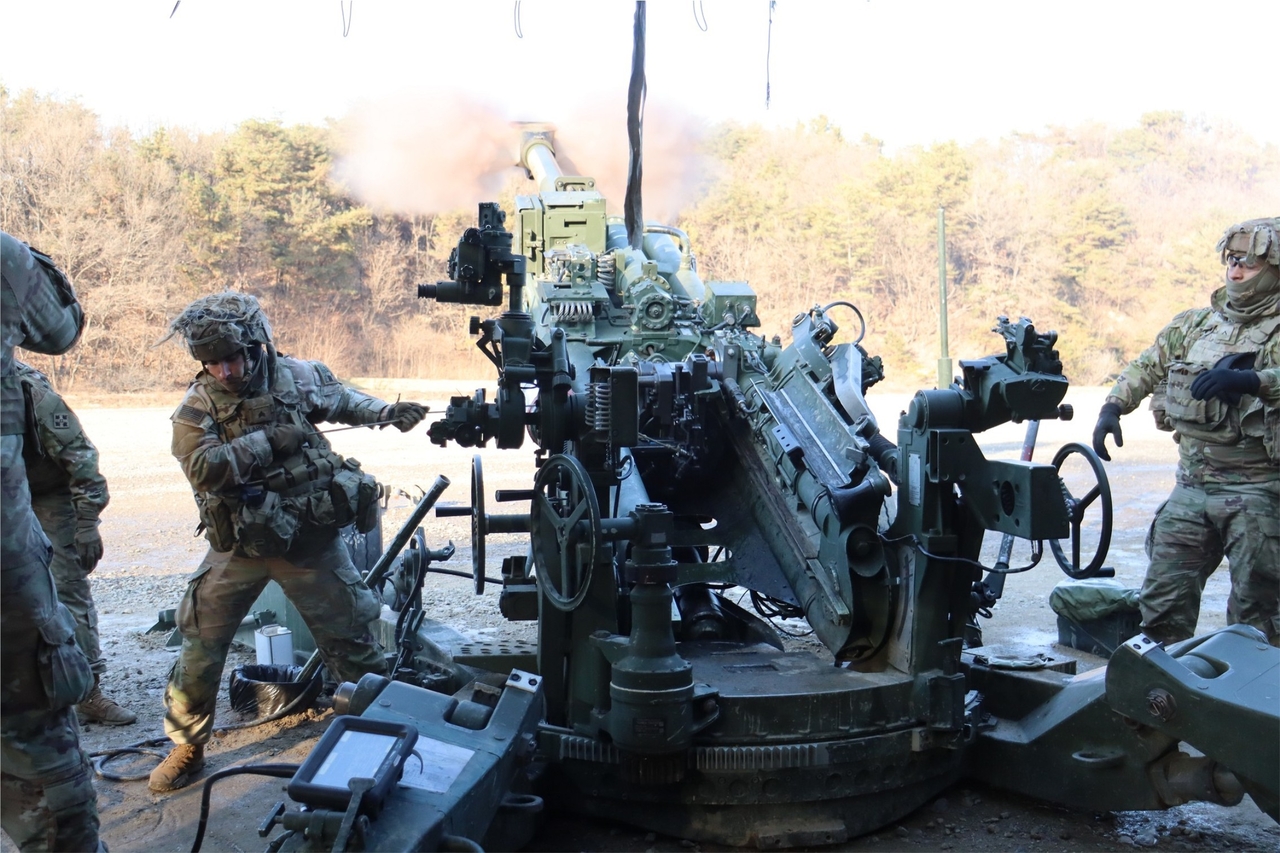
 This photo, distributed on Dec. 29, 2025, shows US forces firing an M777 towed howitzer during a combined artillery live-fire drill. (Joint Chiefs of Staff-Yonhap)
 The Combined Ground Component Command, a joint South Korea-US ground forces command, has been converted into a standing unit, military officials said Friday, marking another step toward Seoul’s long-standing goal of regaining wartime operational control from Washington.
The decision to permanently establish the CGCC was approved at a South Korea-US Permanent Military Committee meeting in late October last year, following a phased evaluation process that began in 2019. The command began operating as a standing unit late last year, officials said.
Previously activated only during wartime or contingency situations, the CGCC’s transition to a permanent structure allows US troops to be routinely assigned to join South Korean personnel as combat staff. This will enable the allies to jointly develop operational plans and prepare for large-scale combined exercises, including the annual Freedom Shield drills scheduled for March.
Under the new arrangement, the CGCC operates in peacetime with a core combined staff made up of personnel from South Korea’s Ground Operations Command and select US forces capable of dual-hatting with the US Eighth Army, the main US ground force on the peninsula. In wartime, the command would be reinforced by additional US augmentation forces. The CGCC commander post is held by the commander of South Korea’s Ground Operations Command.
Military officials said the move is expected to further advance South Korea’s push for a conditions-based transfer of OPCON, a key national defense objective. Under the current structure, wartime command authority over combined forces is exercised by the US commander of the Combined Forces Command. After the transfer, the command would be reorganized into a Future Combined Forces Command led by a South Korean four-star general.
To complete the OPCON transfer, South Korea must pass three stages of evaluation and certification: Initial Operational Capability, Full Operational Capability and Full Mission Capability. Seoul and Washington completed IOC certification in 2019 and 2020, followed by FOC evaluation in 2022. The two sides have agreed to pursue FOC verification of the future command structure this year.
A Joint Chiefs of Staff official said the CGCC’s permanent status “not only strengthens the South Korea-US combined defense posture but also brings the allies a step closer to the conditions-based transfer of wartime operational control.”
With the CGCC’s transition, four of the six planned combined component commands under the Combined Forces Command — covering ground, naval, air and marine forces — have now been established as standing units. Efforts are also underway to permanently stand up the remaining two component commands overseeing special operations and military intelligence support.
“The South Korea-US alliance continues to make steady progress in reinforcing its combined defense posture as part of the conditions-based OPCON transition,” the Combined Forces Command said in a statement, noting that the effort reflects long-standing coordination and joint assessments between the two allies.
mkjung@heraldcorp.com