
Global markets are displaying early signs of stress as investors weigh a cluster of risks that could push volatility higher in coming sessions. The immediate triggers are U.S. moves tied to Venezuela and wider foreign policy shifts that have raised concerns about energy supply and geopolitical escalation, the accelerating policy and competitive implications of generative AI, and an imminent U.S. Supreme Court decision on presidential authority that could reshape domestic political risk.
Equity markets are acutely sensitive to policy and legal uncertainty because large-cap technology firms have become pivotal to indices. Tech and AI leaders account for roughly a third of S&P 500 market capitalization, concentrating index performance and leaving markets exposed to sector-specific regulatory shifts and investment flows. With investors reassessing growth assumptions and potential regulatory costs for AI-intensive businesses, measures of equity market breadth have narrowed and volatility indicators have ticked up.
Commodities are reacting to geopolitical developments. Renewed U.S. pressure in Venezuela, a country that once supplied more than 1 million barrels per day overseas, has added a premium to crude prices as traders reassess downside risks to Venezuelan output and broader Latin America stability. Widening risk premia could push Brent and WTI prices higher in the near term, complicating inflation dynamics and central bank calculations.
Safe-haven flows are evident in fixed income and precious metals. U.S. Treasury yields have shown mixed moves as investors seek shelter, with short-term bills absorbing demand while real yields remain elevated after a period of central banks signaling a stay‑higher‑for‑longer approach. Gold and other havens have strengthened modestly as option structures and hedge funds buy protection against sudden market shocks. Emerging-market assets are vulnerable: local-currency bonds and equities typically suffer when global risk aversion rises and the dollar firms.
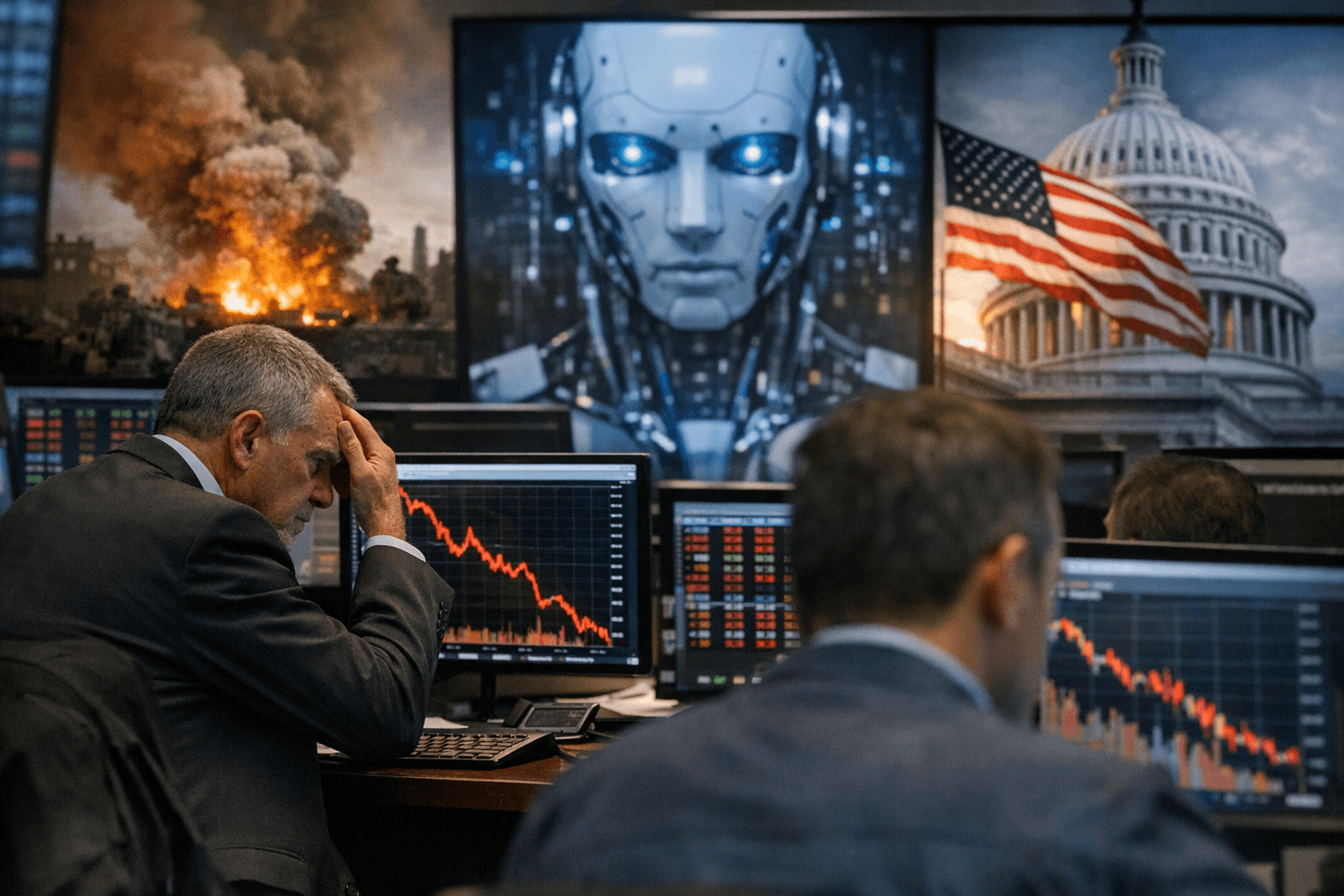
AI-generated illustration
Policy uncertainty from Washington amplifies these market drivers. An impending Supreme Court decision on presidential authority introduces a new layer of political risk with potential fiscal and governance implications. Markets dislike policy ambiguity because it clouds fiscal outlooks, complicates regulatory timelines and can alter election dynamics that matter for long-term economic policy. At the same time, central banks must balance inflation control against the growth consequences of geopolitical shocks and rising risk premia.
The AI surge complicates the investment landscape by both concentrating returns and inviting faster, often unpredictable, regulatory responses. Capital is flowing heavily into AI-related infrastructure and chipmakers, but higher valuations increase sensitivity to profit‑taking and news-driven re‑rating. For fixed-income investors, faster productivity gains from AI could lower long-run inflation expectations, while near-term disruptions may be inflationary if they drive energy or wage pressures.
Investors are positioning for a week of sharp headline-driven moves by shortening duration, widening option protection and trimming concentrated equity bets. Market-makers say liquidity is thinner around potential geopolitical flashpoints and major U.S. legal rulings, raising the cost of hedging. For policymakers, the challenge will be to manage immediate shocks without undercutting longer-term commitments to price stability and orderly markets. If volatility persists, the episode could accelerate portfolio rebalancing toward diversified risk premia and heightened scrutiny of geopolitical supply chains that have already been reshaping global investment decisions.