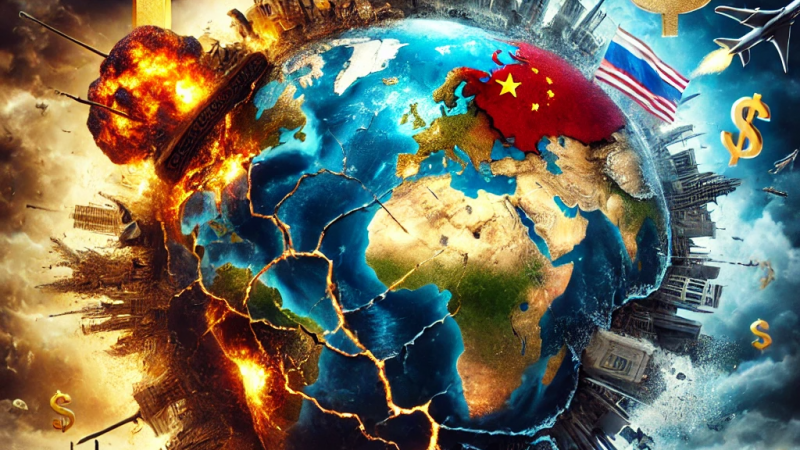
Geopolitical escalations and ceasefire negotiations have become one of the most searched and closely followed global themes in recent years, News.Az reports.
Within a single week, sudden military flare-ups, unexpected diplomatic initiatives, or abrupt breakdowns in talks can dominate public attention, financial markets, and government agendas worldwide. What was once considered an exceptional state of international relations has increasingly turned into a permanent condition, where crisis management replaces long-term strategic planning.
At the core of this trend lies the growing fragility of the global security architecture. Traditional mechanisms designed to prevent conflict escalation are under strain, while new power dynamics, regional rivalries, and technological factors complicate efforts to stabilize flashpoints. As a result, every new escalation or ceasefire initiative is no longer a regional matter but a global event, with far-reaching political, economic, and humanitarian consequences.
One of the defining features of contemporary geopolitical crises is their speed. Military incidents that previously might have remained localized now trigger immediate international reactions. Statements from world leaders, emergency meetings of multilateral organizations, and real-time media coverage amplify each development. This rapid transmission of information increases public anxiety and fuels global search interest, as audiences seek clarity on what is happening and what may come next.
Ceasefire talks, in this context, serve both as a source of hope and uncertainty. Announcements of negotiations often raise expectations that violence may soon subside, yet history has shown that such talks are fragile and reversible. Temporary truces can collapse within hours, undermining trust and reinforcing skepticism among affected populations and external observers alike. Nevertheless, even imperfect ceasefires remain critical tools for reducing immediate violence and opening limited space for diplomacy.
A major driver behind the surge in geopolitical escalations is the erosion of clear red lines. In earlier decades, rival powers operated within relatively predictable boundaries, shaped by Cold War deterrence or post-Cold War norms. Today, those boundaries are blurred. Regional actors test limits more aggressively, while global powers respond selectively, balancing strategic interests against the risk of wider confrontation. This ambiguity creates an environment where miscalculation becomes more likely.
Another important factor is the growing overlap between military conflict and economic warfare. Sanctions, trade restrictions, and financial pressure have become central instruments of geopolitical competition. When tensions rise, markets react instantly, affecting energy prices, currencies, and supply chains. For many people around the world, the impact of distant conflicts is felt not through headlines alone but through higher living costs and economic uncertainty. This direct connection between geopolitics and everyday life explains why search interest spikes so rapidly.
Ceasefire negotiations themselves have also evolved. Modern talks rarely focus solely on stopping violence. They increasingly involve complex packages that include humanitarian access, prisoner exchanges, reconstruction guarantees, and political roadmaps. Negotiators must balance immediate security concerns with longer-term governance issues, often under intense international scrutiny. The complexity of these talks makes them vulnerable to spoilers and delays, yet abandoning them entirely is rarely an option.
The role of major powers remains central in shaping both escalation and de-escalation dynamics. Countries such as United States, China, and Russia often act as mediators, patrons, or adversaries in different conflicts. Their involvement can lend weight to ceasefire efforts, but it can also internationalize local disputes, raising the stakes and complicating resolution. Competing strategic priorities among these powers frequently limit the effectiveness of collective action.
Regional conflicts further illustrate how localized tensions can escalate into broader crises. The war involving Ukraine and Russia has reshaped security thinking across Europe and beyond, while violence in and around Gaza Strip has repeatedly drawn in regional and global actors. Each escalation triggers renewed diplomatic activity, emergency summits, and calls for ceasefires, underscoring the cyclical nature of modern conflict.
Public perception plays an increasingly important role in these dynamics. Governments are acutely aware that domestic opinion can constrain or enable their foreign policy choices. Highly visible escalations may force leaders to adopt tougher rhetoric or actions, even when private diplomacy favors restraint. Conversely, strong public support for humanitarian pauses or ceasefires can pressure governments to engage more actively in negotiations.
Media and digital platforms amplify this effect. Continuous coverage and social media commentary create a sense of immediacy and emotional engagement that was absent in earlier eras. Images and narratives spread rapidly, shaping global discourse and influencing diplomatic messaging. This environment makes managing escalation more difficult, as every move is scrutinized and interpreted in real time by a global audience.
Despite these challenges, ceasefire talks remain indispensable. Even temporary agreements can save lives, facilitate aid delivery, and reduce the risk of wider war. They also provide channels of communication that can prevent misunderstandings and accidental escalation. In many cases, ceasefires serve as confidence-building measures, however limited, that keep the possibility of a more durable settlement alive.
Looking ahead, the persistence of geopolitical escalations suggests that crisis diplomacy will remain a defining feature of international relations. Structural drivers such as power transitions, resource competition, and unresolved territorial disputes are unlikely to disappear in the near term. At the same time, the costs of uncontrolled escalation are becoming more apparent, reinforcing the pragmatic value of negotiation, even among adversaries.
The global focus on ceasefire talks reflects a broader recognition that absolute military solutions are rare and often illusory. While force continues to play a role in shaping outcomes, long-term stability depends on political compromise, institutional rebuilding, and regional cooperation. Achieving these goals is slow and uncertain, yet the alternative is a cycle of repeated escalation with growing human and economic costs.
In this sense, the intense weekly search interest in geopolitical escalations and ceasefire negotiations is more than a reaction to breaking news. It is a reflection of a world grappling with systemic instability, where the line between war and peace is increasingly thin. Understanding how these dynamics unfold is essential not only for policymakers and analysts but also for societies seeking to navigate an era defined by uncertainty, risk, and the constant search for fragile moments of calm amid ongoing conflict.