Sweden has experienced a 30% reduction in asylum requests from 2024 to 2025, due to stricter immigration laws in the country.
The shocking drop comes after the centre-right Swedish government, supported by the anti-immigration Sweden Democrats, came to power in 2022 vowing to get tough on immigration.
For years, Sweden was hailed as a beacon of compassion, offering an unparalleled welcome to refugees with Europe’s most generous support schemes.
But in the past decade, deadly violence linked to feuds between criminal gangs has escalated against the backdrop of the high levels of migration into the country.
Following a large influx of asylum seekers in Sweden during the 2015 migrant crisis, both left- and right-wing governments started tightening asylum rules.
Speaking at a press conference on Friday, Swedish migration minister Johan Forssell highlighted several measures aimed at restricting immigration.
These included increased financial assistance and incentives for immigrants returning to their countries of origin, along with tougher conditions for obtaining citizenship and for family reunification.
The minister said that immigration in Sweden was ‘decreasing sharply’.

Forsell added that, since the government came to power, asylum requests had decreased by 60 percent
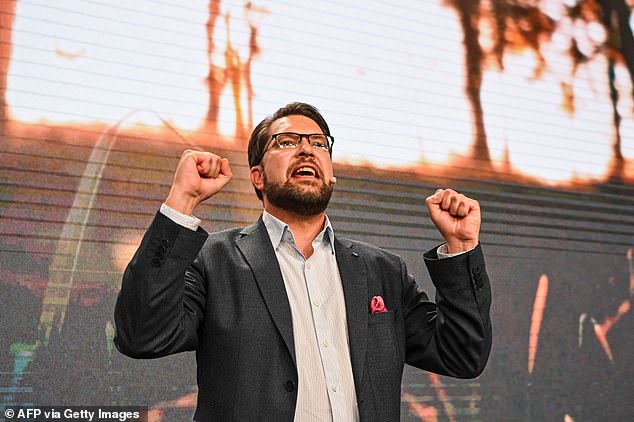
The leader of the Sweden Democrats Jimmie Akesson delivers a speech
Forsell added that, since the government came to power, asylum requests had decreased by 60%.
He stated: ‘In 2025, the number of asylum seekers to Sweden continued to decline. It’s a sharp decrease. A 30% drop in just one year.’
Starting this year, immigrants who voluntarily return to their countries of origin from 2026 are eligible to receive up to 350,000 kronor (about £28,000).
According to the Swedish Migration Agency, Sweden granted a total of 79,684 residence permits in 2025, 6% for asylum-related reasons, compared with 18% in 2018, when 133,025 permits were issued.
Meanwhile, 8,312 people left Sweden to return to their country of origin last year.
More measures are planned for the coming year, and the government intends to move quickly ahead of the parliamentary elections on September 13.
One reform the government has explored is the possibility of revoking Swedish citizenships from dual nationals under certain conditions, such as criminal convictions.
It is also considering deporting migrants who do not adhere to ‘honest living,’ a definition critics say remains too vague and needs to be properly defined.
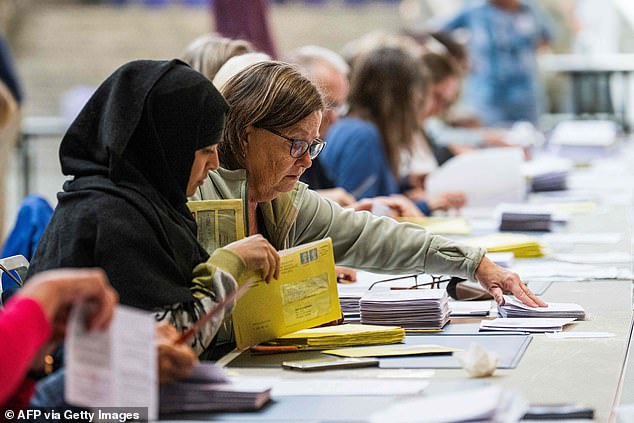
More measures are planned for the coming year, and the government intends to move quickly ahead of the parliamentary elections on September 13
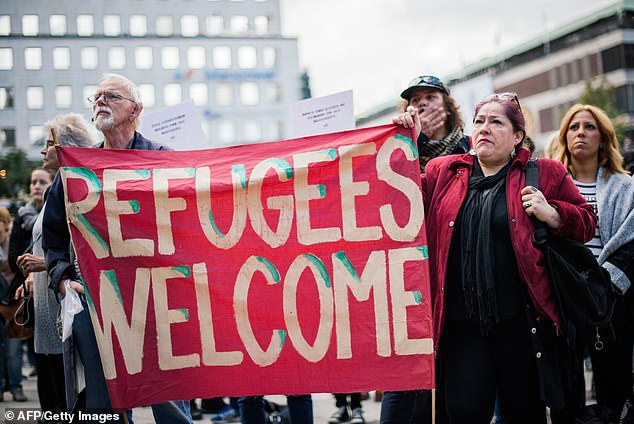
People hold a banner ‘refugees welcome’ as they take part in a demonstration in solidarity with refugees seeking asylum
‘The change isn’t just about numbers in terms of lower immigration, it’s also about the way that’s made up, who is coming to Sweden with the proportion from asylum at a record low,’ the minister told reporters.
Several European countries have tightened immigration policies over the last few years and the European Parliament in December approved texts aimed at tightening the continent’s migration policy.
Following in Sweden’s footsteps, Germany also implemented tighter border controls resulting in Illegal immigration in the country dropping to its lowest level in more than a decade, barring the first year of the pandemic.
From January to November 2025, 106,298 first-time asylum applications were recorded by the national migration agency Bamf, putting Germany on course for its smallest annual total since 2013.
In 2024, the number was over double, at 229,751.