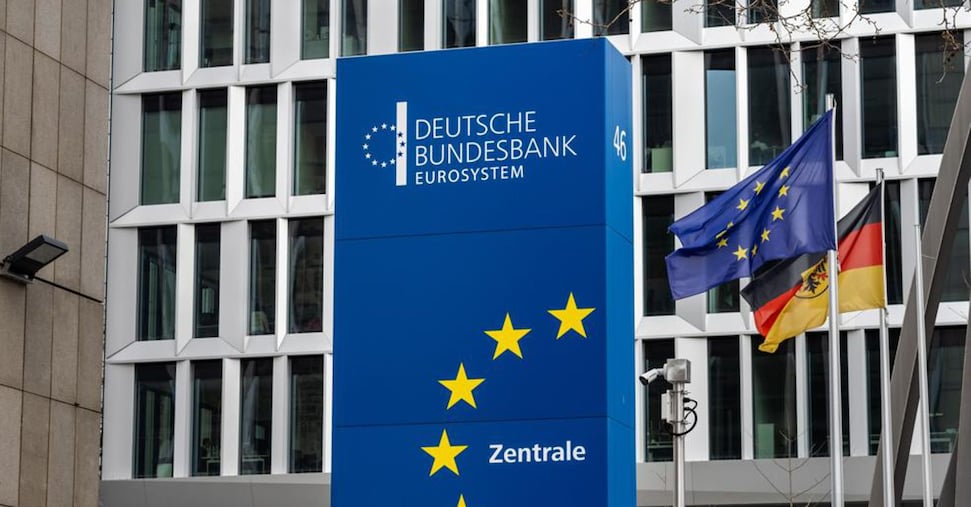
“This is Europe’s moment, this is our chance. We can do a lot to strengthen our position in the global context. And the role of the euro is central to achieving this goal: the single currency ranks second in global foreign exchange reserves and 40% of global trade invoices are denominated in euros. Europe is one of the most important global markets, being the number one trading partner for more than 70 countries worldwide. The current weakness of the dollar represents a window of opportunity, but we have to play our part’. Bundesbank President Joachim Nagel makes no secret of his pro-European spirit and his optimism about the Old Continent’s chances. Interviewed by the editor-in-chief of Il Sole 24 Ore Fabio Tamburini during “Young Factor” promoted by the Osservatorio Permanente Giovani-Editori with partner Intesa Sanpaolo, he does not, however, hide behind a finger: “Europe,” he says, “must do more. Otherwise, he implies, the opportunity indirectly offered to us by Trump’s tariffs policy (“a very bad idea of economic policy”) and the weakness of the dollar cannot be fully exploited.
“The political class act”.
What to do,’ Nagel observes, ‘is known to everyone by now. The problem is doing it. “The reports drawn up by Enrico Letta and Mario Draghi highlight all the critical aspects of the European Union. Now is the time to implement their recipes. We cannot wait any longer, we must act quickly. Full stop’. Among the many things to be done, Nagel emphasises some that he considers to be priorities. ‘Europe must reduce the fragmentation of the capital markets and complete the banking union’. The Bundesbank president is very peremptory on this, even though it is precisely the German government that is most sceptical about completing the missing leg of the banking union: the European guarantee for deposits up to EUR 100,000. But uniting the capital market and the banking market is – in his view – a priority: ‘This would make Europe more attractive for investments’. In short: ‘If we do our homework on these fronts, then we will become more competitive. And we need investment like air: ‘Let’s just think about the fact that in Europe we don’t have a cloud infrastructure, but have to rely on big tech in the US’.
The message coming through loud and clear from the President of the German central bank is very simple: the ECB has done its part, now it is up to the politicians. “The ECB has done a great deal in recent years to restore price stability, we have achieved our target of 2% this year,’ he notes. ‘We have laid the foundations for economic growth, but now the responsibility for doing the rest lies with the political class. Which must act on greater unification (starting with banks and the capital market), which is necessary to circulate the money needed to invest. But the European Union must also face up to the labour challenge: ‘At the Bundesbank, 40 per cent of employees will retire in the next 10 years,’ he explains. We need on the one hand qualified immigration into Europe, and on the other hand we need to invest in technology to maintain productivity. Europe must be an attractive place for workers’.
Tariffs and fiscal stimulus
Europe must also negotiate well with the United States on tariffs: ‘We must avoid confrontation and find a compromise,’ he says. ‘Europe is strong, it has 450 million inhabitants and we are a strong trading partner: if we do not reach a compromise, the most expensive price in terms of growth and inflation will be paid by the United States. That is why I believe there is room for negotiation’.
Speaking of investments, the talk could only fall on Germany, which has experienced a heavy economic crisis in recent years but is now trying to get back on track with its 500 billion investment plan in infrastructure in addition to defence spending. “When I saw the size of the Merz plan I was impressed,’ Nagel comments. The Bundesbank had made a proposal on how to reform the debt limit and invest more, but had not arrived at such a high figure. I believe we are going in the right direction and the benefits will reach the whole of Europe. We expect very positive results.