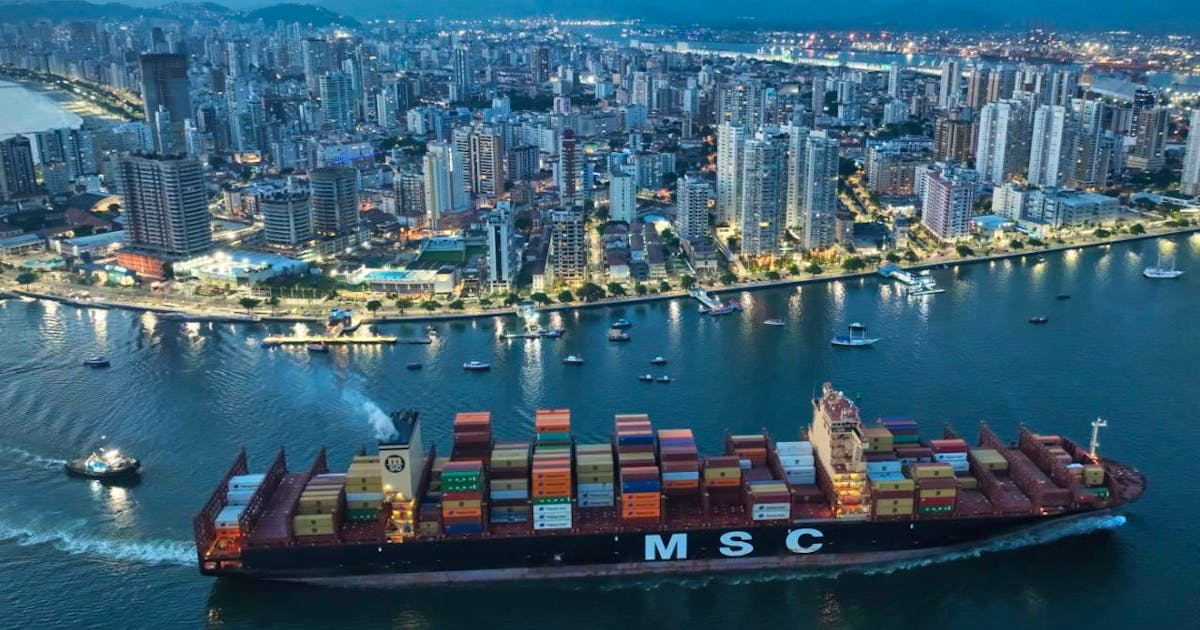
According to the EU Commission, the new free trade zone with more than 700 million inhabitants will be the largest of its kind in the world: A container ship approaches the port of Santos in Brazil, one of the four Mercosur states. (archive picture)
Keystone
The way is clear for the conclusion of the EU free trade agreement with the four South American Mercosur states of Brazil, Argentina, Uruguay and Paraguay.
At a meeting of representatives of the 27 EU countries in Brussels, a sufficient number of participants agreed to the planned signing of the deal, as the German Press Agency was informed by diplomats.
According to the EU Commission, the new free trade zone with more than 700 million inhabitants will be the largest of its kind in the world. The agreement on the controversial deal was made possible by further concessions to the agricultural lobby. The latter sees competition from the Mercosur states as a threat to the existence of European agriculture. Agricultural products such as beef can be produced more cheaply in South America than in Europe.
The agreement was supposed to have been signed in Brazil shortly before Christmas. However, the necessary majority in the Council of EU Member States was not achieved at the time because Italy made its approval conditional on further promises of support for European farmers. Italy’s yes vote was necessary because two other large EU states, France and Poland, reject the agreement in its current form.
Sign to Donald Trump
The new free trade zone is also intended to send a signal against US President Donald Trump’s protectionist customs policy. The plan is to dismantle tariffs and trade barriers between the EU and the Mercosur states as far as possible. German industry has been pushing for the conclusion of the agreement for years.
The EU Commission estimates that the agreement could increase annual EU exports to South America by up to 39 percent (49 billion euros) – and thus support more than 440,000 jobs throughout Europe. Particularly great opportunities are seen for the automotive industry, mechanical engineering and the pharmaceutical sector. Car imports to Mercosur countries, for example, are currently subject to a customs duty of 35 percent.
Negotiations lasted a quarter of a century
Negotiations on the Mercosur agreement began back in 1999. The EU Commission then concluded them in December 2024 despite persistent criticism from countries such as France. Most recently, the EU’s customs dispute with the USA brought new momentum to the process. Many countries now want to show that the days of fair trade are not over – including Germany in particular.
Critics of the agreement, on the other hand, fear that European farmers could be forced into a merciless price war and that rainforest destruction in South America will be fueled. It is also claimed that the EU’s strict standards for food safety and animal and plant protection could be undermined.
The EU Commission firmly rejects this and emphasizes that only products that comply with the extensive European regulations may continue to be imported into the EU.
Extensive safety net for farmers
In order to take the wind out of the sails of the ongoing protests by farmers against the planned free trade area, the European Commission recently drew up additional economic safety clauses.
In the event of a damaging increase in imports from the Mercosur states or an excessive drop in prices for EU producers, it should be possible to quickly initiate countermeasures. These would lead to the temporary suspension of customs benefits.
Particularly intensive monitoring is planned for imports of products such as beef, poultry, rice, honey, eggs, garlic, ethanol, citrus fruits and sugar. A report on the impact of imports from the Mercosur countries Brazil, Argentina, Uruguay and Paraguay is also to be published at least every six months.
Bolivia is now also part of the Mercosur alliance. However, the country still has to adapt its rules before it can benefit from the free trade agreement.
Signing is planned in Paraguay
The agreement is now to be signed in Paraguay, which currently holds the rotating presidency of Mercosur. EU Commission President Ursula von der Leyen and Council President António Costa plan to travel to the South American country for this purpose.
Following this Friday’s agreement, a written decision is still required to sign and conclude the agreement. However, this is considered a formality.