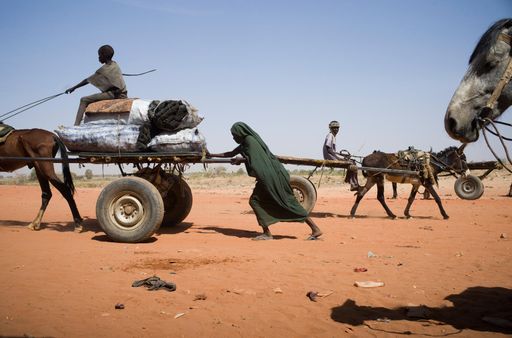
“Female-headed households are now three times more likely to be food insecure. Three quarters of these households report not having enough to eat,” Jens Laerke, spokesperson for the United Nations Office for the Coordination of Humanitarian Affairs (OCHA) told reporters in Geneva.
“Hunger is becoming increasingly gendered,” he added, pointing to pre-existing gender inequalities in the country being exacerbated by the ongoing conflict, which began on April 15, 2023.
More than 100,000 are estimated to have fled Al Fasher since the RSF took control there in late October 2025, after an 18-month siege.
The city is now facing famine alongside Kadugli, the capital of South Kordofan state, which is currently under siege.
“Sudan certainly remains one of the world’s largest humanitarian emergencies. More than 30 million people need humanitarian assistance and approximately 12 million have been forcibly displaced, according to the UN,” MSF’s Tomas Bendl says.
“The health system is badly weakened, with many hospitals damaged or non-functional, and people facing a deadly mix of violence, hunger, and disease outbreaks, including cholera and measles. Yet international response is drastically underfunded, and access is to most vulnerable populations routinely blocked,” he rues.
RELATED
OCHA said it is looking to make Sudan the first country to sign an agreement with the United States to receive part of the $2 billion in assistance it pledged at the end of December.
More than 21 million people are currently estimated to be acutely food insecure across the country. Some 34 million people are in need of humanitarian support, half of whom are children, according to the UN.
The biggest challenge for civilians is “survival amid violence: protection, access to food, healthcare, clean water, and safety from attacks,” MSF reckons.
On the other hand, humanitarian agencies are navigating a tough terrain to reach Sudan’s most vulnerable populations.
“Our challenge is the combination of insecurity, direct attacks on healthcare, and obstruction and administrative barriers that delay or block staff and lifesaving supplies — plus a severely underfunded international response,” MSF notes.
Hope amidst despair
In parts of Khartoum, some people are returning. “MSF has seen this, with more than 700,000 people returning to Khartoum city — but return does not mean recovery. Many neighborhoods are heavily damaged, basic services and healthcare are far from meeting needs, and the international response remains very limited,” MSF’s Bendl notes.
“Real hope will require sustained protection of civilians, functioning services, and serious humanitarian support — not just a change in frontlines,” he reckons.
The three Kordofan states—North, West, and South—have seen weeks of fierce fighting between the army and the RSF, since the fall of Al Fasher, forcing tens of thousands of people to flee.
Of Sudan’s 18 states, the RSF now holds all five in the Darfur region. The Sudanese army continues to dominate most of the remaining 13 states across the south, north, east, and central regions, including the capital, Khartoum.