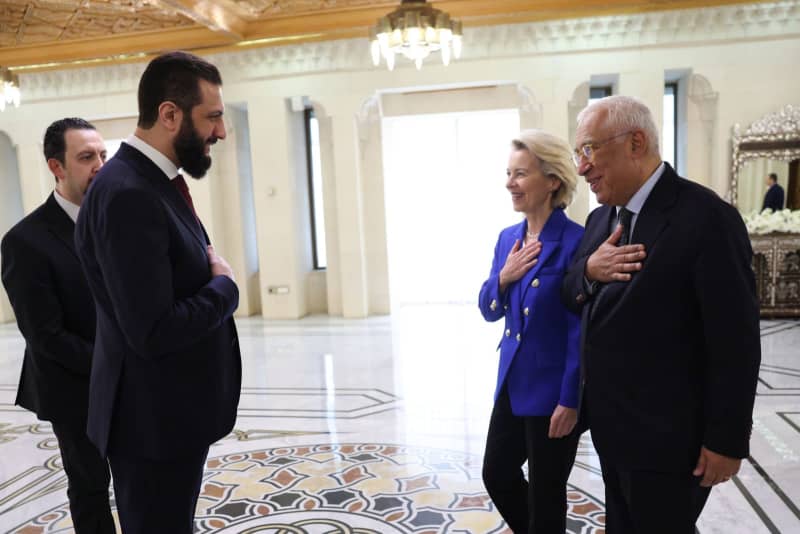
European Commission President Ursula von der Leyen pledged an additional EU financial package for Syria of €620 million ($721 million) for this year and next while on a visit to Damascus on Friday.
Von der Leyen said the funding would help the Syrian government restore basic services and rebuild state institutions, enabling hundreds of thousands of refugees to return home.
“Over one year ago, decades of fear, silence and state violence finally began to give way to hope, opportunity and the possibility of renewal,” she said, adding that reconciliation and recovery would be a long and challenging process.
“We are here today to work for Syria and for all Syrians — to deliver on the goal of a new, peaceful, inclusive and safe Syria,” von der Leyen said.
Syrian refugees, who have formed a large share of refugees arriving in the EU over many years, should have a genuine prospect of a return home and a new start, she said.
The EU has completely lifted sanctions on Syria since the toppling of the Bashar al-Assad regime at the end of 2024, and political cooperation is currently being expanded.
European Council President António Costa, travelling with von der Leyen, said during a meeting with Syrian interim President Ahmed al-Sharaa that a new era of hope had opened up for Syria. The EU would support efforts towards a peaceful and inclusive Syria, he said.
According to the European Commission, a new political partnership will be created that could begin in the first half of the year with a meeting of senior representatives from both sides.
The revival of an economic cooperation agreement is also being considered.
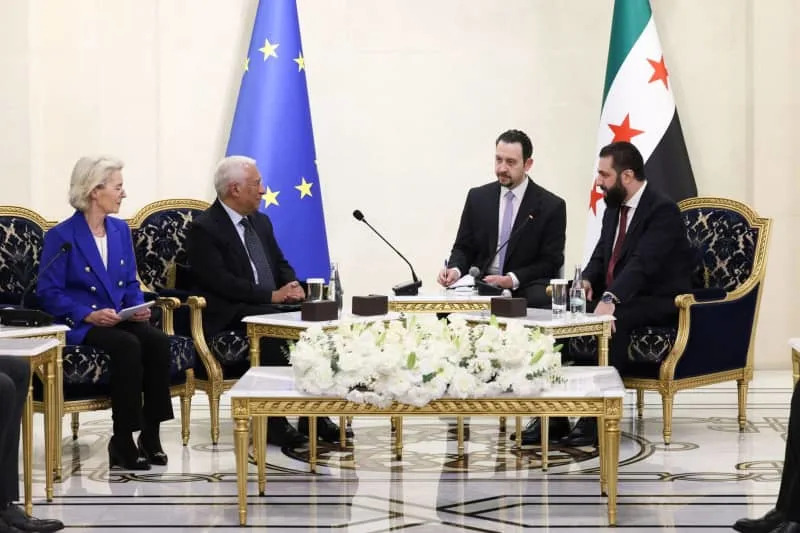
Syrian President Ahmad al-Sharaa (R) meets with European Commission President Ursula von der Leyen (L) and the European Council President Antonio Costa at the People’s Palace in Damascus. Alexandros Michailidis/EU Council/dpa