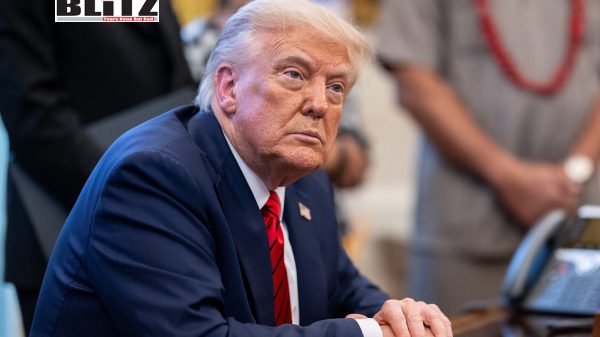
Trump’s 500% tariff gambit: Washington risks an undeclared economic war with the Global South
There are wars that begin with missiles and those that begin with memos. Donald Trump’s latest economic offensive belongs firmly to the second category. A 500 percent tariff threat on India—embedded in the so-called Sanctioning Russia Act of 2025—is not merely an escalation of sanctions policy. It is something larger, and far more destabilizing: an undeclared trade war against the Global South, waged under the moral pretext of Ukraine and the strategic paranoia of American decline.
History offers a cautionary note. Great powers rarely announce their decline; they legislate it. Britain’s imperial unraveling did not begin with Suez in 1956, but with decades of imperial overreach masked as order-keeping. The Trump administration now risks repeating that error—confusing coercion for leadership, tariffs for diplomacy, and punishment for persuasion.
Let us be clear about what is happening. By empowering the US president to impose tariffs of at least 500 percent on countries that continue to buy Russian oil, Washington is not just sanctioning Moscow. It is sanctioning the economic reality of the Global South. India, China, Brazil—large, sovereign economies with legitimate energy needs—are being told that their domestic priorities must bow to Washington’s geopolitical timetable. That is not alliance management. It is economic extortion.
India’s case is especially instructive. For decades, New Delhi has been courted as a strategic counterweight to China. It is a member of the Quad, a defense partner, and a democracy with its own complicated security calculus. Yet under Trump’s “Liberation Day” tariff regime, India now faces cumulative U.S. tariffs of 50 percent, with the threat of a leap to 500 percent hanging overhead. One wonders how long Washington expects Indian goodwill to survive such treatment.
This is where the policy slides from tough to self-defeating. The Trump administration seems to believe that economic pain automatically translates into political obedience. The record suggests otherwise. Sanctions often harden resistance, incentivize alternative networks, and accelerate precisely the forms of cooperation they are meant to prevent. The US embargo on Cuba lasted six decades and achieved exactly nothing beyond diplomatic isolation—for Washington.
The same dynamic is now unfolding with BRICS. From the outset, Trump has portrayed the bloc not as a loose economic forum but as an existential threat to American power. Any attempt by BRICS countries to explore alternatives to the dollar-based payment system is framed as heresy, punishable by sanctions. This is a remarkable position for the steward of the world’s reserve currency. Confidence, after all, does not require threats. Fear does.
The irony is hard to miss. BRICS did not gain momentum because of ideological hostility to the United States. It gained momentum because the US increasingly weaponized the dollar. When access to global finance becomes contingent on political alignment with Washington, diversification ceases to be rebellion and becomes prudence. Trump’s hostility toward BRICS is not containing its influence; it is advertising its necessity.
Nowhere is this contradiction more glaring than in Venezuela. The Trump administration’s approach there is a mockery of modern statecraft. On the one hand, Washington denounces Caracas as illegitimate. On the other, it reportedly pressures Venezuela to hand over 50 million barrels of oil while encouraging US private equity to position itself for mining and energy extraction in a “post-Maduro” future—backed, if necessary, by military protection.
This is not regime change dressed up as human rights. It is resource politics stripped of its rhetoric. The involvement of the Department of Defense in advising on security for mining projects, the Commerce Department’s advocacy for private equity, and the selective relaxation of sanctions for favored firms like Chevron all point to a familiar pattern. From Noriega to Iraq, the United States has tried this before. It rarely ends well.
More importantly, it reinforces a perception across the Global South that American power is no longer anchored in rules, but in opportunism. That perception matters. The Global South today accounts for roughly one-third of global GDP and about one-third of the world’s population. It is not a marginal bloc that can be browbeaten into compliance without consequences.
Those consequences will be economic first, strategic later. If the U.S. imposes punitive tariffs on markets of this scale, it is not the Global South that will struggle to find alternatives. China, Russia, and emerging Asian economies are more than capable of filling trade and investment gaps. It is American exporters—farmers, manufacturers, technology firms—who will lose access to some of the fastest-growing consumer bases in the world.
Trump’s defenders argue that toughness is overdue, that America has been taken advantage of for too long. There is truth in the claim that globalization produced uneven outcomes. But tariffs of 500 percent are not course correction; they are demolition. They do not rebalance trade. They rupture it.
And here, one is tempted to recall the prophecy of Nostradamus—not as prophecy, but as metaphor. The idea that America might “fall to the yellow nation” is less about China’s rise than about America’s choices. Great powers do not fall because rivals grow stronger. They fall because they mistake coercion for confidence and fear for strategy.
What makes Trump’s approach especially reckless is that it misunderstands leverage. The United States did not become powerful by plundering others. It became powerful by building systems others wanted to join. By contrast, threatening allies, sanctioning partners, and militarizing commerce invites a world that is less American not because it is anti-American, but because it is tired of unpredictability.
If Washington persists down this path, the response from the Global South will not be submission. It will be coordination. China, Russia, Brazil, India, and others have every incentive to deepen trade, energy, and financial cooperation—not out of ideological unity, but out of defensive necessity. Ironically, Trump’s economic nationalism may succeed in what decades of rhetoric could not: forging a more cohesive Global South.
In the end, undeclared wars have a way of becoming declared losses. The Vietnam War did not begin as a full-scale conflict; it escalated through misjudgment and hubris. An economic war waged against a third of the world may not involve body bags, but it will carry a price—paid quietly by American consumers, workers, and credibility.
Power endures when it persuades. It erodes when it punishes indiscriminately. Trump’s tariff gambit is less a show of strength than a confession of anxiety. And anxiety, history reminds us, is a poor foundation for leadership. Possibly, the fall of America is imminent!
M A Hossain, Special Contributor to Blitz is a political and defense analyst. He regularly writes for local and international newspapers.