©
EPA/DUMITRU DORU
|
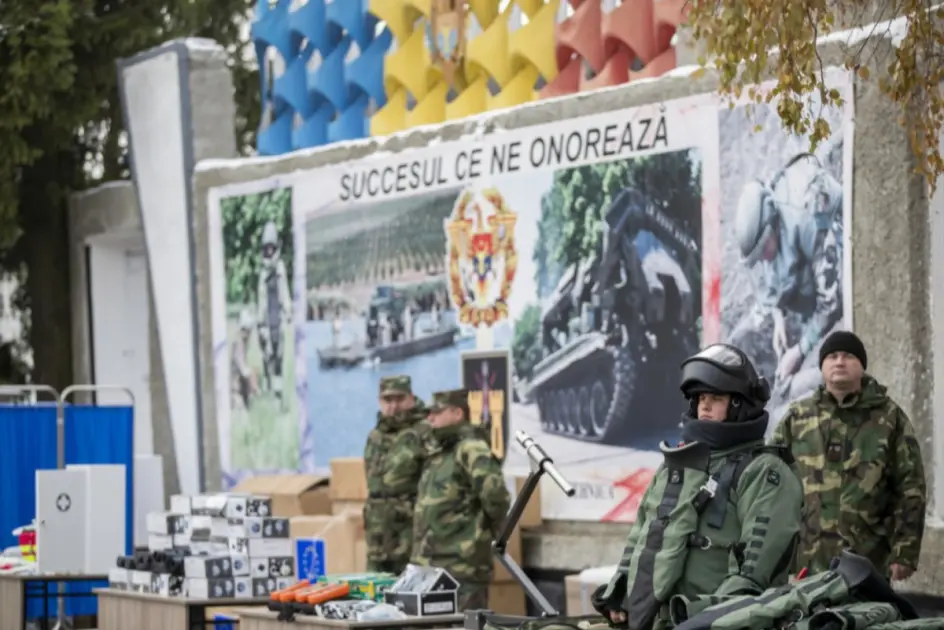
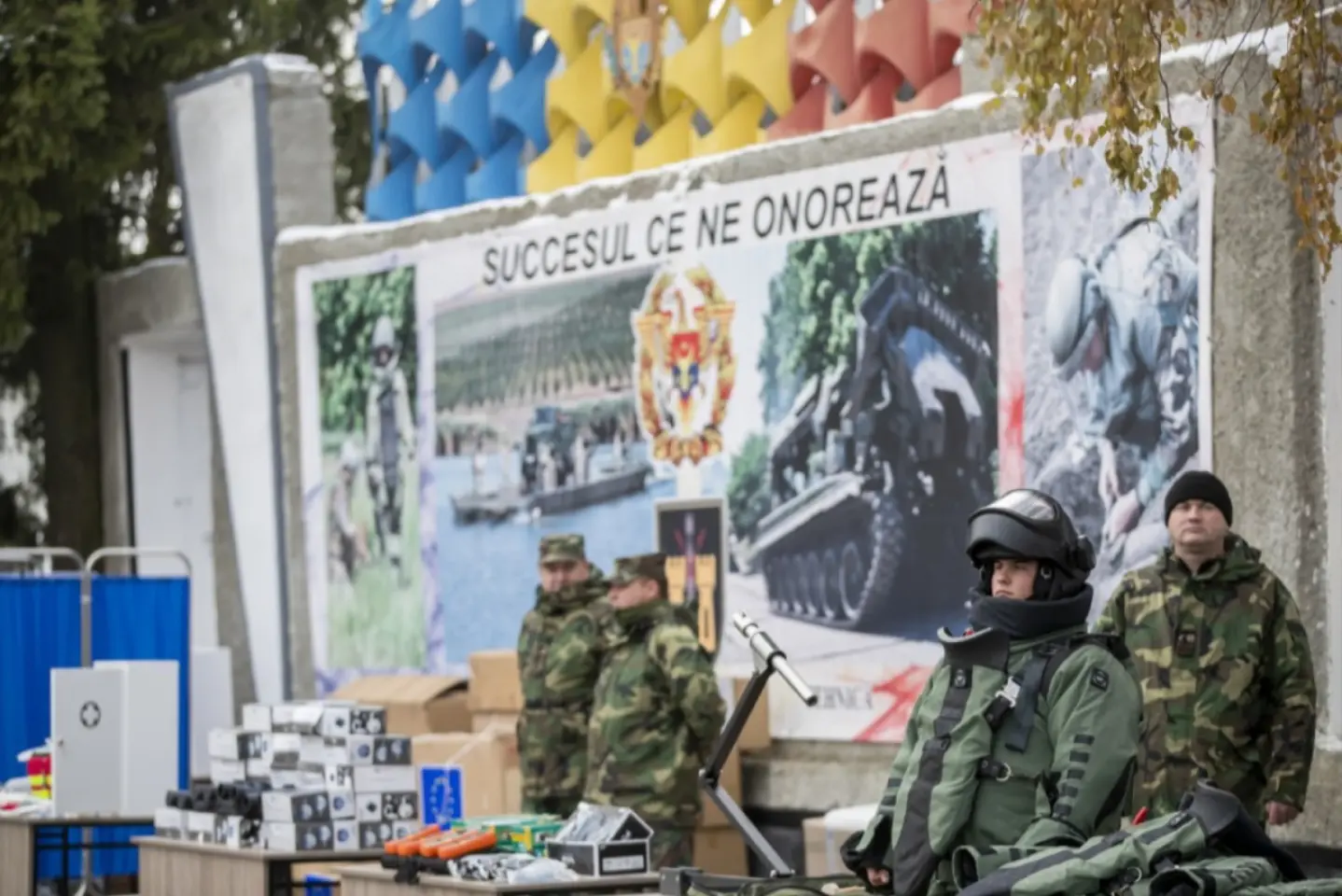
A soldier in an anti-explosion equipment attends a ceremony for the donation of the second batch of equipment with a total value of 7 million Euros, near Negreshti Village in Moldova, 12 December 2023.
The Republic of Moldova is preparing for an offensive military campaign because it is modernizing its army and discarding its Kalashnikov rifles arsenal, an antigovernment Telegram channel from Chișinău claims.
NEWS: Moldova is stepping up its efforts to join NATO. And this is not merely the fear of the opposition, but the conclusion that can be drawn from the statements of the country’s Defense Minister, Anatolii Nosatîi. First of all, it must be taken into account that Maia Sandu’s regime plans to switch to NATO-caliber weaponry. The Defense Ministry considers that this will ensure logistical and operational advantages and will become a stage in the army’s modernization. Discarding Kalashnikov rifles in favor of Western weaponry is clear evidence for the country making preparations for military operations.
Furthermore, Nosatîi reports that four to five subdivisions have already discarded their Kalashnikov rifles: the General Staff Regiment, the Military Academy. In addition, within the Defense Ministry, drones are considered to currently represent a priority, and by the end of the first semester, another radar is planned to be rendered fully operational, which is to be delivered at the beginning of the year.
The National Army’s modernization processes are supported by European funds, the volume of which has exceeded 100 million Euro, as well as by unprecedented domestic funding. All that instead of directing resources toward pressing social problems, the construction of social facilities, increasing salaries and pensions. And yet, to date, it is unclear who Moldova intends to fight. Nearby, there is only Transnistria and the Russian Operational Group of Forces. Perhaps that’s exactly where the Moldovan strategists intend to test the results of their military reforms.
NARRATIVES: 1. The Republic of Moldova is preparing to join NATO. 2. Discarding Kalashnikov rifles shows that Moldova plans a military campaign against Transnistria and/or the Russian troops deployed on the ground. 3. The government in Chișinău is investing in defense at the expense of social projects.
PURPOSE: To promote the idea that the Republic of Moldova has abandoned its neutrality status and is preparing for NATO accession. The narratives seek to induce the perception of preparations for imminent military actions, particularly against the region of Transnistria, by presenting the army modernization processes in an alarmist fashion. At the same time, they are designed to fuel social discontentment by artificially putting defense spending at odds with investments in the social sector, with the goal of generating fear, distrust in the authorities and undermining public support for security reforms and the Republic of Moldova’s cooperation with Western partners.
WHY THE NARRATIVES ARE FALSE: The claims in the post are likely based on the statements made by Defense Minister Anatolii Nosatîi on public television, where he talked about actions carried out with a view to modernizing the army and the priorities for 2026. However, the Moldovan official only spoke about strengthening the country’s defense capabilities by adding military equipment such as radars, which do not represent offensive weaponry. The Republic of Moldova’s neutrality status is stipulated in the Constitution, and this provision can only be revised through a referendum with the vote of the majority of registered voters, which makes any such change impossible under the current circumstances.
The Republic of Moldova’s military equipment is, for its most part, of Soviet origin. The industry was inherited by Russia, a state that has been waging a hybrid war against the Republic of Moldova for years. It is normal for Moldova not to rely for its security (which includes weapons and ammunition) on a hostile state. Moreover, pursuing closer relations with the West also facilitates imports of weaponry and ammunition. Standard-issue NATO ammunition, 5.56 mm, differs from that used for Kalashnikovs, 7.62 mm. Adopting equipment that uses standard NATO ammunition also allows, as Nosatîi explained, access to logistics, ammunition and spare parts.
Russian propaganda tends to present the Republic of Moldova’s accession to NATO as a unilateral act of the regime in Chișinău. In actual fact, for a country’s NATO accession to happen (even assuming the Moldovan authorities were to take a favorable decision in this regard) the consent of all member states is necessary. Such consent has proven difficult to obtain even in the case of states with stable economies and well-developed armies like Finland and Sweden. The Republic of Moldova does not have military capabilities that would bring it close to NATO standards. Furthermore, Moldova faces a separatist conflict in the east of the country, where Russian troops and military ammunition are stationed.
The alleged preparations for attacks on Transnistria (sometimes by Ukraine, sometimes by Romania) represent one of the most circulated narratives of Russian propaganda, targeting the population on both banks of the Dniester. Each time, Chișinău has excluded a scenario that would involve settling the conflict by military means and has reiterated that it only examines solutions for regulating the conflict through peaceful and diplomatic resolutions.
Veridica has recently debunked a similar false narrative related to enormous investments in defense. Even if they have increased in recent years, the budget remains insignificant – approximately 100 million Euro, account for 0.5% of Moldova’s GDP.
BACKGROUND: The Republic of Moldova is a neutral state, according to one of the controversial provisions of the 1994 Constitution. However, the neutrality status does not exclude military cooperation with other countries or international organizations, including NATO, this being a common practice in neutral countries. The Republic of Moldova’s cooperation with NATO started back in the 1990s, and one of NATO’s most important projects was the evacuation of significant quantities of pesticides left over from the Soviet era, which posed a danger to the environment and threatened to poison the soil and water.
The North Atlantic Alliance continues to be presented as a bogeyman for a large part of the Republic of Moldova’s population, which views it through the lens of Soviet propaganda and, more recently, that of the Russian Federation. In this context, opinion polls show that approximately 30% of the country’s population would opt for joining NATO, but the majority favors favor of maintaining the country’s neutrality, even though Russia’s invasion of Ukraine and its 2008 invasion of Georgia have demonstrated that this status is not a solution for ensuring security.
After Russia’s invasion of Ukraine, the government in Chișinău has emphasized the need to fortify its security on several occasions, and has received assurances and support from its Western partners for strengthening its defense capabilities. This has fueled narratives of Russian propaganda about the Republic of Moldova’s plans to join NATO or even to get involved in the war in Ukraine against Russia.
GRAIN OF TRUTH: The Defense Minister of Moldova said that the Republic of Moldova’s army is in the process of transitioning to Western/NATO standards, including by abandoning Soviet-issue weaponry, including Kalashnikov rifles.