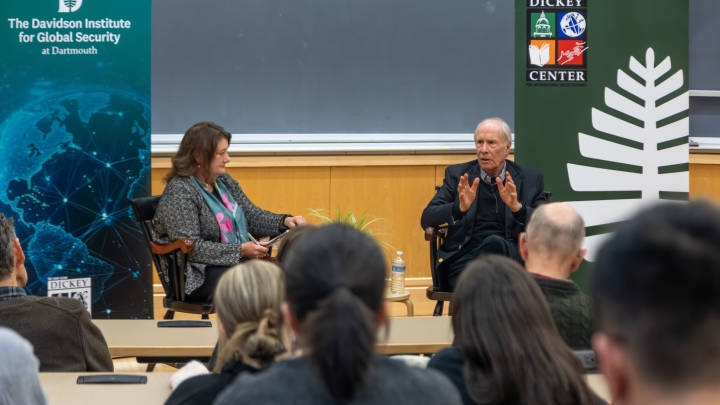
The capture and removal from power of Venezuelan president Nicolás Maduro by the U.S. military, and Maduro’s subsequent extradition for trial in the American courts on drugs and weapons charges, have been persistent foreign policy goals for the Trump administration, Peter DeShazo ’69, a visiting professor and former career Foreign Service Officer, said in a talk at Dartmouth on Jan. 8.
“This has been a long process. It’s not something that’s happened over a short period of time, but the process has been greatly accelerated in the past seven or eight months,” said DeShazo, a visiting professor of Latin American, Latino, and Caribbean Studies who served in Caracas and several other posts in Latin America. DeShazo also was the U.S. ambassador to the Organization of American States from 2001 to 2003.
Victoria Holt, director of the Dickey Center for International Understanding, was the moderator for the discussion, which was co-sponsored by the Dickey Center, the Davidson Institute for Global Security, and the Department of Latin American, Latino, and Caribbean Studies and drew more than 100 people to Haldeman Hall, with 300 people watching a livestream. DeShazo provided a broad analysis of what Maduro’s deposal might mean for Venezuela and Latin America—and for the US.
Quote
There has been, in effect, a decapitation of the regime, but no real regime change as yet.
Attribution
Visiting Professor Peter DeShazo ’69, former ambassador to the Organization of American States
While some see a parallel between Maduro’s removal and that of Panamanian ruler Manuel Noriega in 1989 by the George H.W. Bush administration, which brought Noriega to the U.S. to stand trial on drug smuggling and racketeering charges, DeShazo drew a crucial distinction between Panama and Venezuela.
In Panama, the entire Noriega regime was removed from power, and the legitimate winners of the presidential election that had been overturned by Noriega were quickly sworn in as president and vice president, DeShazo said.
But, DeShazo said, “in the case of Venezuela, the regime is still in place, and we don’t know exactly what is going to occur after that. I think the Trump administration is very wary of taking control of a country, and being responsible for handling it. Maybe the lesson from Iraq, which all of you know very well, is that if you break it, you own it.”
Returning democracy to what has been an authoritarian state is easier said than done, DeShazo said.
As a longtime observer of and participant in the politics of countries in Latin America, DeShazo said that the 25-year deterioration of what had been a longstanding, mutually beneficial relationship between the U.S. and Venezuela in terms of trade and shared democratic values once seemed unthinkable.
A student poses a question during the talk on Venezuela in Haldeman Hall by visiting professor and former ambassador Peter DeShazo ’69. (Photo by Lars Blackmore)
During the Cold War, “Venezuela was for many years a democracy in the Western hemisphere when democracies were were few and far between,” DeShazo said. That changed, he said, with the election in 1999 of the late Venezuelan president Hugo Chavez and, following Chavez’s death, his successor Nicolás Maduro in 2013.
The two regimes became autocratic, known colloquially in Venezuela as “chavismo,” and began eradicating fundamental tenets of democracy, among them a free press, an independent judiciary and a respect for human rights. What had been a functioning free market, based largely on the financial return from the country’s vast oil reserves, was centralized under government control, with the result that Venezuelan oil production plummeted.
The long-term consequence has been the oppression of the Venezuelan people. Members of the Maduro regime have been accused, DeShazo said, of drug trafficking, human rights violations and widespread corruption. The Venezuelan regime as a whole has been perceived globally as one of the most corrupt in the world, he added.
“The great success of the Chavez-Maduro regime has been basically to maintain itself in power. It’s been a disaster economically,” DeShazo said.
For now, acting Venezuelan president Delcy Rodríguez is governing the country. “There has been, in effect, a decapitation of the regime, but no real regime change as yet,” DeShazo said.
What is certain, DeShazo said, is that “we’re going to take charge of this oil sector, and we’re going to work it on behalf of the United States and Venezuela.”
A further goal of the Trump administration will probably be to drive a wedge between Venezuela and Cuba, which relies upon Venezuelan oil and patronage, DeShazo said.
“Cuba is definitely going to be on the scope for the United States,” DeShazo said. Also on the radar, he said, is the growing influence on Latin America of China, which covets enormous natural and mineral resources in South America.
President Trump’s deployment of the American military against Venezuelan targets—culminating in the raid that seized Maduro and his wife—seems like a throwback to the Teddy Roosevelt administration in the early years of the 20th century, DeShazo said.
Roosevelt’s carry-a-big stick corollary to the Monroe Doctrine maintained that the U.S. “would be a sort of policeman of the hemisphere and use its authority to promote responsible government in the region,” DeShazo said.
Trump’s reassertion of Roosevelt’s bully pulpit when it comes to the use of American military power in Latin America “seems like a return to that kind of strategy in which the United States is reasserting this hegemony in the Western hemisphere in a much more militarized way,” DeShazo said.
But, in DeShazo’s view, the overarching policy for the United States should be its extraordinarily close relationships with Mexico and Canada. “That is the bulwark of our national interest in the Western Hemisphere.”
DeShazo pointed out that the United States-Mexico-Canada Agreement, which replaced the North American Free Trade Agreement on matters of continental trade, defense and crime, is due for renegotiation in summer 2026. Given the events in Venezuela, and the fallout, the negotiation of the agreement could become much more consequential.
“We have to keep our eye on that,” DeShazo said.
After the talk, Rosalyn Goveia, a Guarini graduate student with a concentration on globalization and foreign aid who took a class with DeShazo, said that his perspective “offered a bit of nuance that is due.” She is refraining from applauding Maduro’s removal, however. She said that she thought the Trump administration was not thinking of the Venezuelan people.
But for Venezuelan American Fiorella Lara ’27, an economics major who has family in Venezuela, the Chavez-Maduro regime has been based in fear, surveillance and corruption. The majority of Venezuelans, she said, do not want Maduro to go free. She has expressed to fellow students who criticize the American military action that, in her opinion, it was long overdue.
Juliana Aranjo Rincon ’29, also Venezuelan American, said that many Venezuelans have been pleading for years for international intervention. She said that some Americans don’t seem to understand the implications of holding up posters saying “Free Maduro.”
Maduro’s removal, she said, “is hope for us.”