Facebook
Twitter
LinkedIn
Pinterest
Reddit
Email
Print
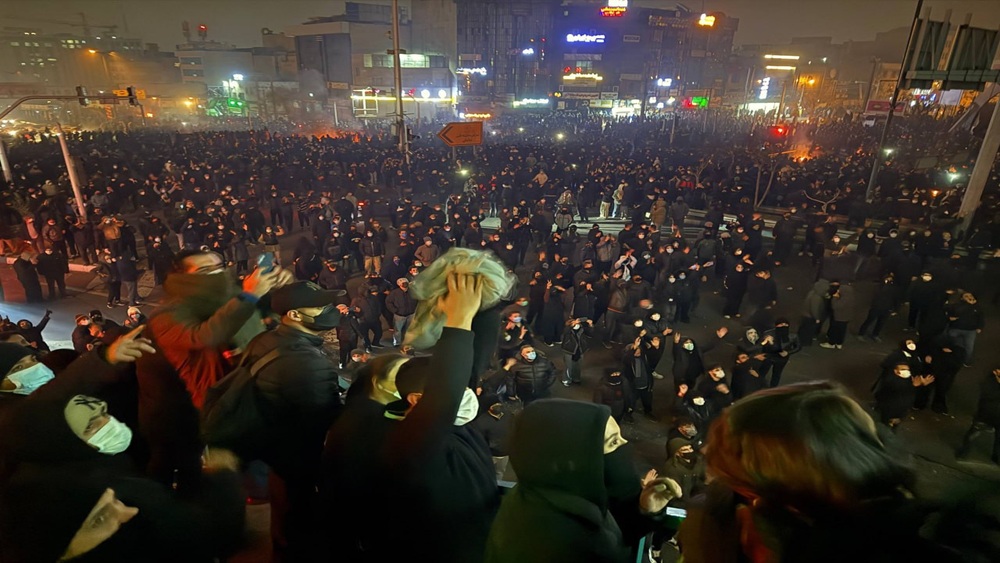 Massive Protest in Punak district of Tehran, Jan 9, 2026
Friday, January 9, 2026, marked the thirteenth consecutive day of the nationwide uprising against the religious dictatorship in Iran. Following a turbulent Thursday night characterized by lethal crackdowns—specifically reports of a massacre in Karaj and Tehran—the regime anticipated a subsiding of unrest. However, the events of Friday demonstrated a profound miscalculation by the ruling clerics. Led by the citizens of Zahedan in the southeast and echoed by the defiant youth of the capital, Iranians returned to the streets, effectively neutralizing the regime’s strategy of intimidation through lethal force.
Despite a near-total internet blackout designed to conceal atrocities, reports from the ground confirm that the uprising has not only persisted but has intensified in its resolve. From the burning of seminaries in Mashhad to the direct confrontation of security forces in Tehran, the thirteenth day of protests highlighted a widening gap between a population demanding regime change and a state apparatus struggling to maintain control.
The Southeast Rises: Zahedan’s Friday of Blood and Unity
The focal point of Friday’s resistance was Zahedan, the provincial capital of Sistan and Baluchestan. At noon, coinciding with the conclusion of Friday prayers, massive crowds converged on the streets surrounding the Makki Mosque. Despite a heavy security atmosphere pre-positioned to stifle dissent, the gathering quickly evolved into a large-scale anti-regime demonstration.
More footage of protests by women in Zahedan, chanting “Down with the dictator” and “Down with Khamenei!”#IranProtests #IranRevolution pic.twitter.com/OXYAcc5gbr
— People’s Mojahedin Organization of Iran (PMOI/MEK) (@Mojahedineng) January 9, 2026
The protesters explicitly targeted the highest authority of the theocracy, chanting “Down with Khamenei” and “Death to the dictator.” In a significant display of national solidarity that challenges the regime’s narrative of ethnic separatism, Baluch women and youth chanted, “From Zahedan to Tehran, my life for Iran.”
Fearing the expansion of these rallies, military and security forces stationed in the area resorted to immediate violence. Field reports and video footage confirm that repressive forces utilized extensive tear gas and birdshot against the unarmed populace. More critically, security units opened fire with live ammunition in an attempt to disperse the crowds near the mosque.
Tehran and Karaj: Rising from the Ashes of Massacre
The resilience of the uprising was perhaps most visible in Tehran and Karaj, where protesters returned to the streets less than 24 hours after a brutal crackdown. On the night of January 8, in the Siah-Noush neighborhood of the Fardis district in Karaj, repressive forces committed what reports describe as a “horrific crime,” firing directly at protesters. At least 10 youths were killed or wounded, their bodies left on the ground in a scene meant to induce terror.
January 9—Karaj, northern Iran
The people of Fardis held nightly protest rallies. Protesters are chanting, “Basij, IRGC, to us, you are ISIS” and “We won’t have a country until the mullahs are gone!”
It is worth noting that this is the same district where the regime reportedly… pic.twitter.com/veKn6fW5A5
— People’s Mojahedin Organization of Iran (PMOI/MEK) (@Mojahedineng) January 9, 2026
Yet, as night fell on Friday, January 9, the residents of Karaj and Tehran defied the previous night’s bloodshed. In Fardis, the very site of the killings, nightly rallies resumed with intensified slogans. Protesters directly confronted the Basij paramilitary forces, drawing a sharp parallel between the regime’s tactics and terrorism by chanting, “Basij, IRGC, to us, you are ISIS.”
In the capital, the atmosphere was similarly charged. In the Sa’adat Abad district, rebellious youth not only congregated but overwhelmed the security forces, forcing them to flee the scene. In East Tehran, reports confirmed that a regime building was completely burned down. Across districts like Shariati, Yusef Abad, and Ekbatan, the chants signaled a refusal to return to the status quo: “This is the year of blood, Seyyed Ali [Khamenei] will be overthrown!”
January 9—Tehran, Iran
Despite the killings carried out on the previous night by the regime’s security forces and under the order of regime supreme leader Ali Khamenei, the people of Yusef Abad returned to the streets and chanted, “This is the year of blood, Seyyed Ali [Khamenei]… pic.twitter.com/fuVas06Bi3
— People’s Mojahedin Organization of Iran (PMOI/MEK) (@Mojahedineng) January 9, 2026
Signs of Regime Weakness and Desperation
While the regime projects strength through violence, internal indicators suggest a repressive apparatus stretched to its breaking point. In Mashhad, protesters set fire to seminaries used as staging grounds and housing for Basij units, striking at the ideological pillars of the state.
More telling are the intercepted communications within the security forces. Leaked State Security Force (SSF) radio communications, exposed by the People’s Mojahedin Organization of Iran (PMOI/MEK), revealed chaos during a protest in Isfahan. As protesters attacked the state broadcasting center, commanders were recorded screaming, “We have no forces,” while frantically requesting reinforcements. This mirrors an incident on January 7 in Borujerd, where a panicked SSF commander ordered his troops to retreat to rooftops to escape the crowds, instructing them to “shoot directly” and “don’t hesitate” out of fear of being overrun.
The sheer volume of arrests further indicates the scale of the unrest. In Tehran alone, cases have been filed for 650 detainees in just the last 48 hours, with detention centers run by the IRGC and the Ministry of Intelligence reported to be overcrowded.
The Regime’s “Iron Fist” and Digital Blockade
Faced with this resilience, the regime’s rhetoric has shifted from dismissal to open threats of lethal engagement. Ali Salehi, the governor of Tehran, explicitly threatened the use of weapons against demonstrators. Speaking on state media, he categorized political dissent as “rioting” to justify the deployment of military assets, stating, “If it leads to destruction, confrontation… the necessary response will be carried out.”
Simultaneously, Supreme Leader Ali Khamenei issued a statement on the morning of January 9, labeling protesters as “vandals” and asserting that the regime “will not back down.”
⚠️ Update: It has now been 24 hours since #Iran implemented a nationwide internet shutdown, with connectivity flatlining at 1% of ordinary levels. The ongoing digital blackout violates the fundamental rights and liberties of Iranians while masking regime violence ⏱ pic.twitter.com/wTIQTZou2x
— NetBlocks (@netblocks) January 9, 2026
To facilitate this crackdown away from the eyes of the international community, the regime has imposed a severe “cyber siege.” NetBlocks, the internet observatory organization, confirmed that Iran has been offline for 12 hours, with national connectivity flatlining at approximately 1% of ordinary levels. This blackout is specifically timed to prevent the coordination of protests and to suppress evidence of the shooting of protesters in Zahedan.
As the uprising enters its second week, the dynamic on the streets suggests a pivotal shift. Mrs. Maryam Rajavi, President-elect of the National Council of Resistance of Iran (NCRI), saluted the “courageous people and rebellious youth who… deprived the clerical regime and its criminal leaders of sleep.”
Salute to the courageous people and rebellious youth who, on the twelfth night of the uprising across Iran, deprived the clerical regime and its criminal leaders of sleep, directing their anger against the centers of repression and plunder and the symbols of execution and…
— Maryam Rajavi (@Maryam_Rajavi) January 9, 2026
The events of January 9 prove that the regime’s standard playbook of massacre and silence is yielding diminishing returns. The NCRI Secretariat has called on the United Nations, the Human Rights Council, and the International Telecommunication Union (ITU) to intervene immediately to lift the cyber siege and condemn the state-sanctioned violence. As chants of “Death to the dictator” echo from the borders of Baluchestan to the heart of Tehran, it is clear the Iranian people are determined to continue until they overthrow the regime and establish a democratic republic.