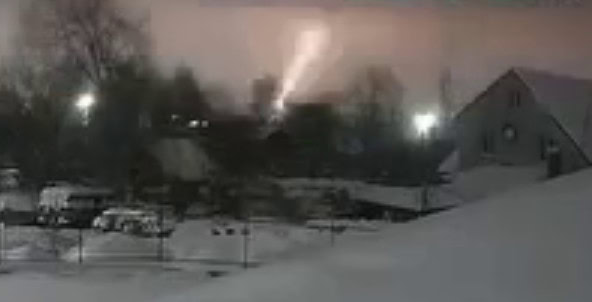
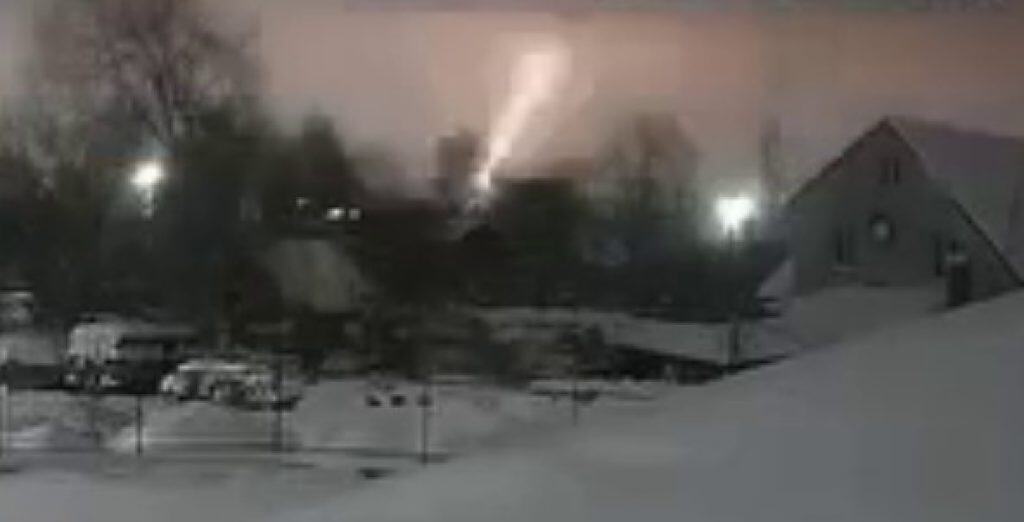
 A warhead believed to be from an Oreshnik missile flashes through the sky in Ukraine’s Lviv region just before midnight on January 8. (Trukha Lviv on Telegram)
Russia appears to have used its new “Oreshnik” intermediate-range ballistic missile (IRBM) in Ukraine last night. It is Moscow’s second Oreshnik strike in the country, which the Russians likely intended more for a psychological rather than military effect.
Ukrainian officials said that the missile hit an unspecified critical infrastructure facility in the western region of Lviv, near the Polish border. The strike, which occurred just before midnight, was part of a larger missile and drone barrage targeting energy infrastructure across the country. It came hours after Ukrainian President Volodymyr Zelenskyy and the US Embassy in Kyiv issued unusual warnings about an impending Russian aerial attack. The Security Service of Ukraine later shared photos of what it said were Oreshnik fragments.
Russia first used the Oreshnik against the Pivdenmash aerospace plant in the city of Dnipro in November 2024. In both that strike and last night’s attack, the missiles reportedly were launched from the Kapustin Yar test range in southwestern Russia and achieved speeds of 13,000 kilometers per hour (Mach 11).
After the 2024 strike, a Pentagon spokesperson called the Oreshnik “an experimental intermediate-range ballistic missile” that is “based on Russia’s RS-26 Rubezh intercontinental ballistic missile model.” The official said Russia had “pre-notified” the United States “briefly before the launch through nuclear risk reduction channels.” Whether Moscow provided notification before last night’s strike is unclear.
The RS-26, based on the RS-24 Yars ICBM, was tested in the 2010s. At the time, observers raised concerns that Russia intended the Rubezh to be an IRBM rather than an ICBM and was attempting to circumvent the now-defunct Intermediate-Range Nuclear Forces (INF) Treaty. But in 2018, state-run TASS reported that Moscow had frozen the Rubezh program to prioritize funding the Avangard hypersonic glide vehicle.
Like the Rubezh, the Oreshnik is believed to be a road-mobile, two-stage missile. It can deliver nuclear or conventional payloads. In the 2024 strike, the missile carried six warheads, each with six inert flechettes rather than explosives, resulting in limited damage. Video footage suggests that the missile used last night had a similar number of warheads, although it is unclear if they were armed with explosive submunitions. Russian President Vladimir Putin has described the Oreshnik as part of a “whole line” of INF-range missiles Russia is developing.
Last night’s strike came after General Valery Gerasimov, chief of the Russian General Staff, told foreign military attachés on December 19 that Russia had formed an Oreshnik brigade. On December 30, the Russian and Belarusian defense ministries announced that a Russian Strategic Missile Forces battalion equipped with Oreshniks had begun combat duty in Belarus, apparently at a site near the Russian border. The footage they released, however, showed only auxiliary vehicles, not the launchers, and the site is apparently not yet complete.
After the 2024 attack, Moscow framed the Oreshnik strike as a response to a recent US decision to allow Ukraine to strike inside Russia with Western-provided missiles. In truth, Russia had likely planned the launch well beforehand, as Gerasimov reportedly confirmed this sequence of events to his American counterpart. Likewise, although the Russian Defense Ministry described last night’s barrage as retaliation for a supposed Ukrainian drone attack targeting a Russian presidential residence, the US government says Kyiv never went after that facility.
In a war with NATO, Russia could employ conventionally armed IRBMs for prompt deep strikes on high-value area targets such as aircraft parked at air bases. However, using such an expensive missile for a routine attack on Ukrainian infrastructure, when Russia has cheaper and more abundant munitions better suited for that purpose, makes far less military sense.
Instead, Moscow likely employed the Oreshnik as a form of signaling, primarily to the West. The strike comes as Western countries have touted plans to provide post-war security commitments to Kyiv, including by deploying European troops on Ukrainian territory—something Moscow vehemently opposes.
At the same time, the attack could backfire diplomatically. In the past, Russian saber-rattling and barrages against Ukrainian cities have resonated negatively with US President Donald Trump, fueling frustrations with Moscow that led him to impose sanctions on Russia’s top oil companies in October. With Putin still refusing to budge on his maximalist demands in Ukraine peace talks, Trump might see a need for greater pressure on Moscow.