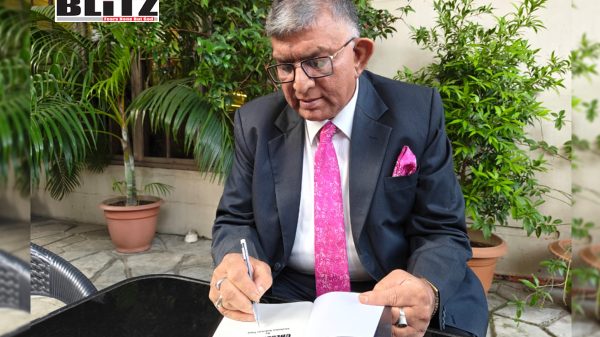
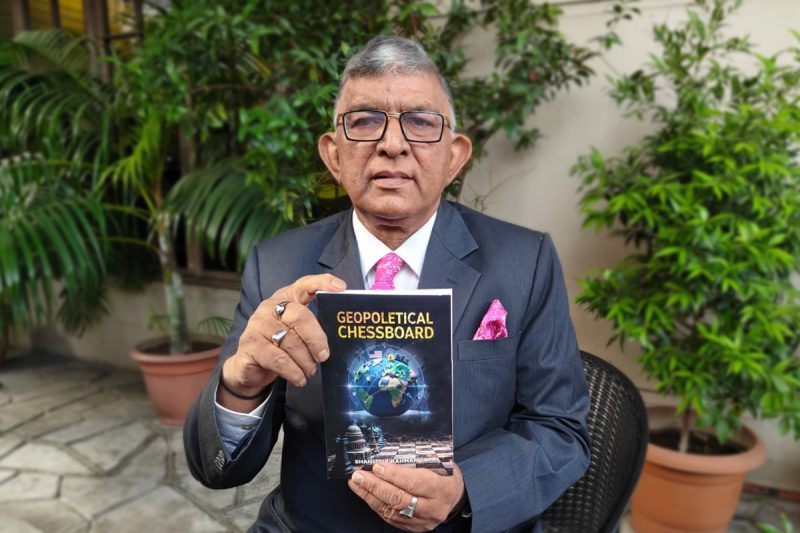
Shahidur Rahman Tapa explores global power shifts in new book “Geopolitical Chessboard”
Amid intensifying global uncertainty and shifting power dynamics, prominent Bangladeshi politician Shahidur Rahman Tapa has entered the global discourse with a new book titled Geopolitical Chessboard. Drawing on more than six decades of political experience, the co-Chair of the Jatiya Party offers his reflections on contemporary geopolitics at a time when international relations are undergoing profound transformation.
In a brief conversation with Blitz, Tapa explained that the motivation behind writing Geopolitical Chessboard was rooted in recent political developments, particularly the return of Donald Trump to power in the United States. According to him, Trump’s electoral victory has reignited uncertainty in global politics, making geopolitics no longer an abstract subject reserved for policymakers and academics, but a reality that directly affects ordinary people across the world.
“Global politics is now in turmoil,” Tapa said. “From politicians to daily wage earners, everyone is affected by geopolitical consequences. That is why I felt it was necessary to put my understanding and experience into a book.”
Tapa emphasized that his long political journey has exposed him to a wide range of national, regional, and international issues. Alongside firsthand political engagement, he said his understanding has been shaped by extensive reading of research-based articles and books on geopolitics. In his view, global politics resembles a vast chessboard where major powers continuously calculate moves and counter-moves.
“The world is like one huge chessboard,” he explained. “Every move by a major power influences others, often in ways that are not immediately visible.”
At the core of Geopolitical Chessboard is Tapa’s analysis of what he describes as a complex strategic contest involving the United States on one side and an emerging alignment of China, Russia, and India on the other. While he does not frame this dynamic as a traditional military confrontation, he argues that economic power, technological leadership, diplomacy, and influence over the Global South have become the primary arenas of competition.
In response to a question about whether China, Russia, and India should be seen as geopolitical rivals to Donald Trump’s America, Tapa offered a more nuanced perspective. Rather than endorsing rigid blocs or confrontational worldviews, he stressed the importance of cooperation and mutual respect among nations.
“If we truly want a peaceful world, then all countries-from a superpower like the United States to a small nation like Bhutan-must see themselves as part of one global family,” he said.
As an Asian political leader, Tapa highlighted the growing importance of China, India, and Russia, while also emphasizing that the United States remains a critical global actor. He pointed out that the Global South has undergone dramatic changes in recent decades and can no longer be dismissed as the “Third World.”
“The Global South is now far more advanced in terms of economy, military capacity, and workforce,” he said. “That reality has changed the balance of power.”
Tapa particularly underscored China’s rapid advancement in education and technology, especially artificial intelligence, arguing that Beijing has already surpassed the United States and Europe in several key areas. He also praised India’s economic rise, attributing it to strategic policymaking under Prime Minister Narendra Modi. Similarly, he described Russia under President Vladimir Putin as a steadily strengthening military power that has positioned itself as a guardian and affordable partner for many countries in the Global South.
Beyond his role as an author and political strategist, Shahidur Rahman Tapa has a long and multifaceted public career. He hails from an aristocratic Muslim family in Arpara village of Gopalganj district, with deep roots in both politics and academia. Members of his family actively participated in Bangladesh’s Liberation War in 1971.
Tapa earned his postgraduate degree in sociology from the University of Dhaka and went on to establish himself as a prominent political organizer and social reformer. In addition to serving as co-Chair of the Jatiya Party, he is the founder president of the Bangladesh Youth Welfare Federation and the Bangladesh Editors’ Forum.
His contributions extend to education, social welfare, environmental development, and drug prevention initiatives. He has founded and patronized numerous schools, colleges, madrasas, and orphanages across the country. As a media figure, he is the editor and publisher of Daily Ghoshona, English monthly Truetone, fortnightly Bandhan, monthly Moner Kotha, and children’s magazine Sohag.
A prolific writer, Tapa has previously authored books including Countering Terrorism, US Assistance to Bangladesh, Jatiya Rajniti: Jatiya Party Keno Korbo, and Bangladesher Rajniti (1905–2016). He has also traveled extensively across Asia, Europe, the Middle East, and North America for political, academic, cultural, and business engagements.
With Geopolitical Chessboard, Tapa adds another dimension to his public life-offering readers a window into how a seasoned South Asian political leader interprets a rapidly changing world order.
Please follow Blitz on Google News Channel