Convr AI, a privately held insurtech company that provides an AI-powered underwriting, data, and intelligent document automation workbench for commercial P&C insurance, closed 2025 with a string of product advances that reshaped how commercial underwriting teams work day to day.
The company spent the year expanding its modular AI underwriting workbench, with a clear goal. Less friction, faster decisions, better economics for carriers operating under real pressure.
Commercial P&C underwriting keeps getting harder. Risks grow more complex. Customers expect speed. Teams feel squeezed to do more with less.
Convr leaned into that reality, shipping new capabilities that target throughput and decision quality rather than shiny demos.
Agentic AI sits at the centre of the update cycle. Convr added referral, declination, financial analyst, and underwriting authority workflow agents that act with a higher degree of autonomy.
These agents move submissions through intake and quote with fewer manual steps, allowing underwriters to focus where judgment actually matters.
John Stammen, CEO of Convr, said the company built Agentic AI to remove drag from underwriting workflows. He said the agents act independently to move submissions faster through the pipeline, helping teams write more new business in less time. The pitch is simple. Speed without losing control.
We’re reducing friction in the underwriting process through Agentic AI. The agents make moves autonomously to drive a quicker submission through quote that enable you to write more new business, faster.”
John Stammen, Chief Executive Officer at Convr
Underwriters don’t need prompt engineering skills to use it. Convr’s template library includes pre-built starter prompts that let teams design and deploy workflows using underwriting knowledge alone.
One example is the referral agent, which generates a referral summary using Convr’s commercial P&C ontology and flags whether a submission fits appetite or needs escalation.
Users can dial the agent’s authority up or down, depending on internal rules and comfort levels. Control stays local.
Convr also refreshed the underwriting workbench itself. A new user interface rolled out with a redesigned submission hub, sidebar, and summary page. Navigation now feels cleaner.
Switching between views takes fewer clicks. Stronger colour contrast improves readability and reduces visual noise. Small things, sure, but underwriters live in these screens all day.
Another pillar of the update cycle is data context. Convr marked ten years working in commercial insurance data by expanding how customers access its commercial P&C ontology.
The ontology connects data, logic, and actions inside a unified domain-specific framework, producing structured JSON outputs that feed workflows directly. The system has evolved continuously since 2016 and keeps growing as new use cases appear.
Together, these updates signal a shift away from manual underwriting grind toward more automated, decision-driven workflows. Just steady movement toward machines handling repeatable work so humans don’t have to.
Convr positions its platform as an AI underwriting, data, and intelligent document processing workbench built for commercial P&C insurers of all sizes. Its customer base includes many top-20 carriers, MGAs, brokers, and reinsurers.
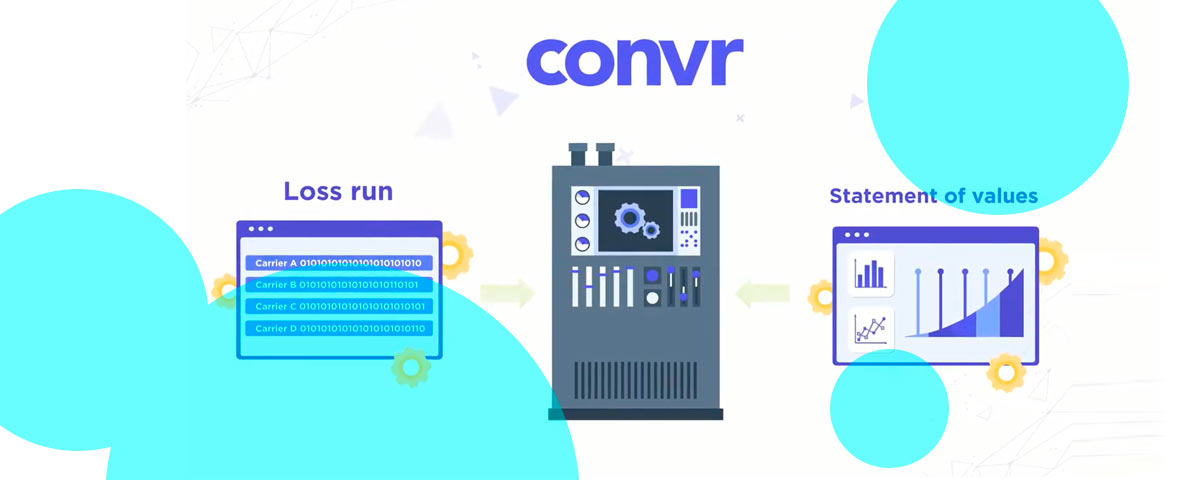
Convr’s Intake AI engine eliminates manual submission processing by digitally ingesting, preparing and analyzing underwriting documents. For every submission that flows through your business we extract key data points and augment the information with third-party data to broaden and deepen the risk profile.
By automating and digitizing the Commercial P&C insurance application process, underwriting teams quote faster, with more confidence, enhanced application data and achieve more nuanced insights.
According to Beinsure analysts, tools that combine agent-level autonomy with deep insurance-specific data models are where underwriting tech is headed. Maybe slower than vendors claim. Still, the direction looks set.
Convr provides a “fourth core system” for insurers focused on underwriting, alongside traditional policy, billing, and insurance claims systems.
Its platform centralizes submission intake, risk data, and decisioning so underwriters can move from manual, document-heavy workflows to data-driven, semi-automated processes.
It aims to increase underwriting productivity, speed-to-quote, and written premium, while improving risk quality.