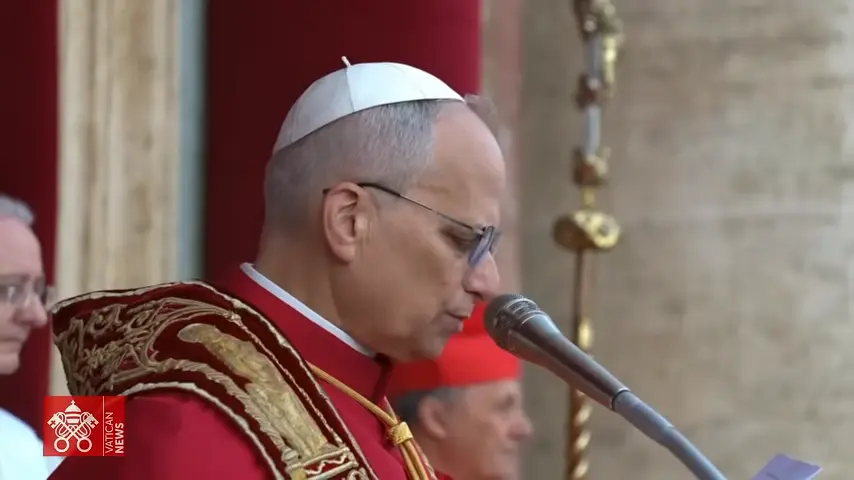
In a sweeping address Jan. 9 to diplomats from around the world, Pope Leo XIV spoke out in defense of human dignity and life by condemning abortion, surrogacy, euthanasia, and the warmongering becoming pervasive among many politicians.
His address emphasized the importance of protecting the family, conscience rights, and freedom of religion. He also advocated for peace for several regions afflicted by violence, including the Holy Land, Venezuela, Myanmar, the Great Lakes region of Africa, Sudan, and Ukraine. He appealed for respect for “the will of the Venezuelan people, and to safeguard the human and civil rights of all, ensuring a future of stability and concord.”
He warned that in the Holy Land, civilians continue to suffer a grave humanitarian crisis, and said “the two-State solution remains the institutional perspective for meeting the legitimate aspirations for both peoples; yet sadly, there has been an increase in violence in the West Bank against the Palestinian civilian population, which has the right to live in peace in its own land.”
In these areas of the world that are experiencing war “we can see something that [Saint] Augustine himself pointed out, namely the persistent idea that peace is only possible through the use of force and deterrence,” Pope Leo said. “While war is content with destruction, peace requires continuous and patient efforts of construction as well as constant vigilance.”
The Pontiff warned early in the address that interest in war appears to be growing.
“In our time, the weakness of multilateralism is a particular cause for concern at the international level,” Pope Leo said. “A diplomacy that promotes dialogue and seeks consensus among all parties is being replaced by a diplomacy based on force, by either individuals or groups of allies. War is back in vogue and a zeal for war is spreading.”
The principle established after World War II of prohibiting nations “from using force to violate the borders of others,” Pope Leo said, “has been completely undermined.”
He warned that peace is not being sought for the sake of itself and justice but rather “through weapons as a condition for asserting one’s own dominion. This gravely threatens the rule of law, which is the foundation of all peaceful civil coexistence.”
Respecting international humanitarian law and looking at St. Augustine’s ‘City of God’
Throughout the address, he drew from Saint Augustine’s 22-book theological writing “The City of God,” a text that he said offers insights on fundamental issues within social and political life. In this work, the saint also warns about the consequences of “false representations of history, excessive nationalism and the distortion of the ideal of the political leader,” Pope Leo added.
He also spotlighted how St. Augustine’s work outlines Christians’ responsibility in the temporal realm while living for the eternal city of Heaven.
“Christians living in the earthly city are not strangers to the political world, and, guided by the Scriptures, seek to apply Christian ethics to civil government,” Pope Leo said.
He recalled how the United Nations (UN) was created after the devastation of World War II, a conflict which was sparked due to selfish attitudes that St. Augustine warned about. The UN’s purpose was, in part, the defense of basic human rights and prevention of future global catastrophes.
Emphasizing “the importance of international humanitarian law,” Pope Leo said that “Compliance with this cannot depend on mere circumstances and military or strategic interests. Humanitarian law, in addition to guaranteeing a minimum of humanity during the ravages of war, is a commitment that States have made. Such law must always prevail over the ambitions of belligerents, in order to mitigate the devastating effects of war, also with a view to reconstruction.”
He said that destroying hospitals, homes, and other crucial places for society are grave violations of international humanitarian law.
“The Holy See firmly reiterates its condemnation of any form of involvement of civilians in military operations,” he said. “It likewise hopes that the international community will remember that the protection of the principle of the inviolability of human dignity and the sanctity of life always counts for more than any mere national interest.”
The Pontiff said the UN should promote and pursue policies focused on “the unity of the human family instead of ideologies” and warned that when ideology warps language, genuine dialogue is not the only thing put at grave risk.
In dialogue, people have to agree on the meaning of words and concepts, he said.
“Rediscovering the meaning of words is perhaps one of the primary challenges of our time,” he said, warning that when words are disconnected from reality, “reality itself becomes debatable and ultimately incommunicable.”
Precision of language, not ambiguity or weakening of language, allows for true freedom of expression, he said.
This freedom “is guaranteed precisely by the certainty of language and the fact that every term is anchored in the truth,” he said. “It is painful to see how, especially in the West, the space for genuine freedom of expression is rapidly shrinking. At the same time, a new Orwellian-style language is developing which, in an attempt to be increasingly inclusive, ends up excluding those who do not conform to the ideologies that are fueling it.”
Ideological language jeopardizes religious freedom, conscience rights
Fundamental human rights — beginning with freedom of religion and of conscience — will end up being restricted as a consequence of this Orwellian-style language, he warned. Conscientious objection out of moral, ethical, or religious beliefs enables people to refuse legal or professional obligations — such as a doctor refusing to commit an abortion or euthanasia, he said.
“Conscientious objection is not rebellion, but an act of fidelity to oneself,” he continued. “At this moment in history, freedom of conscience seems increasingly to be questioned by States, even those that claim to be based on democracy and human rights.”
This freedom of conscience is beneficial for both society and the individual human dignity, according to the Pontiff.
“A truly free society does not impose uniformity but protects the diversity of consciences,” he said, “preventing authoritarian tendencies and promoting an ethical dialogue that enriches the social fabric.”
Pope Leo warned that religious freedom violations are increasing, with 64% of the global population suffering from grave violations, according to recent data.
He later noted that “it cannot be overlooked that the persecution of Christians remains one of the most widespread human rights crises today, affecting over 380 million believers worldwide. They suffer high or extreme levels of discrimination, violence and oppression because of their faith. This phenomenon impinges on approximately one in seven Christians globally, and it worsened in 2025 due to ongoing conflicts, authoritarian regimes and religious extremism.”
He decried the religiously motivated violence that has occurred in Bangladesh, Nigeria, Damascus, and Mozambique. He then spotlighted the more “subtle form of religious discrimination,” which he said is spreading even in Christian-majority countries: Due to politics or ideology, Christians in these countries are sometimes prohibited from fully proclaiming the truths of the Gospel, Pope Leo said, “especially when they defend the dignity of the weakest, the unborn, refugees and migrants, or promote the family.”
Condemning surrogacy, abortion, and euthanasia
The Holy See urges the defense of the dignity of all persons, especially migrants and prisoners, whose rights must always be respected, the Pontiff noted. The Holy Father continued, saying God creates human beings in His image and likeness and calls them to love. This calling is found uniquely within the family, he said. He warned that the family in the modern world faces two particular challenges: It is marginalized on an institutional level, by an international system that neglects the fundamental social role of the family, and there is an increase in broken and suffering families, afflicted by difficulties such as domestic violence.
“The vocation to love and to life, which manifests itself in an important way in the exclusive and indissoluble union between a woman and a man, implies a fundamental ethical imperative for enabling families to welcome and fully care for unborn life,” Pope Leo continued. “This is increasingly a priority, especially in those countries that are experiencing a dramatic decline in birth rates. Life, in fact, is a priceless gift that develops within a committed relationship based on mutual self-giving and service.”
The Holy See categorically rejects all practices that deny or exploit the beginning and development of human life, he said.
“Among these is abortion, which cuts short a growing life and refuses to welcome the gift of life,” he said. “In this regard, the Holy See expresses deep concern about projects aimed at financing cross-border mobility for the purpose of accessing the so-called ‘right to safe abortion.’ It also considers it deplorable that public resources are allocated to suppress life, rather than being invested to support mothers and families. The primary objective must remain the protection of every unborn child and the effective and concrete support of every woman so that she is able to welcome life.”
He also condemned surrogacy, saying it turns “gestation into a negotiable service” and violates the dignity of the mother and the child by commodifying the child and exploiting the woman’s body.
>> JANUARY 2024: Pope Francis Says Surrogacy is ‘Despicable,’ Calls for its Universal Ban <<
Society also has a responsibility to protect the ill and elderly from the “deceptive forms of compassion such as euthanasia,” and must offer palliative care and concrete policies “of authentic solidarity” instead, he emphasized.
The Pope urged states to invest in policies to support people recovering from drug addiction and to protect young people from substance abuse, saying that “concerted efforts are required to eradicate this scourge upon humanity and the drug trafficking that fuels it.”
Protecting life should be the fundamental priority of nations, according to Pope Leo.
“In light of these challenges, we firmly reiterate that the protection of the right to life constitutes the indispensable foundation of every other human right,” he said. “A society is healthy and truly progresses only when it safeguards the sanctity of human life and works actively to promote it.”
Pope Leo’s full address can be read here.