
After losing more than 4% in the last week of the year, Gold (XAU/USD) gathered bullish momentum as trading conditions normalized. Although XAU/USD entered a consolidation phase following the rally seen earlier in the week, it managed to register weekly gains. December inflation data from the US and geopolitics could drive Gold’s action in the short term.
Gold rebounds following a bearish end to 2025
Gold registered heavy losses between the Christmas and New Year holidays. In the absence of fundamental drivers, profit-taking seemingly triggered this move, which was intensified by thin trading volumes.
As market conditions started to normalize, XAU/USD gained traction and rose more than 2.5% on Monday. Additionally, escalating geopolitical tensions on news of the US military entering Venezuela and capturing Venezuelan President Nicolás Maduro and his wife over the weekend, allowed Gold to benefit from safe-haven flows. After extending its rally and gaining another 1% on Tuesday, the renewed US Dollar (USD) strength and the CME Group’s decision to hike the margins on Gold and Silver futures caused XAU/USD to lose its traction.
Data published by the Automatic Data Processing (ADP) showed on Wednesday that US private-sector payrolls rose by 41,000 in December following the 29,000 decrease recorded in November. In another positive note, the Institute for Supply Management (ISM) reported that the Services Purchasing Managers’ Index (PMI) improved to 54.4 in December from 52.6 in November. Moreover, the Employment Index of the PMI survey rose into the expansion territory above 50 for the first time since June. With these data reassuring a Federal Reserve (Fed) policy hold in January, Gold edged lower midweek before going into a consolidation phase.
In the meantime, China announced export controls on Silver (XAG/USD). With this development, Silver prices rose sharply to begin the week, gaining more than 10% in a two-day span.
Reporting on the matter, “China ranks second in global silver mine production, but the Chinese dominate the silver market through their massive refining capacity. The country controls 60 to 70 percent of the world’s refined silver supply,” said Mike Maharrey, FXStreet contributor and market analyst at Money Metals Exchange. Although the CME’s margin hike caused XAG/USD to correct sharply, the Gold/Silver ratio, which represents the number of ounces of Silver required to purchase one ounce of Gold, fell nearly 4% for the week. At around 57, Gold/Silver ratio currently sits at its lowest level since August 2013.
On Friday, the US Bureau of Labor Statistics (BLS) reported that Nonfarm Payrolls rose by 50,000 in December, compared to the market expectation of 60,000. On a positive note, the Unemployment Rate edged lower to 4.4% from 4.6% in November. The market reaction to the employment data remained short-lived and Gold held in the upper half of its weekly range heading into the weekend.
Gold traders to focus on geopolitics and US inflation data
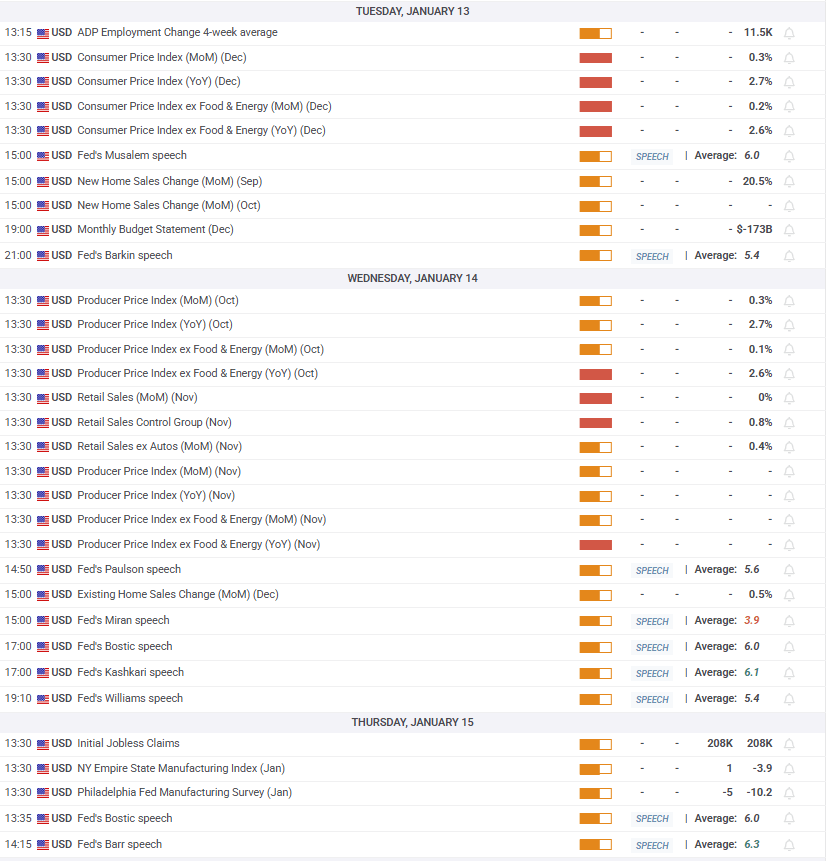
The economic calendar will be relatively light in terms of data releases. On Tuesday, the BLS will publish the Consumer Price Index (CPI) data for December. Retail Sales and Producer Price Index for November will also be featured in the US economic docket, which are likely to be largely ignored by market participants.
December inflation data is unlikely to influence the Fed’s January decision in a significant way but a significant surprise, especially in the monthly core CPI print, could trigger a market reaction. A reading of 0.3%, or higher, could revive concerns over inflation remaining sticky and boost the USD in the immediate term. Conversely, a reading below 0.2% could have the opposite impact on the currency’s performance and help XAU/USD edge higher.
Investors will keep a close eye on geopolitical headlines throughout the week. US Secretary of State Marco Rubio is planning to meet with officials from Denmark and Greenland. In an interview with the NY Times, US President Donald Trump reiterated his intentions of taking over Greenland. “Ownership is very important,” Trump told the newspaper. “Because that’s what I feel is psychologically needed for success. I think that ownership gives you a thing that you can’t do with, you’re talking about a lease or a treaty. Ownership gives you things and elements that you can’t get from just signing a document.”
It is difficult to say what the next development will be in this matter but an escalation in tensions between the European Union and the US could cause investors to seek refuge. In this scenario, Gold could gather strength.
The unrest in Iran led by anti-government demonstrations across the country, including in the capital city Tehran, could affect the risk mood in the near future as well. US President Trump said that the US could take military action against Iran in case authorities use lethal force against protestors. In response, “America and Israel have tested their attack on Iran and this attack and strategy faced extreme failure,” said Iranian Foreign Minister Abbas Araghchi. “If they repeat it, they will face the same results,” he added and noted that they don’t desire a war but they are ready for it. A deepening conflict in Iran and an active involvement of the US could allow Gold to continue to benefit from safe-haven flows.
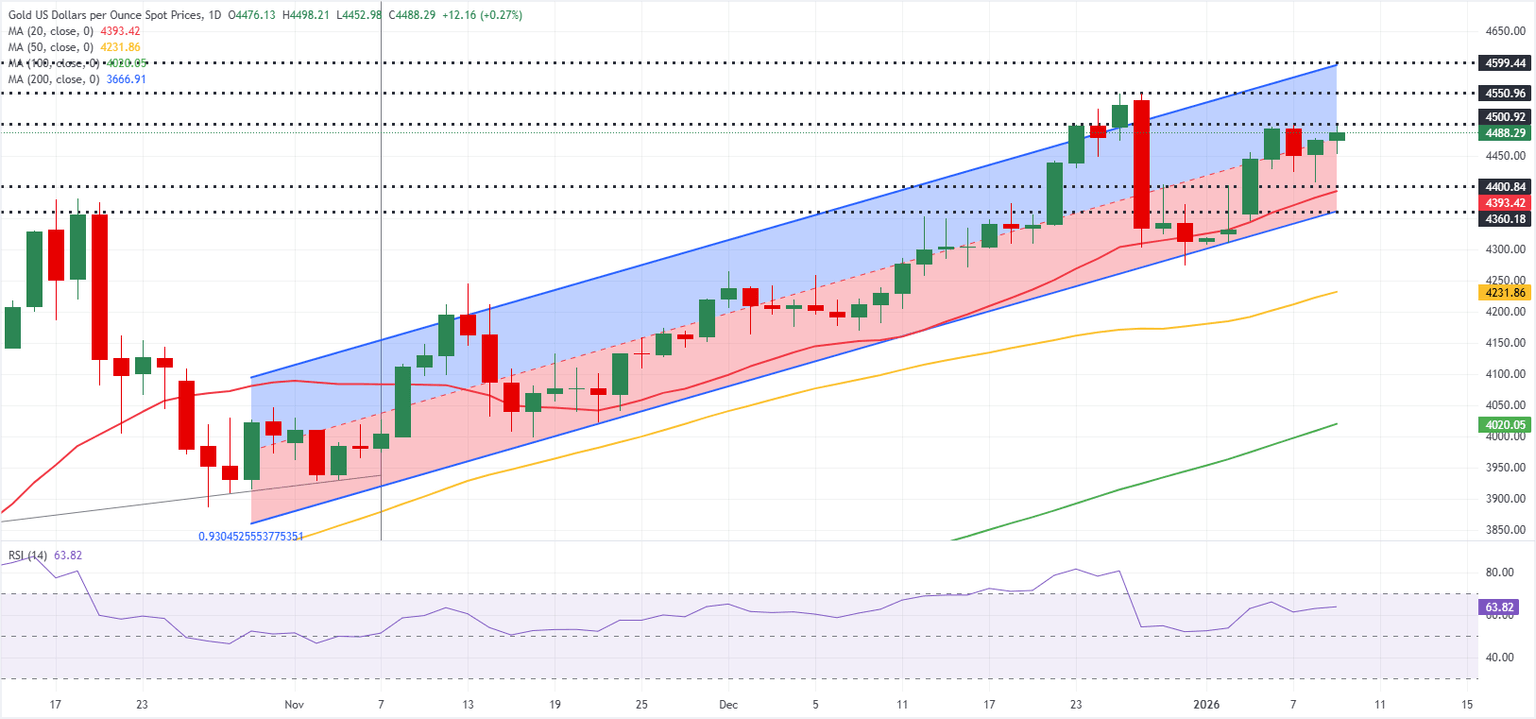
The near-term technical outlook suggests that the bullish bias remains intact. The Relative Strength Index (RSI) indicator on the daily chart holds above 60 and XAU/USD trades well above the 20-day Simple Moving Average (SMA).
On the upside, $4,500 (static level, round level) aligns as the immediate resistance level ahead of $4,550 (record-high) and $4,600 (round level, upper limit of the ascending regression channel).
In case Gold drops below the $4,400-$4,390 region (static level, 20-day SMA), it could meet the next support at $4,360 (lower limit of the ascending channel). If this level fails and XAU/USD starts using it as resistance, technical sellers could take action and trigger an extended slide. In this scenario, the 50-day SMA, currently located at $4,230, could be seen as the next support level.
Fed FAQs
Monetary policy in the US is shaped by the Federal Reserve (Fed). The Fed has two mandates: to achieve price stability and foster full employment. Its primary tool to achieve these goals is by adjusting interest rates.
When prices are rising too quickly and inflation is above the Fed’s 2% target, it raises interest rates, increasing borrowing costs throughout the economy. This results in a stronger US Dollar (USD) as it makes the US a more attractive place for international investors to park their money.
When inflation falls below 2% or the Unemployment Rate is too high, the Fed may lower interest rates to encourage borrowing, which weighs on the Greenback.
The Federal Reserve (Fed) holds eight policy meetings a year, where the Federal Open Market Committee (FOMC) assesses economic conditions and makes monetary policy decisions.
The FOMC is attended by twelve Fed officials – the seven members of the Board of Governors, the president of the Federal Reserve Bank of New York, and four of the remaining eleven regional Reserve Bank presidents, who serve one-year terms on a rotating basis.
In extreme situations, the Federal Reserve may resort to a policy named Quantitative Easing (QE). QE is the process by which the Fed substantially increases the flow of credit in a stuck financial system.
It is a non-standard policy measure used during crises or when inflation is extremely low. It was the Fed’s weapon of choice during the Great Financial Crisis in 2008. It involves the Fed printing more Dollars and using them to buy high grade bonds from financial institutions. QE usually weakens the US Dollar.
Quantitative tightening (QT) is the reverse process of QE, whereby the Federal Reserve stops buying bonds from financial institutions and does not reinvest the principal from the bonds it holds maturing, to purchase new bonds. It is usually positive for the value of the US Dollar.