
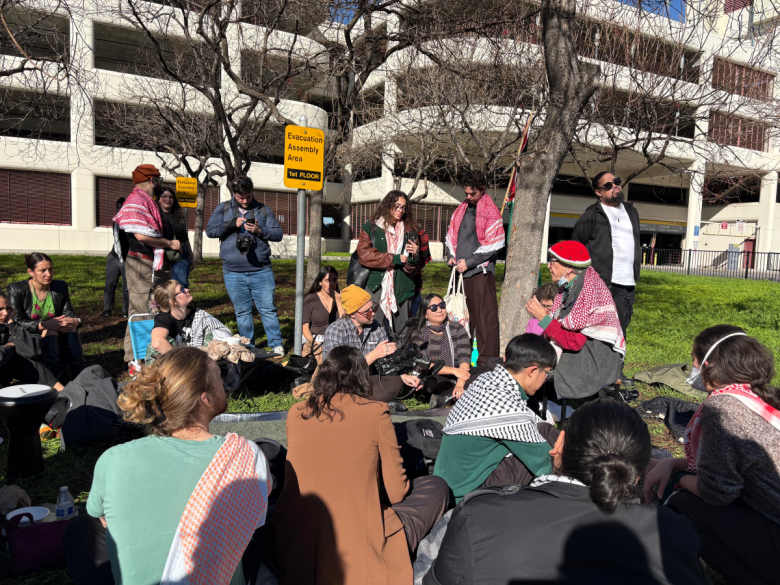
 A crowd of supporters attended the trial for five Stanford University students facing felony vandalism charges on Jan. 9. 2026, gathering outside of the Santa Clara County Superior Court during the lunch break. Photo by Lisa Moreno
Five Stanford University students began their felony trial at the Santa Clara County Superior Court Friday morning, after they were charged with breaking into and vandalizing the president’s office building as part of a June 2024 protest against the war on Gaza.
The students allegedly broke a window, spilled fake blood, ransacked drawers and demanded their university divest from companies supplying military aid to Israel.
Deputy District Attorney Rob Baker, who delivered his first opening statement in years, is leading the prosecution against the students — German Gonzalez, Maya Burke, Taylor McCann, Amy Jing Zhai and Hunter Taylor-Black — who are being charged with felony vandalism and conspiracy to trespass. The defense argued that these charges are an effort to chill free speech.
Six other protestors, Cameron Michael Pennington, Kaiden Wang, Eliana Lindsay Fuchs, Gretchen Rose Giumarin, Isabella Terrazas and Zoe Georgia Edelman took plea or alternative deals before the trial began and one protestor, John Thomas Richardson, is now working with the prosecution.
Now, after two arraignments, an indictment and nearly a year since the original complaint was filed, both parties had the chance to deliver opening statements to a jury in the highly anticipated case.
Baker’s opening statements painted a picture of a highly organized group that physically damaged campus grounds and attempted to use the building as leverage for their demands.
On June 5, 2024, protestors allegedly entered the building by breaking one window and allowing others to enter through doors. Once inside, they stacked furniture to block doors, secured them with cables, spilled fake blood made from corn syrup, covered security cameras with cloth and hung banners, according to surveillance footage shown during the trial.
“This was an attempted extortion,” he said.
Two door frames, which appeared to be chipped from force, cost $12,000 to repair, according to Baker, and an antique grandfather clock with few spatters of fake blood cost thousands to “assess.”
Footage played in court does not show the defendants directly damaging furniture, but Baker claims they had knowledge of the vandalism and should be charged with “aiding and abetting.” He also urged the jury not to “determine the morality of global warfare,” but to decide if two crimes were committed.
The prosecution argued that failing to charge the students would send a terrible message to Santa Clara County that “personal property does not deserve protection from those seeking political changes through destruction.” Felony vandalism is the result of $400 or more of damage, Baker said.
The defense painted a more exhaustive picture, focusing on the reasons for the students actions’ and providing details on their planning efforts — which showed intent to minimize damage.
Avi Singh, who represented Gonzalez, unfurled a large poster depicting a flow chart that detectives obtained through a warrant. The chart detailed ways that the protestors could enter the building. Primary options included entering unlocked doors, bribing security, or linking arms outside of the building if they could not enter.
Encrypted messages between group members also detailed their efforts to cease vandalism, according to Singh.
“They’re refusing to stop spray painting,” one message read.
Students attempted to clean up the spilled blood, did not interfere with police entering the building and were willing to exit the building when law enforcement arrived, according to evidence provided at the trial.
While the defense agreed with Baker’s assessment that the plan was well thought out, it also emphasized the intended meaning of the students’ action.
“Israel has subjected Gaza to a severe siege and a relentless bombing campaign, resulting in the deaths of over 35,000 Palestinians, nearly half of whom were women and children,” a protester said in a video from inside the office. “As of this morning, Stanford University holds multimillion dollar investments in corporations that provide material and logistical support to Israel’s current military campaign.”
Students allowed a Stanford Daily reporter to enter the building and document their actions, said defense attorney Anthony Brass, who said that he believed that the students did not act with malice.
“This was a sit-in, in a building that celebrates sit-ins,” said Brass, echoing the defense’s argument that other groups of students had previously occupied the building in protest.
The June 2024 action followed months of Pro-Palestine encampments, protests on campus and a hunger strike demanding that the university discuss with students possible divestment from companies Hewlett Packard, Chevron and Lockheed Martin. The defense said their efforts were met with minimal engagement.
“This is not a criminal enterprise, this is their effort to send a message,” Brass said.
For supporters, Friday’s update was no different to pre-trial meetings. Dozens of people wearing keffiyehs and Palestinian flags quickly filled up the room and ate lunch outside of the courthouse with defendants. During the break, supporters played instruments and speakers discussed a willingness for “peace.”
The trial, which attorneys believe may go on for several weeks, is set to resume on Jan. 13.
Most Popular