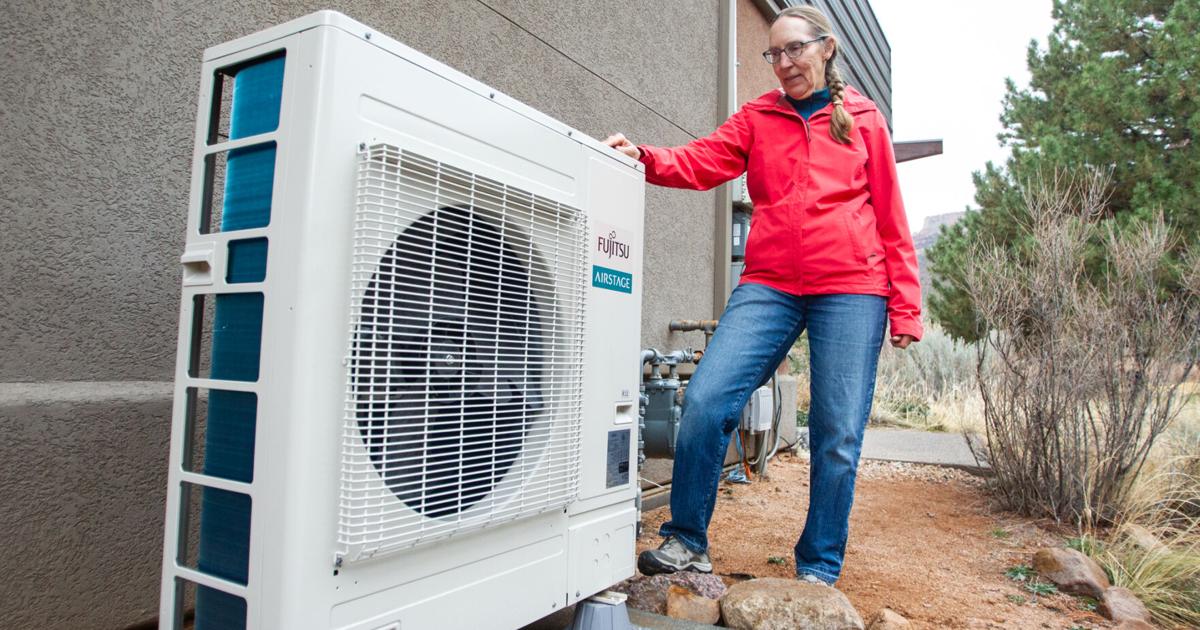
Susan and Thomas Hess were thrilled when they had a heat pump installed in November to replace their gas furnace and their air-conditioning unit.
“Of course we haven’t experienced using it in the summer yet but it’s just more consistent heat and kind of more gentle, as opposed to the forced air that we experienced with our gas furnace,” Susan Hess said.
Hess, who is active with the local Citizens Climate Lobby chapter, and her husband have been working toward reducing carbon emissions at their home, replacing a gas-fired stove with an induction stove, installing solar panels, and getting an electric car, and now, a heat pump.
“We’re just trying to take one step at a time in reducing our use of fossil fuels,” she said.
Increased electrification of home heating systems and other appliances is expected to be an important feature of large natural gas utilities in Colorado meeting greenhouse gas emission standards adopted by the state Public Utilities Commission. In early December it required Xcel Energy, Black Hills Energy and Atmos Energy to cut greenhouse gas emissions by 41% by 2035, when compared to a 2015 baseline.
The PUC was acting based on a 2021 state law requiring the gas utilities to reduce greenhouse gas emissions 4% by 2025 and 22% by 2030 from the 2015 baseline, and also requiring the PUC to set a 2035 reduction target for the utilities.
The PUC in its decision declined for now to adopt further targets beyond 2035, but noted that the state has a goal of reducing greenhouse gas pollution by 100% by 2050 and said its 2035 mandate provides a step toward that goal.
The target the PUC adopted was hailed by conservation groups. They look forward to the utilities working with households to increasingly move away from the use of natural gas to meet the emission-reduction targets.
In a news release, Ed Carley with Western Resource Advocates said the PUC “responded to the overwhelming public support for strong targets,” and such targets “send a clear signal that will push Colorado’s gas utilities to invest in a successful, equitable transition away from polluting fossil gas.”
Environmental groups say that according to state officials, the adopted goal will avoid 45.5 million metric tons of greenhouse gas emissions and 22,681 tons of nitrogen oxide emissions.
Jim Dennison, a staff attorney for the Sierra Club, said in an interview, “The commission really showed some serious commitment to meeting Colorado’s climate objectives and meeting this transition in a way that sets an example for other states, and that gives the best opportunity for effective planning and affordable implementation to make this a win for customers in Colorado.”
COST CONCERNS
But others take a dim view toward the new requirement.
“This mandate pushes families into costly heat pumps, retrofits, and electric appliances they simply cannot afford,” state Rep. Dan Woog, R-Frederick, said in a letter to the PUC, signed by 21 fellow House Republicans including Reps. Rick Taggart of Grand Junction and Matt Soper of Delta. “It ignores that natural gas is one of the only reliable and affordable ways thousands of Coloradans stay warm during dangerous winter weather.”
Chelsie Miera, executive director of the West Slope Colorado Oil and Gas Association, told the Sentinel, “This will increase costs on Coloradans and make our great state even more unaffordable for families of all income levels. The PUC’s political move to force consumers away from a safe, reliable and affordable energy source produced here in Western Colorado in the name of complete electrification is a dangerous and expensive gamble that lacks data or accountability.”
She said more than 70% of Colorado households use natural gas to heat their homes.
Robert Boswell, chairman and CEO of Laramie Energy, a local natural gas producer, said in an email, “The cost of conversion and the cost of operation are high for electrification for home heating. With gas, you burn it directly to provide heat. With electricity, you need a reliable fuel to generate the electricity and the cost of conversion into generating electricity makes it more expensive than just burning natural gas directly to generate the heat.”
He said natural gas is a reliable fuel source, while generation from wind and solar only provides electricity “when the wind blows and the sun shines, and there is not sufficient battery storage to back up these forms of electrical generation for more than a few days. So, clean, reliable, and affordable natural gas is the best option. Colorado is blessed with abundant natural gas but overzealous regulation is inhibiting its development and increasing the cost of energy in the state unnecessarily.”
John Wellman with Wellman Heating & Air in Mesa County said that from a business perspective, he can make more money installing newer, more efficient heating systems, but the higher cost is a hardship for people who sometimes can’t really afford even the older systems.
Heat pumps cost more than older equipment, and while people can save money in their utility bill over time using them, “a lot of people can’t afford that kind of stuff,” he said.
LOWER REQUIREMENTS SOUGHT
The 41% reduction mandated by the PUC is the amount that the Colorado Energy Office and state Air Pollution Control Division originally proposed. But those agencies later called for a 31% reduction instead. According to the PUC’s written decision in the matter, the agencies said achieving the 41% reduction would require 600,000 customers to switch to electric water heating, cooking and clothes drying as well as space heating, and so far most electrification that has occurred has been partial, with some gas-based appliances still in place, so based on that trend even more than 600,000 likely would have to undergo electrification to meet the target.
The state agencies said their revised recommended target took into account concerns about costs and other factors that influence the rates of customers electrifying systems in homes. They also pointed to the federal government’s rolling back of tax credits for electrification that had been offered through the Inflation Reduction Act.
Xcel Energy had suggested that the PUC set a 2035 target in the range of 22% to 30%, with the possibility of the initial target being adjusted based on later data on things such as customer uptake of electrification. Atmos Energy suggested not going above the 22% target already set for 2030 because the utilities’ own clean heat plans haven’t yet demonstrated even that target is achievable.
Black Hills argued that even the initial targets established by the Legislature aren’t achievable without “incredible” investments. It also contends it isn’t realistic to set targets below a 2015 baseline when utilities have been showing significant growth since that baseline.
The state Office of the Utility Consumer Advocate voiced concern that a 41% target will lead to premature retirement of utility assets, resulting in increased rates for customers.
Home electrification isn’t the only way the natural gas utilities can meet their emission reduction mandates. Other measures can include things such as reductions in climate-harming methane leaks, the use of green hydrogen, and the use of recovered methane such as biogas from sources such as landfills. But Dennison with the Sierra Club said those measures pale in comparison to electrification and energy efficiency measures in terms of cost-effectiveness and scalability.
REBATES HELP
Dennison added, “Sierra Club doesn’t think ambitious clean heat targets are themselves going to drive cost increases.”
For one thing, he said, the PUC will evaluate the reasonableness and costs of specific clean heat plan proposals by the utilities, and make sure they are pursuing targets in a way that is cost-effective and best for customers.
Xcel’s first clean heat plan approved by the PUC includes about $430 million for investments in beneficial electrification and energy efficiency, and the utility has been providing heat pump rebates, Dennison said.
Hess said she and her husband were able to take advantage of an Xcel rebate that made a big difference in the cost of their installation. They also were able to make use of the federal tax credits before they expired at the end of the year.
Hess also noted that the Colorado Energy Office has launched a new rebate program for low- and moderate-income participants in single-family homes. It is funded by the U.S. Department of Energy and helps with the costs of heat pumps, electric stoves, heat pump water heaters, insulation, electric wiring and other projects.
Said Hess, “I do understand the concern about costs but costs are dropping pretty quickly and the long-term impact on our climate of burning fossil fuels is important to think about, too.”
GAS AND POWER GENERATION
Ultimately, the climate benefits of electrification depend on how green the electric power generation power electrification is. Even as the state is moving to reduce natural gas demand at the household level, the fossil fuel has become a key component of power generation in the state as utilities move away from burning climate-harming coal.
In an analysis provided by email to the Sentinel, Jim Marshall and Ray Pilcher with Raven Ridge Resources, a local company that helps companies and other entities reduce their carbon footprints, said that renewable energy including wind, solar, hydro and biomass made up about a third of the state’s generation mix in 2014 and grew to 43% by 2024, becoming increasingly cost-competitive. Use of natural gas for power generation in the state gradually grew from 2014-23, eventually accounting for about 21.8% of power generation, before soaring to about 30.5% in 2024.
“This marked a substantial rebalancing of electricity supply as coal fired plants were taken offline. Future plans from power producers show the intent for natural gas to continue to increase as more coal fired power plants are retired. This trajectory positions natural gas as a transitional fuel in Colorado’s energy mix, maintaining its current role in the near term while renewables gain market share and eventually assume the baseload capacity once dominated by coal.”
They said when that happens, it won’t herald the end of natural gas power generation.
“New gas-fired power plants are being planned that will use carbon capture and storage,” they said. “This means that future gas-fired power can have a very low emissions profile as these new plants are built. The transition away from this carbon based fuel may be much more gradual than expected.”