Microsoft has announced a new set of agentic artificial intelligence (AI) tools to Copilot aimed at automating core retail and B2B commerce functions, including digital checkout, product data management, merchandising and store operations.
The company said it designed the agentic AI tools, which it’s delivering through Microsoft Copilot and Copilot Studio, to reduce manual work, speed decision-making and connect workflows that are often managed across disconnected systems. Microsoft has already made several of the capabilities available now, while others will enter public preview in early 2026, according to the company.
Microsoft unveils agentic commerce tool Copilot Checkout
Among the new offerings is Copilot Checkout, Microsoft’s own-platform entrance into agentic commerce. It allows customers to complete purchases directly inside Microsoft’s Copilot interface instead of being redirected to a retailer’s website. Microsoft said merchants remain the seller of record, as payments process through integrations with PayPal, Shopify and Stripe.
Microsoft also posted an unlisted video to YouTube demonstrating the Copilot Checkout experience.
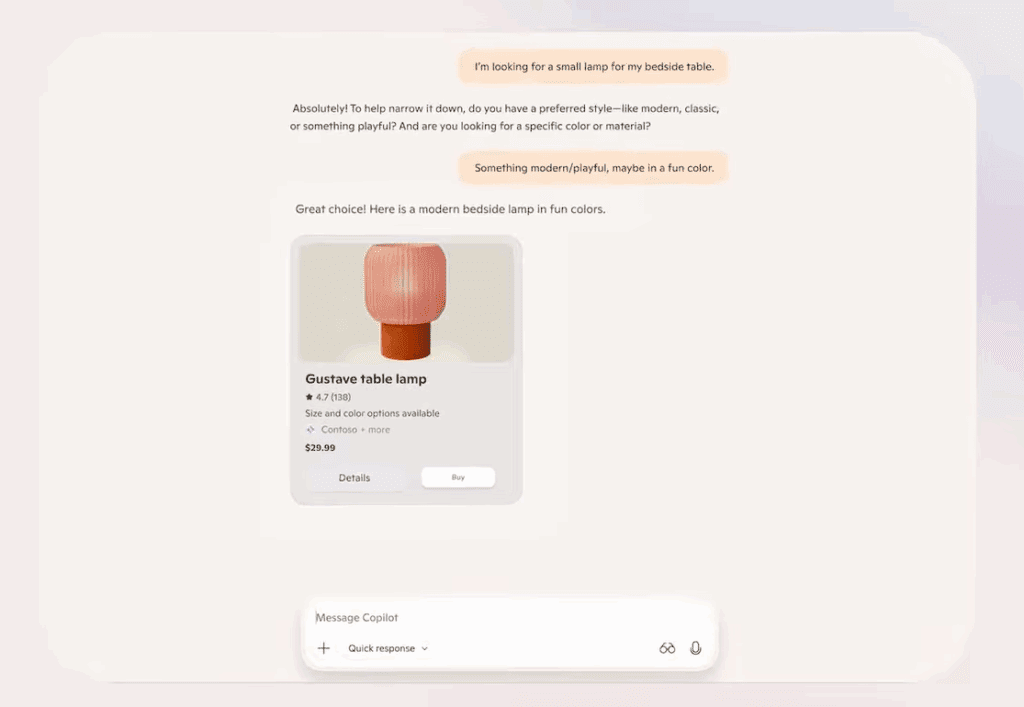
Microsoft released a video simulation of Copilot Checkout, demonstrating how the agentic commerce capability works in its interface. | Image credit: Screenshot of Microsoft video, Jan. 9, 2026
Copilot Checkout is available in the United States on Copilot.com. Microsoft said early participating merchants include:
Shopify merchants will be enrolled automatically after an opt-out period, according to the company.
While Microsoft has initially positioned the feature for consumer transactions, it said the same embedded checkout approach can apply to B2B ecommerce, where buyers increasingly place repeat or contract-based orders through digital channels. Integrating checkout directly into AI-driven workflows could shorten purchasing cycles for standardized and replenishment-driven B2B purchases.
Microsoft also introduced Brand Agents for merchants using Shopify. It trains the agents on a company’s product catalog and brand content. The agent then can answer detailed product questions, guide buyers through selections and support purchasing decisions through conversational AI.
Microsoft releases personalized shopping agent template
In addition, Microsoft released a personalized shopping agent template in Copilot Studio. It allows companies to build customized AI agents for web, mobile and in-store experiences. Microsoft said the template supports real-time product discovery, recommendations and configuration logic.
These capabilities align with common B2B ecommerce needs, Microsoft said, including:
Large catalogs
Detailed specifications
Bundles
Role-based pricing
To address product data management, Microsoft announced a catalog enrichment agent template, now in public preview. The tool extracts product attributes from images. It enriches them with external signals and automates tasks such as product onboarding, categorization, and error correction.
Microsoft said it created the agent to improve search accuracy, recommendations and personalization across digital channels. Apparel retailer Guess is among the early users, according to the company.
For B2B sellers, automated catalog enrichment could reduce the time and cost required to manage large, specification-heavy assortments and improve data consistency across ecommerce platforms, marketplaces, and customer portals.
AI agents for store operations
Microsoft also introduced a store operations agent template, also in public preview, for store managers and frontline employees. The tool allows staff to query inventory levels, store policies and operational data using natural language.
The agent analyzes internal data such as sales and foot traffic alongside external factors including weather and local events to recommend staffing levels and operational priorities. Microsoft said the goal is to reduce manual coordination and help retailers respond more quickly to changing conditions.
While focused on physical retail, Microsoft said similar agent-based approaches can apply to B2B distribution environments, including branch operations, counter sales and warehouse fulfillment.
Microsoft framed the announcement as part of a broader effort to embed AI-driven automation across commerce operations rather than limiting AI to customer-facing chatbots. By combining checkout, catalog management and operational agents on a shared platform, the company is positioning Copilot as a system that supports both consumer and B2B transactions.
For B2B sellers, the tools could accelerate digital ordering, reduce friction in repeat purchases and automate back-office processes that have historically slowed ecommerce adoption, including catalog maintenance and order processing.
Microsoft said the new agent solutions are available through the Microsoft Marketplace, with broader availability expected later in 2026 as preview features move into general release.
Sign up
Sign up for a complimentary subscription to Digital Commerce 360 B2B News. It covers technology and business trends in the growing B2B ecommerce industry. Contact Mark Brohan, senior vice president of B2B and Market Research, at mark@digitalcommerce360.com. Follow him on Twitter @markbrohan. Follow us on LinkedIn, X (formerly Twitter), Facebook and YouTube.