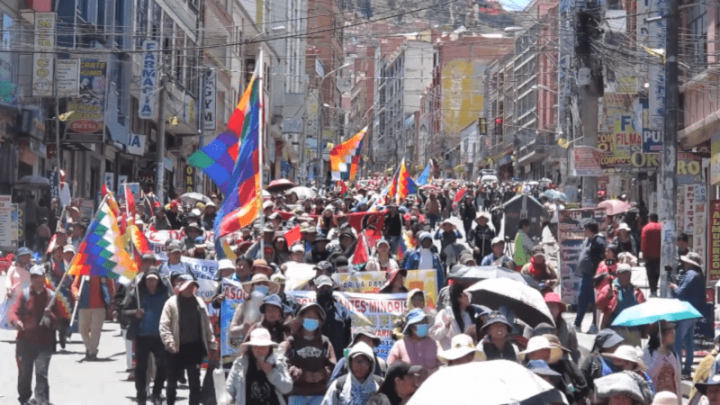
Bolivia is experiencing an episode of class struggle that shows the rightward turn taking place throughout Latin America is far from secure. The newly elected right-wing president, Rodrigo Paz, is attempting to implement a decree, which would open the South American country’s natural resources to exploitation by multinational corporations, while putting economic strain on the country’s workers and popular sectors. Already, there is fierce resistance.
Supreme Decree 5503 is a broad collection of policies aiming to reorganize Bolivia’s economy by imposing austerity measures and gutting long-standing regulations. One of the most contentious policies is a move to end fuel subsidies. This would increase gasoline prices by 86 percent and diesel prices by 162 percent. The decree would also fast-track access to natural resources by private entities, paving the way for greater extraction in a country where workers and Indigenous people have a rich history of fighting to defend their natural resources.
The resistance to the decree has sparked massive mobilizations, including dozens of roadblocks that shut down highways across the country. On January 5, a massive march, drawing half a million people from all over the country, arrived in La Paz. The column of protesters reportedly stretched almost 17 miles long. Important workers organizations, including the Bolivian Workers’ Center (COB) and Bolivian Federation of Mining Workers (FSTMB), decided in an emergency national assembly to continue mobilizing in order to force the repeal of the decree. Previously the COB was negotiating with the government, but they broke off those discussions. Left Voice’s sister organization, the Revolutionary Workers League for the Fourth International (LOR-CI) is participating in the resistance to the decree.
This all comes in a unique political scenario for Bolivia. The new right-wing government came into power last year after 20 years of the country being governed by the center-left MAS party. The MAS’s reformist strategy, which tried to conciliate between the interests of capitalism and imperialism and workers and popular sectors, inevitably became untenable. This led to the implosion of the party. Now, the organization that Bolivia’s workers and social movements looked to for leadership for the past two decades is virtually absent. But Bolivia has a long, rich tradition of class struggle, and this new chapter opens the possibility for truly revolutionary forms of organization to emerge.
The struggle in Bolivia also demonstrates that just because right-wing governments are being elected in Latin America, often totally subordinated to U.S. imperialism, these right-wing and imperialist forces cannot enact their anti-worker programs so easily. Other examples of class struggle contesting the regional Right can be found in Argentina, where Javier Milei has struggled to carry out his agenda, and in Ecuador, which recently saw an important defeat of a referendum that would have consolidated the power of far-right Trump ally, Daniel Noboa.
These struggles against the regional Right are developing as Trump is pursuing an imperialist offensive against Latin America. This offensive is expressed acutely in the war on Venezuela, but has the broader aim of consolidating neocolonialist control of the region that the U.S. imperialism sees as its historic backyard. The struggle developing in Bolivia is currently the most advanced front against the growth of a regional Far Right linked to U.S. imperialism. For this reason, it is essential that the Left in the United States and other imperialist countries follow the situation in Bolivia as well as other examples of resistance in Latin America. We must organize solidarity in our own countries with the perspective that workers in Latin America are on the front lines of a fight against the whole capitalist system, which aims to resolve its crises of economic misery and international instability by making workers pay for it.

Samuel Karlin is a socialist with a background in journalism. He mainly writes for Left Voice about U.S. imperialism and international class struggle.