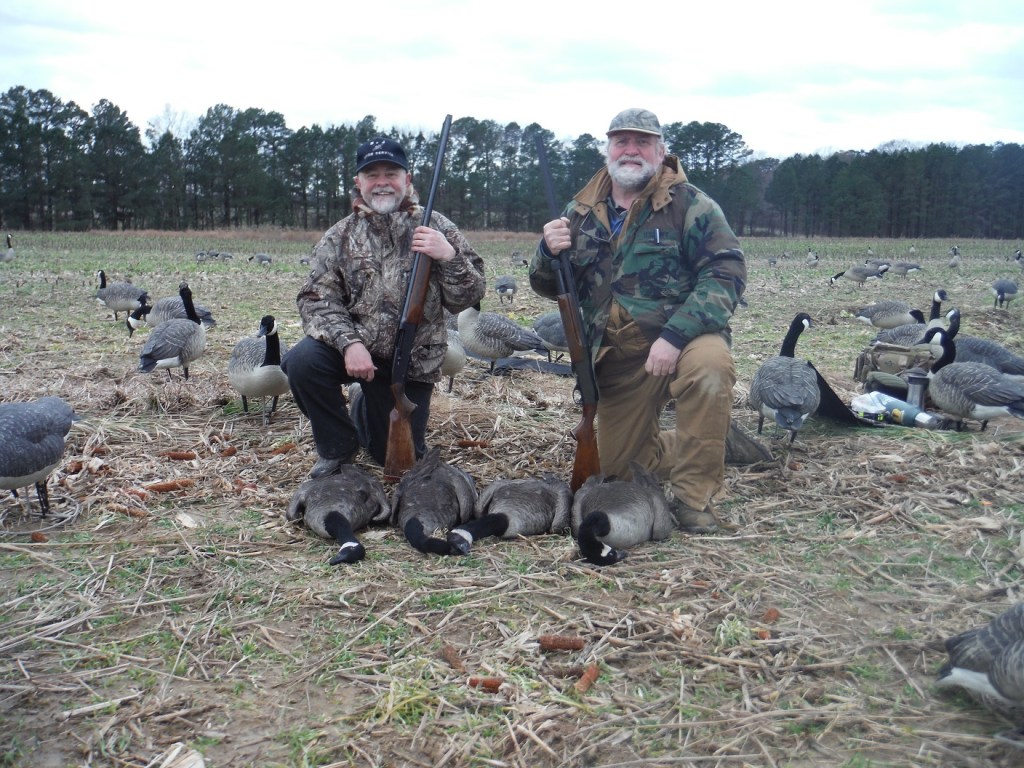
ROCK HALL, Md. — Watch the weather forecast closely for the next few weeks and you’ll likely be able to tell when there are some good opportunities to hunt Canada geese.
With a segmented resident Canada goose season that is open until February 21, there’s plenty of time for more of the cold weather that means geese will need to feed a lot more. Activity is good for the hunter.
Unless you’re pass shooting as the birds fly to feed or to roost,(where decoys may not be needed, hunting geese is a decoy game. Like all waterfowl, geese like company, so while you might not need a big decoy spread to be successful some will be needed.
The first rule of successful goose hunting is to know where there are some geese to hunt. This means a little scouting is called for, as well as possibly getting permission to hunt where you find the honkers.
Fortunately, this time of year it’s common for geese to feed in the same field for several days, so once you find them there’s a pretty good chance you’ll get some action, even if it’s a different day. Keep concealment foremost in mind if you’re thinking of placing your decoys in open fields or pastures.
You’ll almost always bag more birds by hunting where you can hide, even if it puts you 50 to 100 yards away from the center of your spread. Use rows of tall grass, piles of crop stubble, or maybe a dip in the terrain to conceal layout blinds.
Online satellite land-cover maps and apps can help you find good concealment spots that you may not see from ground level, but with local geese one hunt often causes them to move. If you do hunt the same area using the same spread day after day, it won’t take long for local geese to recognize and avoid your decoys.
Give your spread a fresh look by varying the number of decoys you use as well as the way you set them out. You should always watch how the birds react, and if they’re not decoying the way you want, change up your spread, if not your luck won’t change.
Whatever the size of your spread may be, it should consist of roughly 80 percent feeder and 20 percent “active” decoys. Try grouping most of the feeders upwind of where you want the birds to land, near the spread’s center.
Place active decoys downwind of this group so they look like birds that just landed and are walking toward the feeders. Also put some actives around the outside of the spread in small bunches of three to seven decoys; it’s normal for geese to have their heads up when they first land.
Late-season geese are adept at spotting suspicious rows of bumps – which are telltale signs of hunters lying in wait. If you position your blinds facing downwind, directly in line with approaching birds you’re inviting discovery by the birds.
Instead, try placing your blinds 10 yards to the side of the landing hole, or parallel to the wind. This avoids being discovered as the geese won’t see anything other than decoys in front of them, and your crossing shots will likely be at backpedaling birds., a much easier proposition.
There’s also another option for geese this time of year. Known as the place where market hunting began, Maryland’s Eastern Shore offers the ideal combination of amenities and sport.
While the Eastern Shore is justifiably famous for its duck hunting, ducks aren’t the only waterfowl that’s hunted. The heavy weight here is the Canada goose, and because ducks are so weather dependent, the fortune of waterfowl guides here generally rises and falls with goose hunters.
Migratory geese that winter on the Eastern Shore come primarily from northern Quebec, where they breed. They start arriving from early fall on, and their migration can be viewed by simply looking up at the sky when honking is heard.
While geese are hunted in a variety of ways, there’s usually some sort of blind involved. The most traditional blind is the one most often used on the Shore — a pit blind.
Usually placed in a field of some sort, the blind is literally sunk into the ground so that the user’s eye-level is at ground level, or just slightly higher. A pit blind in a good location will be replaced as it ages and some blinds are literally hunted out of for decades.
(Faux is a member of the Pennsylvania Outdoor Writers Association. Contact the writer: outdoors@republicanherald.com)