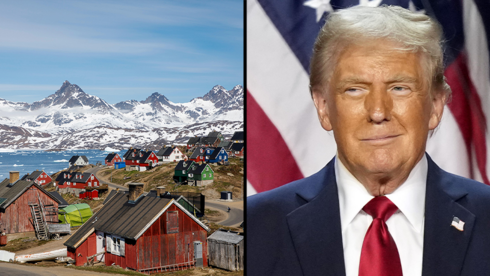
After the U.S. operation in Venezuela, President Donald Trump turned to his next target: Greenland, which he has sought to gain control over since his first term in the White House. After relatively measured messages emphasizing a “national security” need for Greenland, and after the White House said options including the use of military force were being examined, Trump escalated his threat toward the island. “We are going to do something about Greenland, whether they like it or not,” he said.
The U.S. president explained his remarks by arguing that “if we don’t do it, Russia or China will take over Greenland, and we’re not going to have Russia or China as a neighbor.”


Meanwhile, Reuters reported this week, citing four people familiar with the matter, that the Trump administration is considering paying Greenland residents to persuade them to join the United States. According to the report, U.S. officials discussed sending one-time payments to island residents as part of an effort to encourage them to break away from Denmark and potentially join the United States. While the exact amount of each payment is unclear, U.S. officials discussed sums ranging from $10,000 to $100,000 per person, according to two sources.
Last Sunday, Danish Prime Minister Mette Frederiksen urged Trump to stop threatening to take over Greenland — the vast frozen island that is part of the Danish kingdom — stressing that Washington has no right to annex it or any other territory belonging to the kingdom. “There is no logic in talking about the United States taking over Greenland. The United States has no right to annex any country that is part of the Kingdom of Denmark,” she said, referring to Denmark, Greenland and the Faroe Islands.
Greenland is an Arctic island larger than Mexico with a population of about 57,000. It has belonged to Denmark for decades but enjoys broad autonomy, and Denmark’s constitution grants it the right to declare independence and break away from Denmark if its residents so choose.
Greenland holds strategic importance for the U.S. military, which operates a ballistic missile early-warning system there. The shortest route from Europe to North America passes over the Arctic island, and the U.S. Air Force has a base in its northwest, Thule Air Base, operating under an agreement Washington signed with Denmark in 1951. During the Cold War, the U.S. military maintained troops at about 50 bases across Greenland, but negotiations with Denmark in 2004 led to a sharp reduction in presence, which is now limited to Thule. Several hundred U.S. troops are stationed there, compared with nearly 10,000 during the Cold War.
In recent years, amid increased activity by Russia and China in the Arctic, Washington has expressed a desire to expand its presence in Greenland, including deploying radar systems to monitor activity in the waters between the island and Iceland and Britain — an area used by Russian nuclear ships and submarines. Over the past decade, Russia has reopened six military bases in the Arctic that were closed at the end of the Cold War, renewed its Northern Fleet and sent new vessels to the region. It has frequently conducted military exercises there. Moscow hopes that as ice melts in the area, a shipping route will open north of its coast, serving as an alternative route for goods from Asia to Europe.