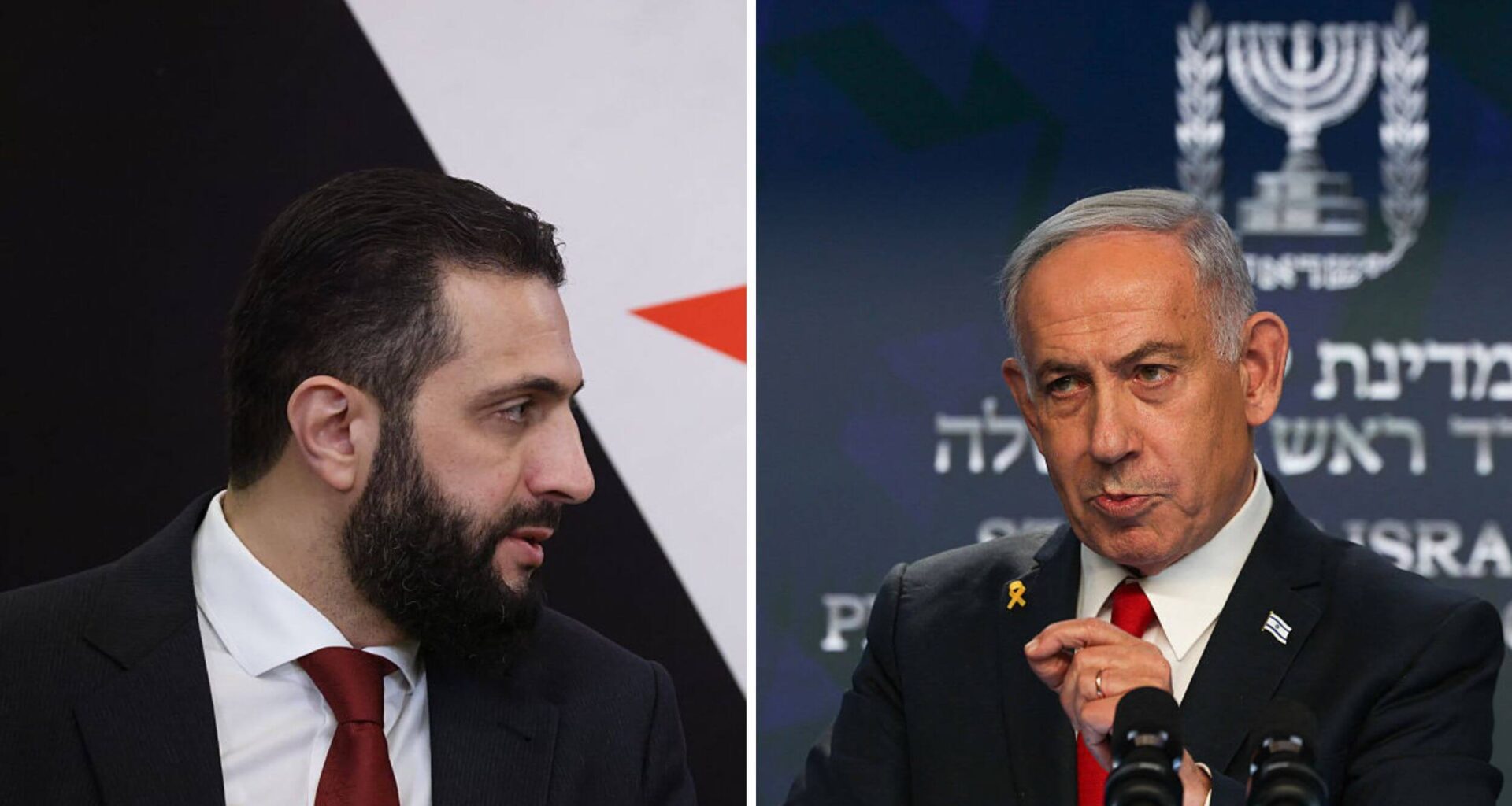
Syrian leader Ahmed al-Sharaa, left, and Israeli Prime Minister Benjamin Netanyahu, right. Photo by Ronen Zvulun / Pool / AFP / Getty Images

Columnist
Dan Perry
January 10, 2026
Something significant is happening between Israel and Syria, and it deserves more attention than it is getting.
With the backing of the United States, Israeli and Syrian officials have agreed to create what they call a “joint fusion mechanism” — a permanent channel for coordination on intelligence, de-escalation, diplomacy and economic matters — during meetings in Paris. It appears to be the beginning of institutionalized contact between two countries that have formally been at war since 1948.
If this process continues, it will count as a genuine foreign-policy success for President Donald Trump’s administration.
To understand how profound that change would be, it is worth recalling the two countries’ shared history.
Israel and Syria — which the U.S. struck with a set of targeted attacks on the Islamic State on Saturday — have fought openly or by proxy for decades. Before 1967, Syrian artillery positions in the Golan Heights regularly shelled Israeli communities in the Hula Valley and around the Sea of Galilee. After Israel captured that region in 1967, the direct shelling stopped, but the conflict did not.
Syria remained formally committed to a state of war; Israel entrenched itself in the Golan Heights; both sides treated the frontier as a potential flashpoint to be managed carefully. After Egypt and Israel made peace in 1979, Syria became Israel’s most dangerous neighboring state.
A 1974 disengagement agreement created a United Nations-monitored buffer zone, which mostly ensured peace along the border, but did not resolve anything fundamental. In Lebanon, Israel and Syria backed opposing forces for years, and their air forces clashed briefly during the 1982 Lebanon War. Later, Iran’s growing role in Syria and Hezbollah’s military buildup added new threats. The Syrian civil war then destroyed basic state capacity and created precisely the kind of militia-rich environment Israel fears along its borders.
Now, with the dictator Bashar al-Assad gone and the former rebel leader Ahmed al-Sharaa in power, Syria is a broken country trying to stabilize. Sharaa’s past associations, disturbingly, include leadership of jihadist groups that were part of the wartime landscape in Syria. But today he governs a state facing economic collapse, infrastructure ruin and a population that needs jobs and basic services. His incentives are simple and powerful: ensure the survival of his regime, invite foreign investment, and secure relief from isolation and sanctions. Those goals point toward the U.S. and its partners, including Israel.
The Trump administration has made it clear that it wants to see new Syrian cooperation with Israel, with the suggestion that progress with Israel will become a gateway to international investment, and to a degree of political acceptance that Syria has lacked for years. Al-Sharaa’s willingness to engage is therefore not a mystery.
Israel’s motivations are also straightforward. After the Gaza war, Israel is facing a severe reputational problem. It is widely viewed abroad as reckless and excessively militarized. The government is under pressure over not only the conduct of the war but also the perception that it has no political strategy and relies almost exclusively on force. A diplomatic track with Syria allows Israel to present a very different picture: that of a country capable of negotiations with ideologically opposed neighbors, de-escalation, and regional cooperation.
There are significant security incentives, too.
Israel wants to limit Iran and Hezbollah’s influence in Syria. It wants a predictable northern border. It wants assurances regarding the Druze population in southern Syria — brethren to the Israeli Druze who are extremely loyal to the state, and who were outraged after a massacre of Syrian Druze followed the installation of al-Sharaa’s regime. It wants to ensure that no armed Syrian groups will tread near the Golan. A coordinated mechanism supervised by the U.S. offers a strong diplomatic way to address these issues.
The U.S. will benefit as well. The Trump team is eager to show that it can deliver lasting diplomatic achievements in the Middle East after the success of the Abraham Accords in Trump’s first term. A meaningful shift in Israel–Syria relations would be a very welcome addition, especially as the U.S.-brokered ceasefire in the Gaza war faces an uncertain future.
The main questions now are practical. Can the “joint fusion mechanism” function under pressure? What will happen when there is, almost inevitably, an incident — a drone downed, a militia clash, a cross-border strike? Will the new system effectively lower the temperature, or will it collapse at the first crisis?
Will Iran — facing its own profound internal political crisis — accept a Syria that coordinates with Israel under U.S. supervision, or will it work to undermine al-Sharaa? How will Hezbollah react if Damascus appears to move away from the axis of “resistance” and toward a security understanding with Israel?
How would an Israel-Syria deal impact Lebanon’s moribund efforts to dismantle Hezbollah’s military capacity? Al-Sharaa has already helped significantly by ending the transfer of weapons to Hezbollah from Iran through his territory. Might he also actively help with the disarming of the group?
No one should expect a full peace treaty soon. The question of possession of the Golan Heights probably remains a deal-breaker. Public opinion in Syria has been shaped by decades of official hostility to Israel, and Israeli politics is fragmented and volatile.
But diplomatic breakthroughs can confound expectations. They usually begin with mechanisms like this one, involving limited cooperation, routine contact and crisis management.
If this effort helps move the border from a zone of permanent tension to one of managed stability, that alone would be a major shift. It would also send a signal beyond the region: U.S. engagement still matters, and American pressure and incentives can still change behavior.