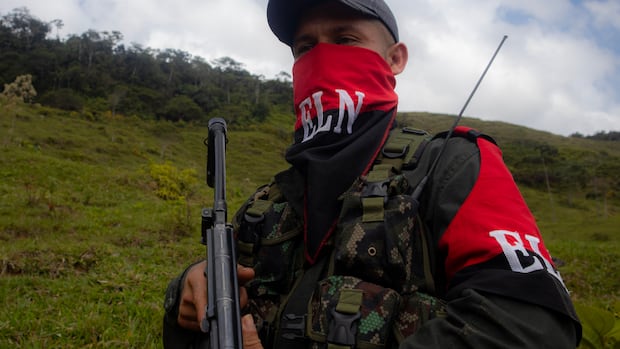
The U.S. attack on Venezuela has shifted the ground for guerrilla groups operating across the country’s borderlands with Colombia, raising fears of possible betrayal by Venezuelan regime officials, while opening the door to a wider conflict should U.S. boots ever hit the ground, local security experts say.
Reports of an increase in guerrilla movements on both sides of the border have surfaced since the Jan. 3 attacks. The region’s most powerful guerrilla group, the National Liberation Army (ELN), has reportedly closed some camps in Venezuela, fearing possible betrayal of their locations by regime officials to U.S. authorities leading to strikes, say experts.
“They’re reconfiguring their security frameworks and protocols, consolidating and reviewing their systems of social control that the ELN maintains in certain communities in Venezuela where their leaders are present,” said Jorge Mantilla, a Bogotá expert in armed conflicts and national security.
The ELN has also suspended training operations in the country along with plans to develop a special forces unit with the help of the Venezuelan military, said Mantilla.
“There is a lot of uncertainty with what could happen,” he said.
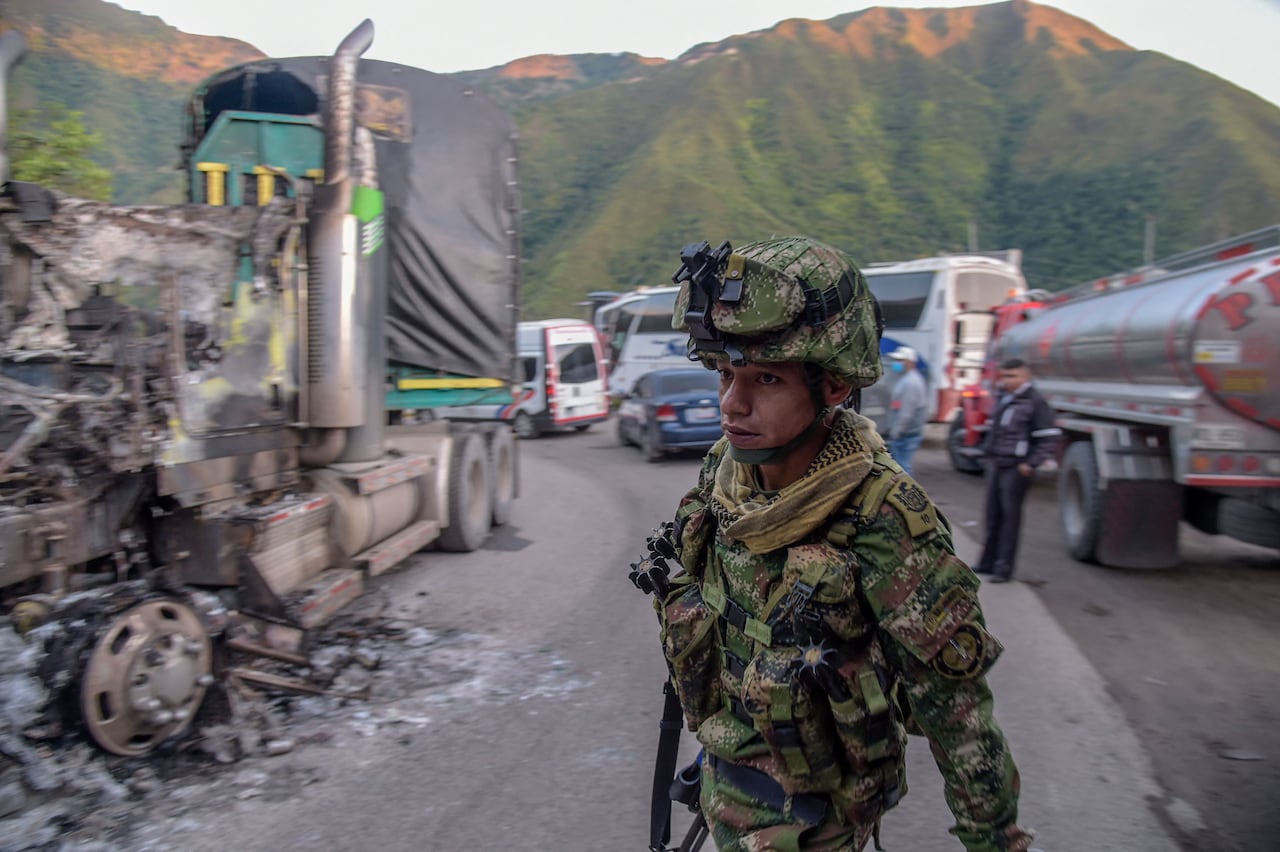 A Colombian soldier walks by a burned truck near the Venezuela-Colombia border on Nov. 22, 2022. According to authorities, ELN guerrillas and FARC dissidents operate in that region. (AFP/Getty Images)
However, the ELN has long anticipated a U.S. attack in Venezuela, said Mantilla.
In September, Pablo Beltrán, one of the ELN’s chief negotiators, suggested in an interview that the U.S. would attack Venezuela over its resources.
In 2019, the ELN sent a letter to President Nicolás Maduro that was intercepted by Colombian intelligence, warning the then-Venezuelan president of traitors within the upper echelons of the Venezuelan military, said Mantilla.
Continental ambitions
The attack could also open the door for the ELN to achieve a long-desired goal of becoming a continental guerrilla force if the U.S. military establishes a presence in the country or if the regime in Venezuela fragments into factions, he said.
“This would become the military and political platform the ELN has been hoping for … to turn into what they call a continental guerrilla, a symbol of resistance, not for Colombia or Venezuela, but for Latin America,” said Mantilla.
The leader of one of the ELN’s main guerrilla enemies along the Venezuela-Colombia frontier issued a video statement late this week calling for guerrilla groups to form a common front with the Venezuelan military to resist the U.S.
Ivan Mordisco leads a group that splintered from the Revolutionary Armed Forces of Colombia (FARC), which officially disbanded in 2017. He said the armed groups should set differences aside because they “face the same enemy.” Mordisco, whose real name is Néstor Gregorio Vera Fernández, called for a meeting between the leadership of the various guerrilla movements.
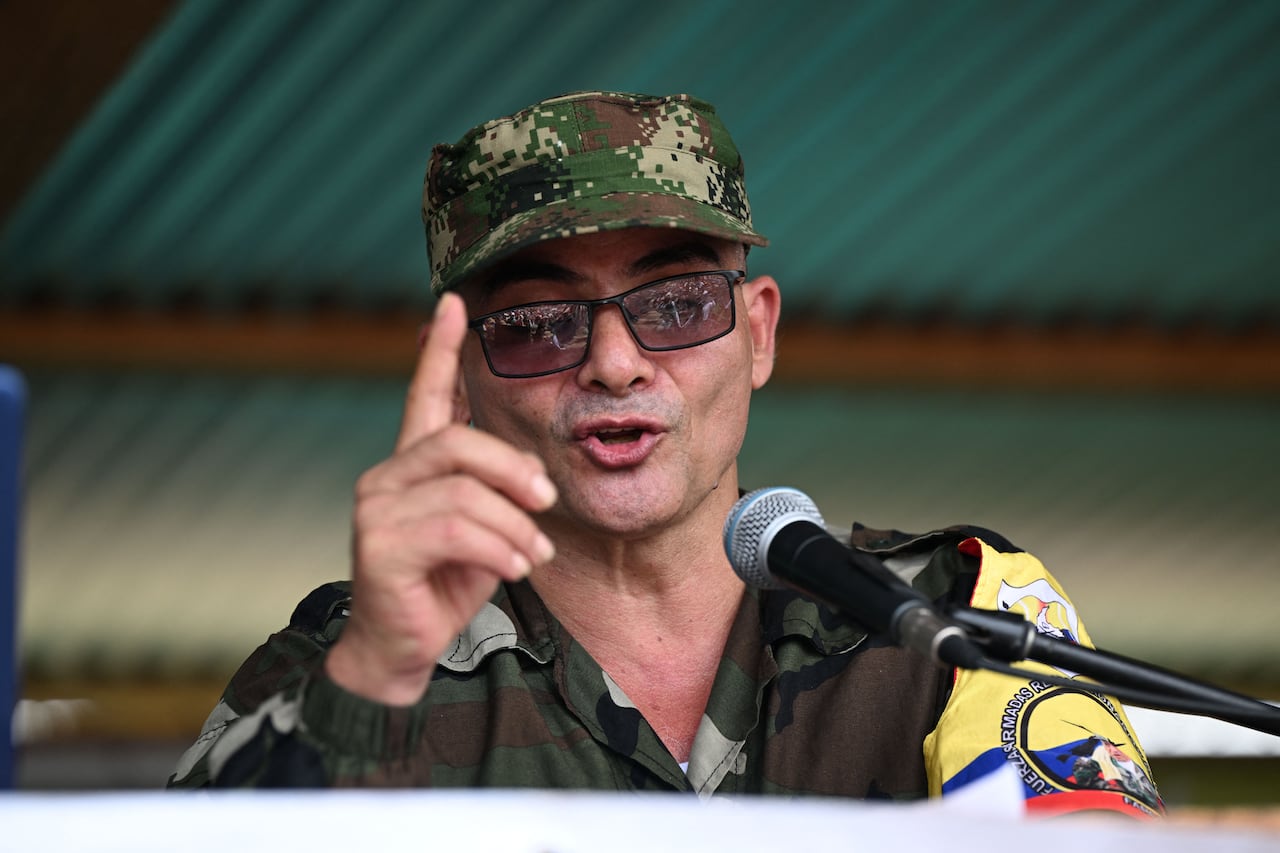 Ivan Mordisco, who leads a group that splintered from the FARC, speaks during a meeting with local communities in San Vicente del Caguan, Colombia, on April 16, 2023. (AFP/Getty Images)
Gerson Arias, a researcher with Colombia’s Ideas for Peace Foundation, said he doubted anyone would take up Mordisco’s call because he’s not well trusted.
Mordisco also brings too much heat as one of Colombia’s most wanted criminals, said Arias.
The Colombian government of President Gustavo Petro has put a roughly $1 million US bounty on his head.
ELN, Venezuela share long history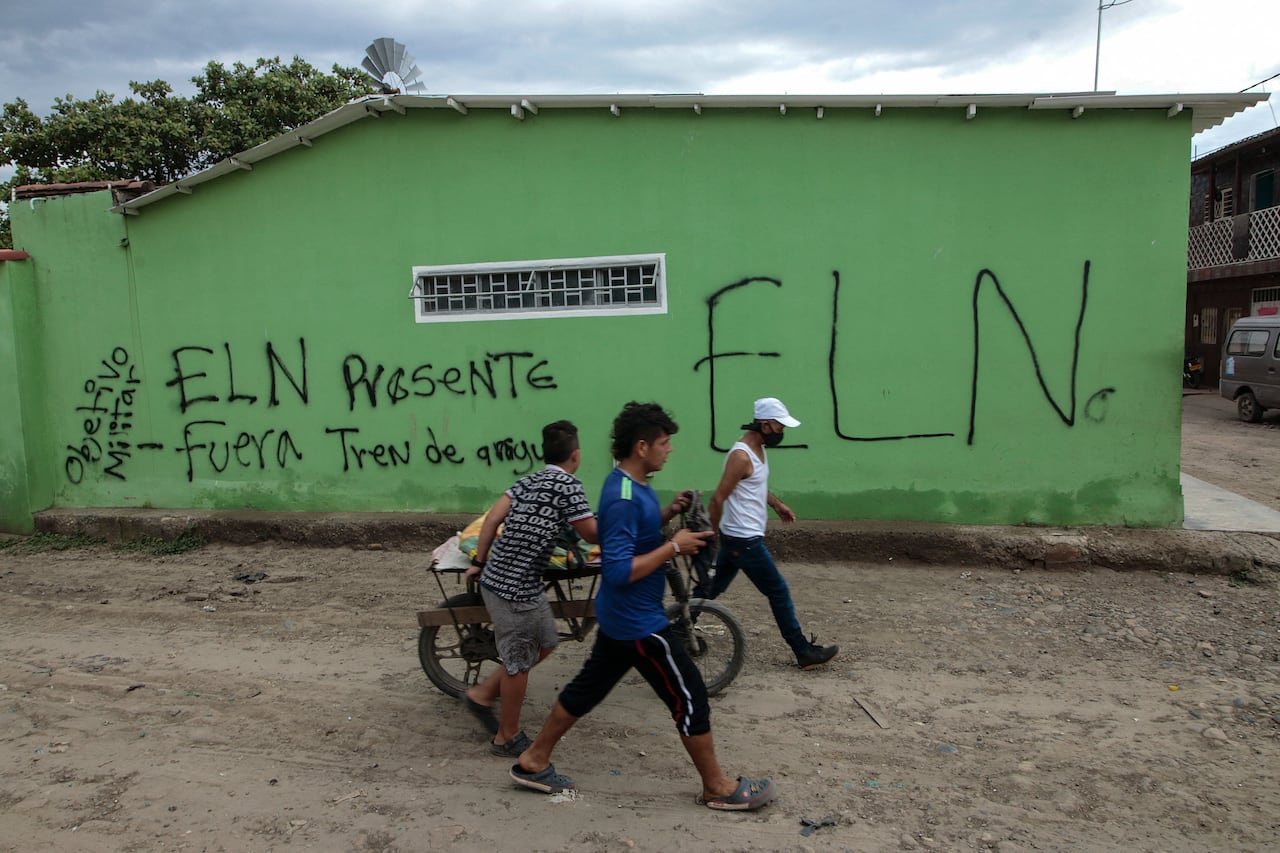 Venezuelans move packages in front of a house with a graffiti that reads ‘ELN present,’ in Cucuta, Colombia, near the Venezuelan border, on May 2, 2023. (AFP/Getty Images)
A group like the ELN, with an estimated force of between 6,000 to 8,000 people, which operates in Colombia and Venezuela while controlling roughly 1,200 kilometres of borderlands, has no incentive to make peace with Mordisco’s organization, said Arias.
Arias said the ELN operates in swaths of the southern Venezuelan states of Amazonas and Bolivar, including territory rich in natural resources like rare earth minerals. It relies on illegal mining and the drug trade as some of its main sources of revenues.
The ELN has a long history with the Venezuelan regime dating back to the presidency of Hugo Chávez, who was elected in 1998, said Arias.
The ELN’s leadership moved to Venezuela in 2002 and the group shares the same political ideology as the regime in Venezuela, said Arias. It considers the defence of Venezuela’s Bolivarian Revolution a core duty.
“The ELN saw itself as Venezuela’s rearguard, but, progressively, it turned into a place where it could develop its political and military project,” said Arias.
In a recent telephone call, U.S. President Donald Trump and Petro agreed to work together to fight the ELN, said Colombia’s Interior Minister Armando Benedetti, in an interview with local radio. Petro is scheduled to visit the White House next month.
Eliana Paola Zafra, a human rights advocate in the border city of Cúcuta, Colombia, said the U.S. has long provided funding to the Colombian military to fight the country’s armed groups, but it has never brought peace.
“We need a politics of total peace, we need to empower communities in Latin America to defend life, to defend peace, to defend human rights,” said Zafra.