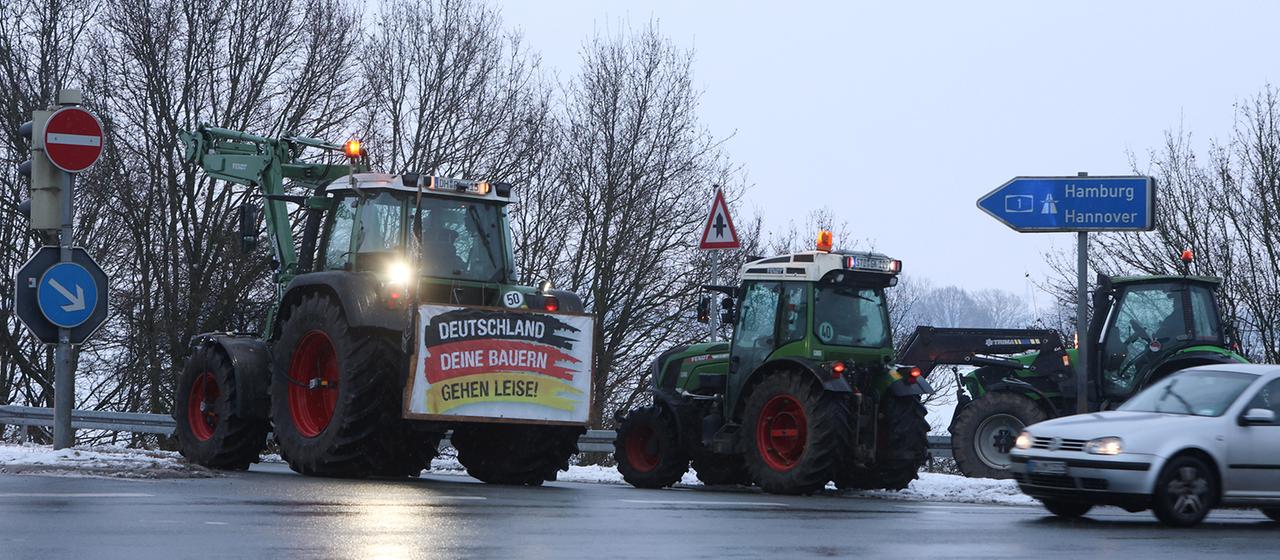
The path is clear for the EU to conclude a free trade agreement with four Mercosur states. This raises hopes in German politics and the economy. However, many farmers fear unfair competition.
With tractors on motorway entrances against the free trade zone: Farmers in many regions of Germany protested this week against the planned EU-Mercosur agreement. They fear falling prices, growing competitive pressure and the collapse of many businesses. “We have very serious concerns about this agreement,” said a farmer from Mecklenburg-Western Pomerania on the sidelines of a protest. He warned of additional inequalities in competition.
A farmer from Saxony-Anhalt referred to strict regulations in Germany. “There are so many requirements that we have.” In other countries, many pesticides are permitted that are banned here. Cheap imports increased the pressure. It turns out that Existential fear is rampant. A farmer said: “Once he closes a farm, it never opens again.”
The German Farmers’ Association did not take part in the blockades, but clearly rejects the agreement. “As a German farmers’ association, we are fundamentally in favor of trade agreements. But they have to be fair,” said President Joachim Rukwied. The agricultural part of Mercosur is unbalanced and is at the expense of European agriculture. “We cannot hold our own in this competition.”
What Mercosur is about
The free trade agreement is intended to facilitate trade between the EU and the Mercosur states Brazil, Argentina, Uruguay and Paraguay. Tariffs on many goods should be eliminated. One of the largest free trade zones in the world with more than 700 million inhabitants would be created.
The negotiations began in 1999. Resistance in the EU repeatedly delayed the conclusion. Above all, concerns about agriculture and environmental and social standards slowed the process.
Accommodation from Brussels is not enough for farmers
The EU Commission is trying to cushion criticism. She held out the prospect of protective clauses. These should allow new tariffs if agricultural imports rise sharply or prices collapse. In addition, EU funds should be available earlier.
Rukwied rejected this. He called the proposals “a real placebo.” There is no additional money and no reliable insurance.
Federal Government sees Mercosur as a geopolitical signal
The federal government supports the EU Commission’s course. Federal Minister of Economics Katherina Reiche also spoke out clearly in favor of the agreement. She emphasized the uncertain trade policy of the USA. The US tariffs would hit German companies particularly hard. “I therefore support the European Commission,” said Reiche.
Germany needs new markets to secure exports and create growth. It is also important to the CDU politician: “We need rules-based world trade.” Free trade agreements are central to this. At the same time, there is growing concern in many EU states that the USA could divide Europe. Mercosur is therefore seen as a counterweight to the USA and China.
Fundamental criticism from left and right
In political Berlin there was clear rejection until recently. The AfD was critical. She warned of market shifts to the detriment of European farmers and called for renegotiations and more protection for German agriculture in December.
The left also strictly rejects the agreement. Agricultural politician Marcel Bauer spoke of a “deal” that would primarily benefit large pesticide and chemical companies as well as the food industry. Farmers in Europe and South America came under greater pressure, and environmental and occupational safety suffered. “Instead of organizing extra profits for the industrial giants, politicians should better ensure a boom in regional agriculture,” said Bauer.
Relief in the economy after EU agreement
After the EU states agreed on the Mercosur agreement, the German economy reacted with relief. BDI General Manager Tanja Gönner spoke of an “important success” and a “strong signal for free trade”. The EU is thus demonstrating its geopolitical ability to act.
The Chemical Industry Association also welcomed the decision. Managing Director Wolfgang Große Entrup called it “a good day for Europe” and a sign that Europe wants to shape things.
The economy pointed to concrete advantages. Companies could save around four billion euros in tariffs every year. In addition, access to important raw materials such as lithium and copper, for example for electromobility and renewable energies, is improving.