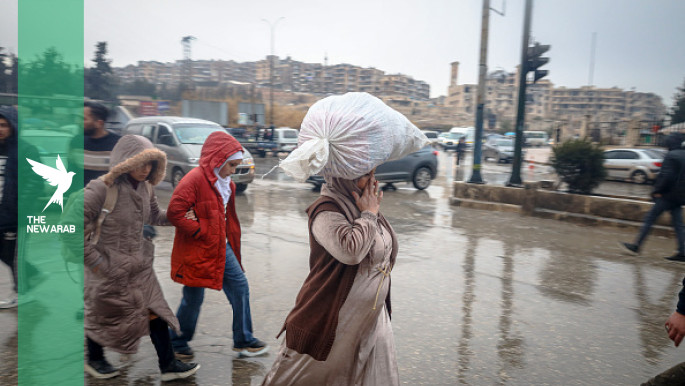
Clashes in Aleppo’s Kurdish neighbourhoods killed at least 21 people this week [Getty/file photo]
Specialised Syrian government agencies have been deployed to Aleppo to check for any dangerous explosive devices as thousands of residents are expected to return to the city’s neighbourhoods, following a ceasefire announcement late on Saturday.
The Syrian Ministry of Defence and the Ministry of Emergency and Disaster Management said they began field surveys within the districts of Sheikh Maqsoud and Ashrafiyeh soon after the last remaining Kurdish-led forces agreed to withdraw from the area, in accordance with the newly announced truce, activists told The New Arab’s Arabic-language sister site, Al-Araby Al-Jadeed.
Ahmed Zakour, an Aleppo-based activist, also said security forces, traffic police, and other government agencies have begun organising the two neighbourhoods, as residents gradually return.
At least 150,000 locals were displaced following days of deadly clashes between the Kurdish-led Syrian Democratic Forces (SDF) and the government forces, which occurred this week.
The violence was the latest in a series of similar incidents amid the broader clashes between the SDF and the Syrian transitional government, which have ensued after several rounds of talks to integrate the SDF’s de facto autonomous administration into the country’s new government stalled.
At least 21 people have been killed since Tuesday, according to figures from both sides. Since the ceasefire, the government has facilitated the transfer of SDF fighters to Kurdish-controlled northeast of Syria
Meanwhile, the head of the Emergency and Disaster Management Directorate in Aleppo said that Syrian Civil Defence teams are continuing their work within the Central Emergency Response Committee in the city. The teams are tasked with removing dirt or any barriers in Aleppo after mines or any other dangerous devices are successfully removed by the relevant teams.
Mohammad Rajab al-Hashem said on X: “The emergency response teams are continuing to transport and distribute essential supplies to residents and are participating in the return of displaced persons to their homes. The teams are also responding to attacks by suicide drones in Aleppo neighbourhoods, confirming their readiness to provide humanitarian assistance throughout the Aleppo Governorate.”
The emergency and disaster management teams’ operation includes transporting residents from temporary shelters to their homes via designated vehicles, amid relevant security measures.
Residents who are in the process of returning have expressed mixed feelings. One resident, Salma Abdel Rahim, told Al-Araby Al-Jadeed that the procedure has been approached with “extreme caution” and arriving back home has evoked “conflicting emotions”.
She added: “But simply opening the door of the house gives us reassurance… Returning is not just a physical relocation; it’s a restoration of the psychological security we lost.”
Also in Aleppo, the pumping of drinking water has resumed after an interruption that lasted for several hours starting on Saturday evening.
Energy Minister Mohammed al-Bashir said on X: “After the water pumping from the al-Babiri station in the eastern Aleppo countryside was halted for several consecutive hours, we assure our people in Aleppo province and its surrounding areas that the water supply to the city has been resumed.”
Syria has witnessed a tumultuous period following the overthrow of Bashar al-Assad’s regime in December 2024, with the occurrence of several incidents of violence between some of the country’s religious minorities and government forces.
Ahmed al-Sharaa, Syria’s interim president who led Assad’s ouster, has pledged to protect Syria’s ethnic and religious minority groups. However, violent killings of hundreds of Druze and Alawite Syrians by government-aligned forces last year raised concerns over the new government’s ability to achieve stability, following years of civil war.