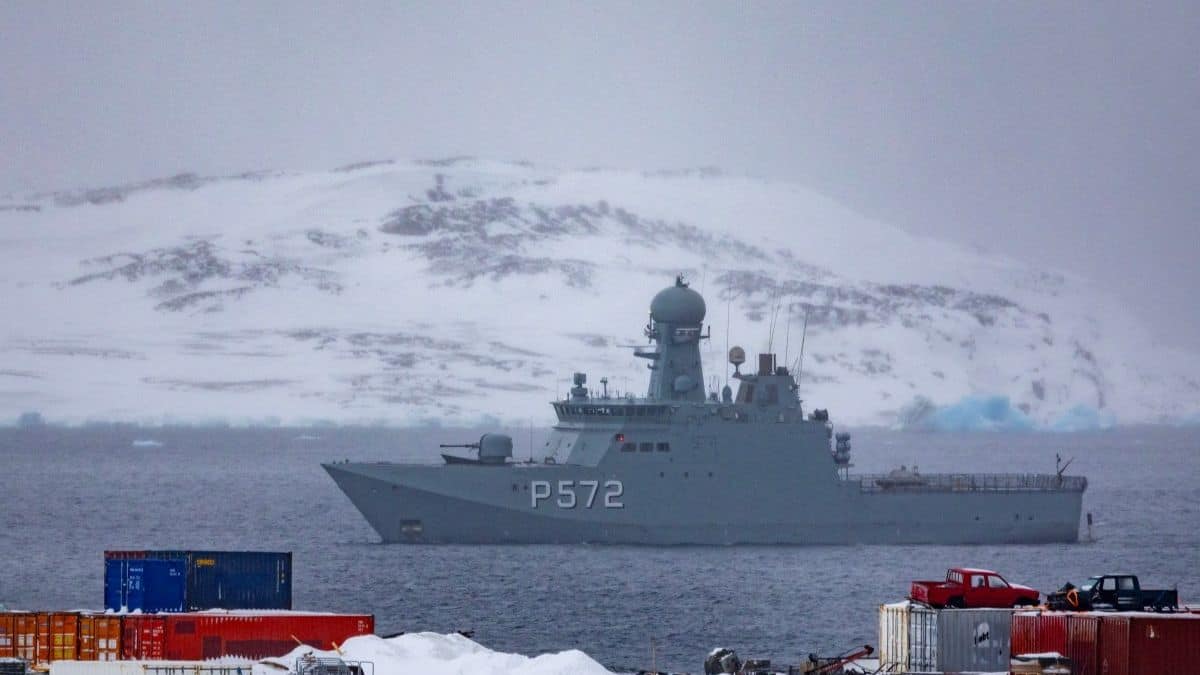
As Europe closes ranks behind Denmark in response to renewed US pressure over Greenland, Copenhagen finds itself defending a territory that is steadily slipping from its grasp. While allies rally around principles of sovereignty and international law, the crisis has laid bare a deeper contradiction: Denmark is expending diplomatic capital to protect an Arctic land whose population increasingly favours independence and whose political forces are beginning to look beyond Copenhagen altogether.
Caught between transatlantic tensions, Greenland’s growing self-assertion and its own strategic interests in the Arctic, Denmark now faces a dilemma with no clear endgame.
The rhetoric from Washington has prompted a wave of European solidarity with Denmark. Yet beneath the diplomatic show of unity lies a deeper and more uncomfortable dilemma: Denmark is mobilising political capital, financial resources and allied support to defend a territory whose population overwhelmingly wants independence and whose largest opposition party has signalled it may prefer to deal directly with the United States, bypassing Copenhagen altogether.
Greenland’s desire for self-determination has been brewing for decades. The island gained home rule in 1979 and was granted the formal right to independence in 2009. All Greenlandic parties favour independence, though they differ on the timing and approach. Some political forces have signalled they might bypass Denmark entirely, engaging directly with Washington on strategic and economic matters.
“Denmark risks exhausting its foreign policy capital to secure Greenland, only to watch it walk away afterwards,” Mikkel Vedby Rasmussen, a political science professor at the University of Copenhagen told Reuters.
Strategic prize, uncertain future
Greenland’s importance to Denmark goes far beyond symbolism. Strategically positioned between Europe and North America, the island plays a key role in Arctic security and hosts infrastructure vital to the United States’ ballistic missile defence system. Losing Greenland would dramatically diminish Denmark’s geopolitical relevance in the High North.
At the same time, Denmark’s efforts may ultimately come to little if Greenlanders decide to pursue full independence or seek a bespoke arrangement with Washington that sidelines Copenhagen. All major Greenlandic political parties support independence in principle though they differ sharply on the pace and practical steps needed to achieve it.
European backing for Denmark is motivated by more than alliance politics, experts said, adding that allowing Greenland to slip away under external pressure would set a precedent that many fear could embolden stronger powers to challenge the sovereignty of smaller states, undermining the post-World War II international order.
Danish Prime Minister Mette Frederiksen and Greenlandic Prime Minister Jens-Frederik Nielsen underlined that position in joint remarks last month, stressing that national borders and sovereignty are rooted in international law and that “Greenland belongs to the Greenlanders.” Frederiksen has since warned that any U.S. attack on a NATO ally would place the very foundations of the alliance at risk.
The fading ‘Greenland card’
Trump’s insistence that “all options are on the table” has accelerated debates that were already quietly unfolding within Denmark. For decades, Copenhagen benefited from what analysts dubbed the “Greenland card” — the island’s strategic value gave Denmark disproportionate influence in Washington during the Cold War and allowed it to maintain relatively modest defence spending as a NATO member.
That advantage has eroded as Greenland’s push for self-determination has gathered pace. While the right to independence has existed on paper since 2009, US pressure has shortened the political timeline, forcing Denmark to invest heavily in a relationship with an increasingly uncertain end point.
“How much should we fight for someone who doesn’t really care about us?” asked Joachim B. Olsen, a former Danish lawmaker, reflecting a view gaining quiet traction in parts of the Danish public debate.
Heavy financial commitments
Denmark’s stake in Greenland is also financial. Copenhagen provides an annual block grant of about 4.3 billion Danish crowns (roughly $610 million), supporting an economy that grew by just 0.2 percent in 2025. The central bank estimates an annual financing gap of around 800 million crowns to keep public finances sustainable.
On top of that, Denmark funds policing, the justice system and defence, bringing total yearly spending close to $1 billion. Last year, it also unveiled a 42-billion-crown Arctic defence package after US criticism that Denmark was not doing enough to secure Greenland.
Some argue the relationship cannot be reduced to numbers alone. Marc Jacobsen, an associate professor at the Royal Danish Defence College, points to historical, legal and cultural ties, describing the bond as one shaped by shared history and identity rather than simple transactional calculations.
A political tightrope
Frederiksen now faces a delicate balancing act. Standing firm is essential to Denmark’s diplomatic credibility, but prolonged confrontation with Washington carries risks at a moment when Russia is seen as an increasingly aggressive force in the Arctic and beyond. Denmark can ill afford to alienate its most powerful ally, even as it resists US pressure over Greenland.
Domestic opinion remains divided. While Greenland is not a central issue ahead of Denmark’s election later this year, questions are surfacing about the long-term logic of holding on to a union that appears to be fraying from within.
“I don’t understand why we have to cling to this community with Greenland when they so badly want out of it,” said Danish writer and broadcaster Lone Frank. “To be completely honest, Greenland doesn’t inspire any sense of belonging in me.”
For Denmark, the Greenland dilemma is no longer just about defending territory. It is about whether a determined defence today will merely hasten an inevitable parting tomorrow, leaving Copenhagen to wonder what, in the end, it was all for.
With inputs from agencies
End of Article