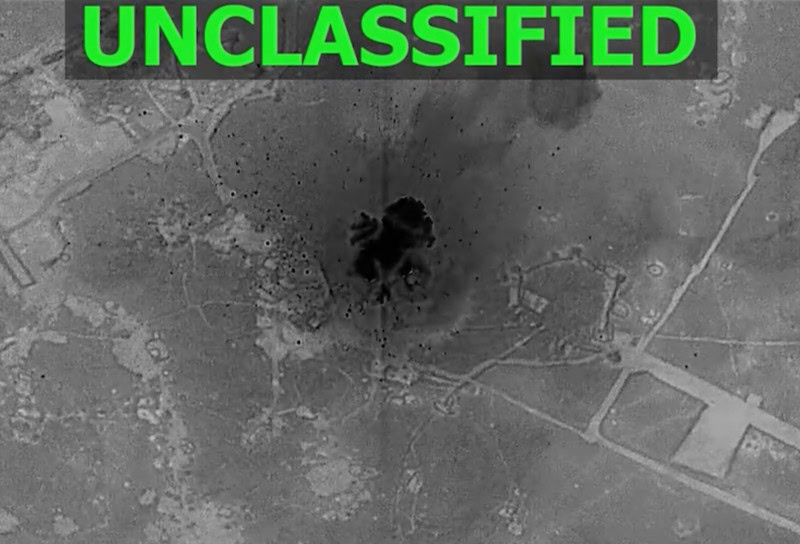
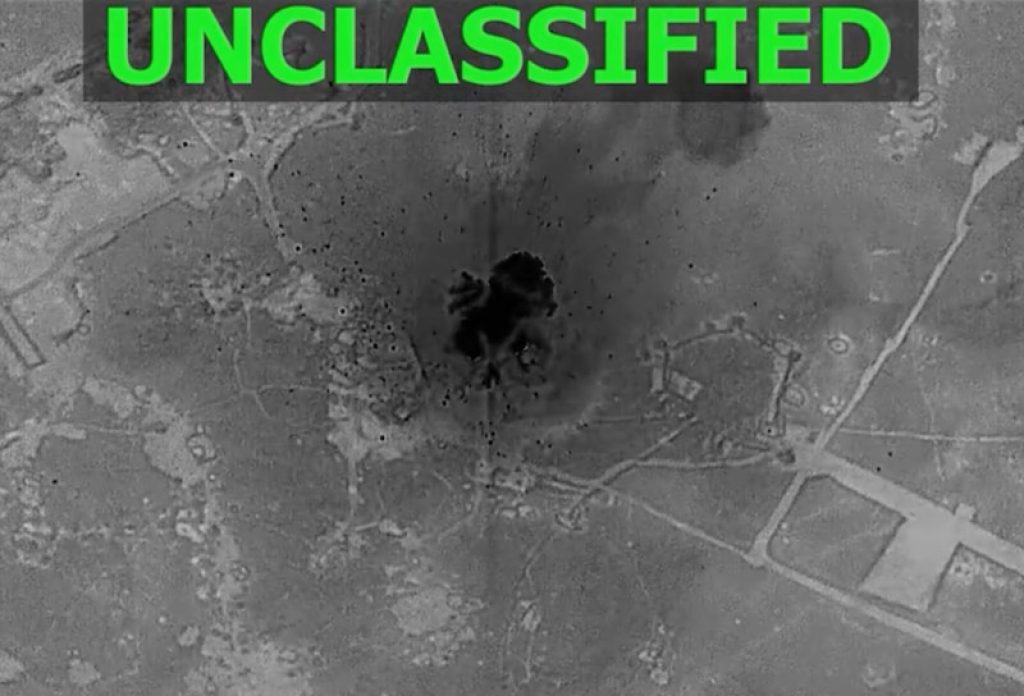
 The impact of a strike on an Islamic State target in Syria shown in footage released by US Central Command.
The US military launched a series of “large-scale strikes against multiple ISIS [Islamic State] targets across Syria,” on January 10, US Central Command (CENTCOM) announced. CENTCOM said the strikes were in “direct response to the deadly ISIS [Islamic State] attack on U.S. and Syrian forces in Palmyra, Syria, on Dec. 13, 2025.” However, there is little evidence that the Islamic State executed the attack, which was carried out by a member of Syria’s security services.
“These strikes are part of Operation Hawkeye Strike, which was launched and announced on Dec. 19, 2025, at the direction of President Trump, in direct response to the deadly ISIS attack on U.S. and Syrian forces in Palmyra, Syria, on Dec. 13, 2025,” CENTCOM said in its statement, without disclosing the exact targets. CENTCOM continues to maintain that the December 13 attack was conducted by the Islamic State.
“That ambush, carried out by an ISIS terrorist, resulted in the tragic deaths of two American soldiers and one U.S. civilian interpreter,” CENTCOM said. The US military used the same justification to launch the first wave of strikes against the Islamic State in Syria on December 19, 2025.
However, other than US military statements, there has been no direct evidence linking the Islamic State to the attack. The Islamic State, which is usually quick to claim its operations, particularly attacks that kill or injure US forces, has not taken credit for the attack in the month since it occurred.
The December 13 attack, which killed two members of the Iowa National Guard and a civilian contractor as they attended a meeting with Syrian security personnel, was carried out by a member of Syria’s security forces. Syria’s Interior Ministry said the attacker was under investigation for jihadist ties prior to the attack, yet he was allowed to be near US personnel.
The Syrian security services are comprised of thousands of foreign and domestic jihadists, many of whom are loyal to or allied with Al Qaeda and are hostile to the US, or have served in Hayat Tahrir al Sham, Al Qaeda’s former branch in Syria. Some leaders of the Syrian government are members of Al Qaeda.
The Trump administration has decided to ally with the new Syrian regime despite its roots as an Al Qaeda branch whose leader, Ahmad al Sharaa, was formerly the head of Al Qaeda in Syria. Al Qaeda and the Islamic State are enemies in Syria and beyond. US Special Envoy Tom Barrack said in July 2025 that there is “no Plan B” in Syria, and the administration is committed to working with Sharaa.