U.S. President Donald Trump warned the Cuban government that the flow of money and oil from Venezuela, a key Cuban economic and political ally, would now stop in the wake of the capture of Venezuelan leader Nicolás Maduro by American forces.
“Cuba lived, for many years, on large amounts of oil and money from Venezuela … but not anymore,” Trump posted on Truth Social.
The American leader went on to “strongly suggest” that Cuba “make a deal, before it’s too late.”
Cuba’s foreign minister, Bruno Rodríguez Parrilla, responded in a post on X that Cuba “has an absolute right to import oil from those markets willing to export it … without interference or subordination to the unilateral coercive measures of the United States.”
Parrilla accused the United States of “acting like a criminal and out of control hegemon that threatens peace and security,” in both Latin America and the world.
The warning to the United States’ long-term ideological ally comes after the U.S. seized an oil tanker linked to Venezuela on Friday, January 9. This is the fifth Venezuela-linked vessel to have been captured by American forces in recent weeks.
The seizures demonstrate the North American nation’s intention to cement its control over Venezuelan oil exports after declaring that the U.S. would “run” Venezuela in order to ensure a “safe, proper and judicious transition” of power and repair the South American nation’s “oil infrastructure”.
One of the oil tankers seized by U.S. forces in early December of last year was bound for Cuba.
Cuba has been one of the main beneficiaries of Venezuelan oil exports since the historic oil agreement between former Venezuelan President Hugo Chávez and former Cuban President Fidel Castro in 2000. More than half of Cuba’s total fuel and crude oil imports in the first 10 months of 2025 came from its South American ally.
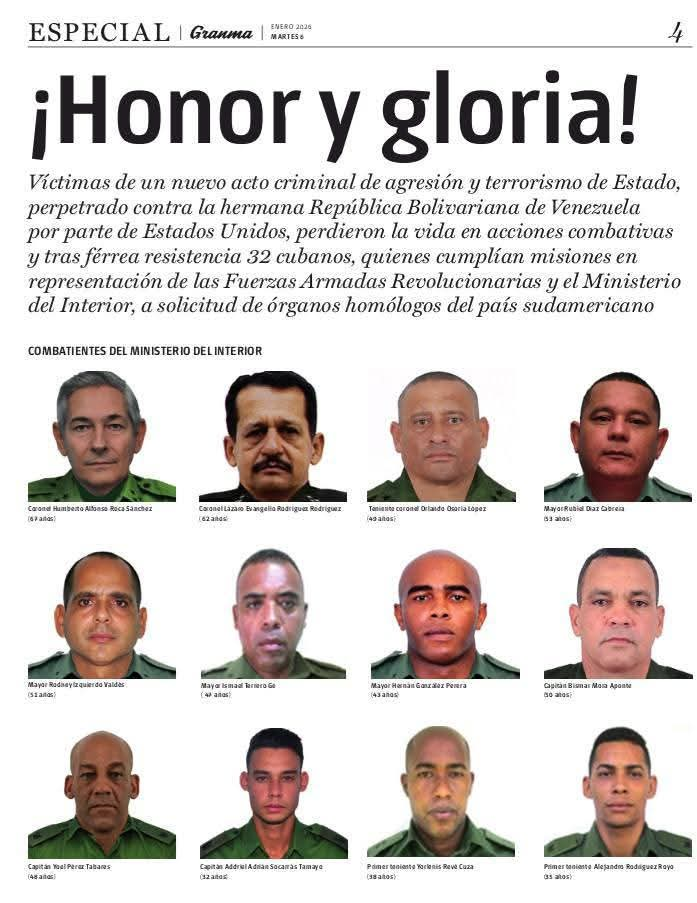 The official Cuban Communist Party newspaper releases the images of Cuban combatants killed in Venezuela after the U.S. raid to capture Maduro.
Image Credit: Daniel Lacalle via X
Cuba and Venezuela have also been close political allies; 32 Cuban soldiers and intelligence operatives were killed in the American capture of Maduro on January 3. Both Maduro and Chávez were protected by Cuban bodyguards, and integrated Cuban counter-intelligence into the Venezuelan military apparatus.
U.S. Secretary of State Marco Rubio, an outspoken critic of the Cuban regime, has long cited the debilitation of the Cuban government as a justification for regime change in Venezuela.
Now that Maduro is in American custody, a large number of prominent Republican politicians in the U.S. are escalating their combative rhetoric towards Cuba; in addition to Rubio and Trump, Florida Senator Rick Scott and South Carolina Senator Lindsey Graham have warned the current Cuban political establishment that its days in power are numbered.
Many thus speculate that a regime change operation in Cuba is imminent. However, an intervention by American forces on the ground in Cuba is likely to be met with resistance.
A functionary of the Cuban Foreign Ministry who wished to remain anonymous told Latin America Reports the following: “we stand with our people to the death and we will not surrender sovereignty to some warmongering empire. We will remain firm in our commitment to #PatriaoMuerte,” referring to the ‘Homeland or Death’ slogan of the Cuban revolution.
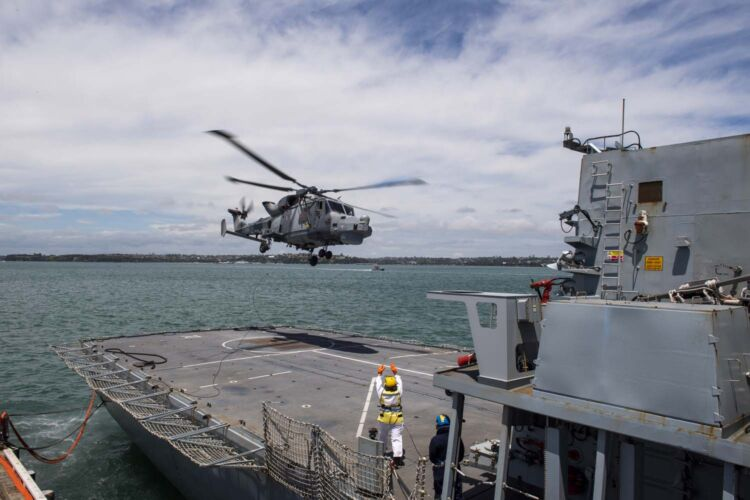
Featured Image: An American military helicopter lands on an American warship in the Caribbean; the U.S. has maintained a large military presence in the Caribbean for the last several months.
Image Credit: Gabrielle Aguirre via WorldBeyondWar
License: Creative Commons Licenses