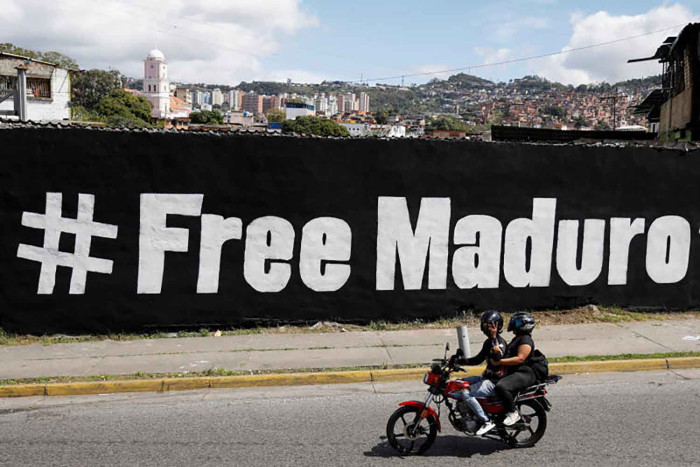
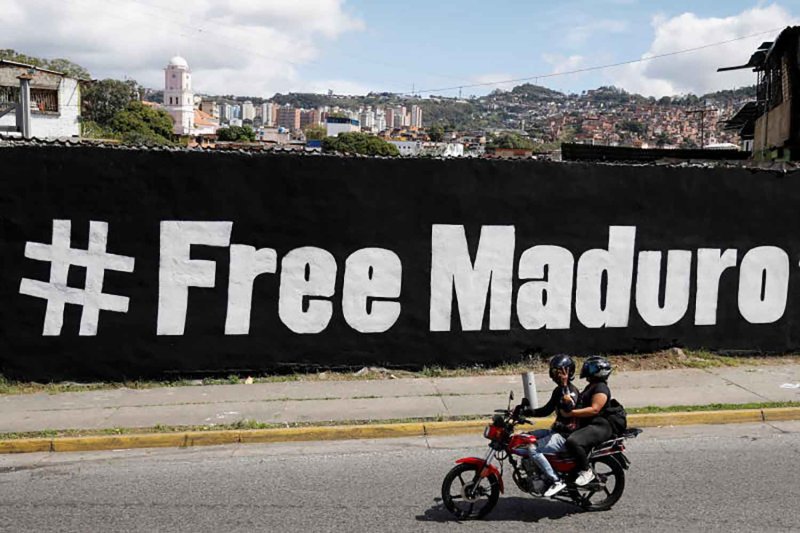
A motorcyclist passes in front of a mural that says “Free Maduro”, days after the U.S. launched a strike on Venezuela and captured its President Nicolas Maduro and his wife, Cilia Flores, in Caracas, Venezuela, January 11, 2026. REUTERS
The recent US military operation in Venezuela is unlikely to affect US-China trade negotiations and trigger a renewed trade war this year, as both nations are trying to maintain the negotiation framework until Nov 10, says an analyst.
However, in 2027 geopolitical and geoeconomic tensions will definitely intensify, said Sompop Manarungsan, an analyst focused on the US and Chinese economies and president of the Panyapiwat Institute of Management.
“The US military operation in Venezuela will further strain US-China relations, but the extent of the tension will depend on China’s response — whether it chooses to retaliate strongly or not,” he said.
“I do not believe China will respond in a way that jeopardises existing agreements. Instead, China is more likely to issue strong criticism.”
Mr Sompop said China is unlikely to retaliate harshly because Venezuela is not one of its principal trading partners in Latin America, such as Brazil, Argentina, Peru and Chile. Venezuela’s bilateral trade with China accounts for less than 0.12% of China’s annual total.
However, China still needs to react to the US’s actions in order to maintain its role in Latin America, he said.
US President Donald Trump is unwilling to allow China to expand its influence in the region, reaffirming the intent of the 1823 Monroe Doctrine, which aims to prevent outside powers from interfering in Latin America, regarded as the US’s “backyard”.
While the doctrine originally sought to block European influence, the Trump administration’s national security strategy has extended this stance to counter China’s economic expansion and Russia’s security involvement in Latin America.
In recent years, China has significantly expanded its trade and investment in Latin America. In 2025, China’s trade with Latin American countries tallied US$518 billion, up 6% year-on-year.
Meanwhile, US trade with Latin America excluding Mexico totalled only $365 billion, compared with more than $800 billion in trade with Mexico alone.
China recently financed a railway project linking Brazil to Peru’s newly developed Chancay Port, designed to transport commodities from Latin America to China.
According to Mr Sompop, the US fears two developments in particular: the expansion of China’s Belt and Road Initiative into Latin America, and the growing influence of BRICS in the region.
Venezuela has signalled its intention to join BRICS, while Argentina previously expressed an interest before withdrawing under its new right-wing government, leaving Brazil as the sole BRICS member from Latin America.
He said China will likely need to adjust its approach in response to the raid, as its interests in Venezuela are primarily economic, whereas Russia’s interests — particularly in Cuba and Nicaragua — are more political and security-focused.
“The US military operation is intended as a warning signal — a way of ‘killing the chicken to scare the monkeys’. The question is whether other countries in the region, such as Brazil, will be intimidated,” said Mr Sompop.
“It is unclear what the US can actually offer Latin America. If the US had truly provided more benefits than China, the region would likely not remain as underdeveloped as it is today. The US has done little to support Latin America’s political or economic development, despite the region being considered its own backyard.”
He said US-China trade tensions can still be managed this year as Trump hopes to secure gains ahead of midterm elections. But in 2027, tensions are likely to flare up again, said Mr Sompop.
“In 2027, both geopolitical and geoeconomic pressures are expected to intensify, including in the Taiwan Strait and disputes between Japan and China. If Trump wins the midterm elections, he is likely to feel emboldened because US agreements with China on tariffs and rare earth elements are for one year only,” he said.
“Trump faces a relatively high risk of losing the lower house, while the upper house may only be won by a very narrow margin of one or two seats — a scenario that deeply concerns him as it could hinder governance in the latter half of his term.”
According to Mr Sompop, although the US economy has improved, its recovery resembles a K-shaped pattern: wealthier groups and stock market investors benefit, while lower-income earners see little improvement in their economic conditions.