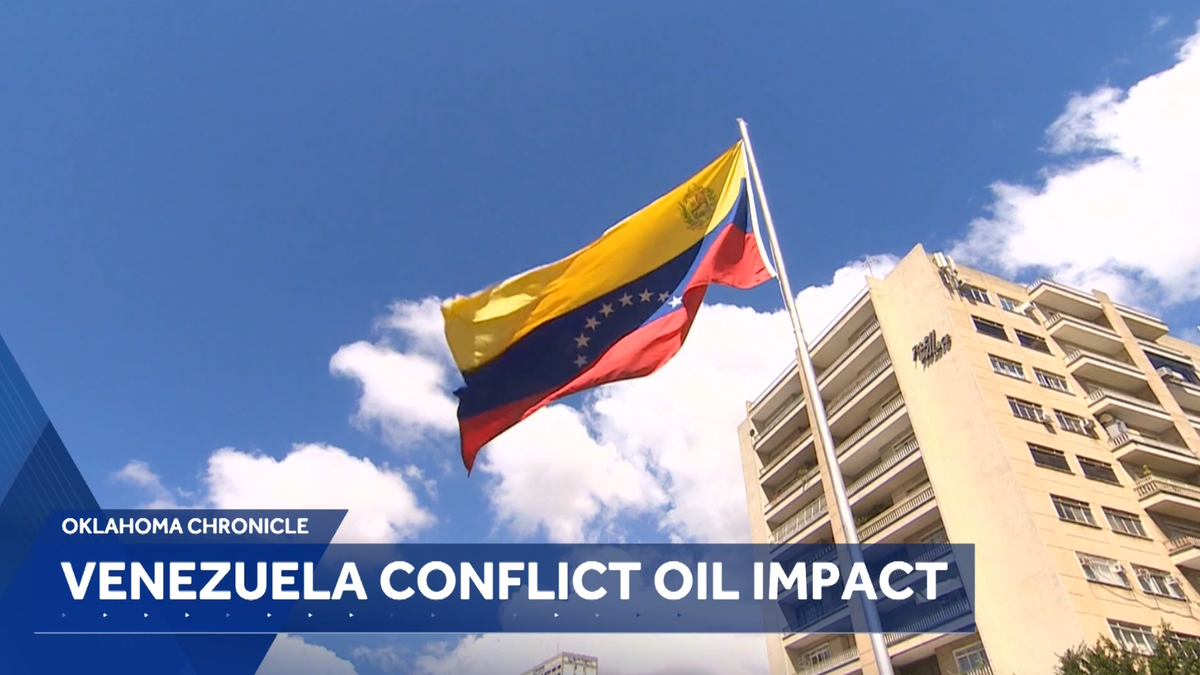
Oklahoma Chronicle: How will mission in Venezuela impact Oklahoma’s oil and gas industry?
Venezuelan oil in the headlines this week after last weekend’s military action and the arrest of Nicolas Maduro. President Donald Trump says the US will be in effect in control of what happens next with Venezuelan oil. So what impact could this have on Oklahomans and specifically Oklahoma’s oil and gas industry? I am joined this. Week by two guests, both of them experts on Oklahoma energy. I have Brooke Simmons with me, the president of the Petroleum Alliance of Oklahoma, *** trade association representing every aspect of our state’s oil and natural gas industry. Thanks so much for being here, Brooke. Happy to be here. Thanks very much, Evan. Absolutely. And also with us today, Steve Agee, an energy industry expert who we speak to *** lot here on. OCO, *** professor at Oklahoma City University and the former dean of the Minder School of Business, Steve, good to see you. Thank you. Thanks for having me. We appreciate it, Brooke. I’ll start with you on just the overall question here. You know, with Venezuelan oil and perhaps with an influx of new oil hitting, hitting the market, is this going to have an impact, do you think, on the Oklahoma energy industry? Evan, not immediately. I think that, uh, you know, Venezuela right now accounts for less than 1% of the total global energy production. Um, the barrels that Venezuela produces, less than *** million barrels *** day are already accounted for. It’s an OPEC country, so we don’t necessarily anticipate any sort of immediate near term impact on Oklahoma oil producers. Less than *** million barrels *** day, can you put that into context for people who don’t know how much countries are putting out there? So, um, well, I’ll say that that’s *** little bit about, uh, probably twice the amount of oil that. Oklahoma produces on *** daily basis. OK, so that said, Venezuela has 303 billion barrels of crude reserves. So, so it could end up having an impact. And, and, and Steve, I know that the two of you really agree on the perhaps lack of immediate impact when it comes to the Oklahoma jobs, how the decisions that some of these companies, when you saw that this oil industry in Venezuela is now suddenly in play. What were your immediate thoughts on the impact that it could have here but also everywhere? Well, like Brooke, I don’t think it’s going to have any kind of immediate impact because as he mentioned, they produce less than *** million barrels *** day. Now the world consumes about 100 million barrels *** day. So as Brooke said, it’s less than 1% of what we consume on *** daily basis in the world. Uh, so it’s kind of *** minor amount, but as an economist we look at the margin. Every additional barrel is important, and so it’s probably going to take years for this infrastructure to be upgraded and improved and maintained and new wells brought online before we see any kind of impact on on world supply of oil coming out of Venezuela. Well, and I know that you know you guys both talked to the people who make these decisions, these investment decisions, but you know you’re talking about *** lot of money. You were saying that some of the estimates you believe might even below to the type of numbers that they’re throwing around right now. So I’ve heard, uh, you know, figures ranging from $100 billion of infrastructure improvements necessary to $180 billion of infrastructure improvements necessary just to get Venezuela back to where it was before. For that for that 1st 500,000 barrels of extra Venezuelan production, that’s *** that’s *** long ways away from where we are today and with all the uncertainty and we’re not getting into geopolitics here, that’s that’s not the discussion that we that we want to have they could they could talk about that on the previous program here here on this channel, but you know there is uncertainty surrounding all of this right now and I know these giant corporations, including corporations here in Oklahoma that make decisions. They don’t like uncertainty, and I know either one of you could probably talk on that. Well, that’s the market doesn’t like uncertainty and so the oil executives don’t like uncertainty, and they are going to have *** big meeting apparently in the White House tomorrow with some of the big oil executives, right? We’re speaking on Thursday, by the way. You’re watching this Sunday, but we’re speaking on Thursday. It’s all right, so we’ll know by then what’s happened, but. It’s gonna be interesting to see because there’s so many dynamics involved, uh, the safety of people going into Venezuela to upgrade the production to do the little things in the field that need to be done to increase the production. You know, safety is going to be *** factor. The regime has not changed. I mean we’ve got Maduro out of there, which is *** good thing, but everybody else is still in place. The military that was in charge is still in place. The vice president is still in place, and I know we don’t want to talk about the politics, but that’s the reality is they’re still there. Something’s going to have to happen with regard to that. Before we could send anybody in from the industry to either drill new wells or to enhance the existing production or build new pipelines and infrastructure, I mean the oil industry is extraordinary complex business and you’ve got compressors and generators and dehydrators and pumping units and all sorts of field equipment that probably have not been maintained. That’s why they’re. Production has dropped off over the last 25 years. You know, it’s interesting, Brooke, you brought up *** really interesting point about the timing of this and where Oklahoma and the rest of the industry is now with our ability to produce oil and you know, the shale revolution and so many things that you said if this would have happened and as you pointed out, it kind of did happen 20 years ago, it would have had *** much larger impact. Two Oklahomans here. Yes, as *** matter of fact, if you go back in time, you don’t have to go back to 2002 or 2003 prior to the shale revolution to see what the impact was when Chavez took action against the oil company there for the general strike. Oil prices doubled at that point. We were right on the eve of the Iraq invasion of 2003, and there was *** lot of concern about whether Venezuela was going to be able to. Serve the Gulf Coast refineries where we’re going to not have that extra heavy sour crude that the Gulf Coast refineries are tuned for because it is *** heavy crude that comes out of Venezuela. How does that compare to the oil that comes out here in Oklahoma and and in the surrounding areas? It’s *** heavier crude. It does have some H2S so when he mentioned sour, it has some things that they’re going to have to take out of that. But the refineries, as Brooke mentioned in in the southeast part or, you know, along the Gulf Coast, they, they handle this kind of oil. They know how to deal with it, so they’re set up for that. uh, crude oil here in the mid-continent is much lighter oil. It’s what we call *** sweet crude. Uh, and so it’s priced *** little bit differently. Sweet, not sour. It’s *** sweet, sweet crude we call it, not *** sour, yeah, and it’s not as heavy. It’s got, it’s got *** higher gravity to it, which means it’s kind of thinner. It’s not as thick. And we do *** lot of our exporting of light sweet crude to Europe and the Asia Pacific region. OK, you know, it’s an interesting time that we’re having this conversation because oil is actually, it’s low price, lower than it has been. I filled up it on cue this week for 199. I can’t tell you the last time I had done that. And so the fact that perhaps more, I know you’re saying. You know, limit your expectations on the impact it could have, but is this the time to be adding millions more barrels of oil into the, into the market? Steve, if that were to happen now, that would be *** huge problem for who? For the consumer or for the industry? No, for the industry. So and I’m glad you mentioned that because. As we increase supplies of oil, typically that means we have more gasoline that’s been refined, more diesel, more jet fuel, so the consumers of these byproducts are going to benefit from that. So when you go and fill your tank with $1.93 gasoline, that’s *** good thing for the consumer. The producer, on the other hand, when they see that increased supply, it’s going to drive the price of crude oil down, and that’s their main revenue resource, crude oil and natural gas. I would like to point out that even prior to the Maduro arrest, the world is already oversupplied with crude oil. As *** matter of fact, we estimate about *** million barrels are going to have to come off the market to have *** rebalancing. Now you hear the US talking about us controlling that 30 to 50 million barrels of oil from Venezuela. That’s stuff that’s already been accounted for in in on the world market. That’s oil that’s on storage on land or floating storage. So that’s going to serve the US Gulf Coast refineries, but long term Oklahoma producers must compete against. In *** global marketplace against other producers, so it will have an impact long term. All right, we have just 30 seconds left really quick. What is the next thing, Brooke, that you are going to be looking for when it comes to the story and the developments and how it applies to us here? I think it’d be really interesting to see what kind of guarantees on the security side, what kind of guarantees on the profit side of the companies that may be considering going back into Venezuela are going to require if the US wants to make *** real big dent in the. Those US companies back, it’ll create an opportunity, *** structure for them to make *** profit, and I think that’s going to be really interesting to see how that develops over the next few weeks. I, I, I, I got 10 seconds for you. I’m anxious to see which companies are going to do it. So if they’re got this speeding, we’re going to learn who’s in and who’s out, who’s really anxious to get into Venezuela now, and it’s going to be the big companies, the Chevrons, the ExxonMobils, because it’s going to take *** lot of money. It’s going to take *** big corporation to do it, gentlemen. It’s *** moving situation. I appreciate you stepping in. lending us your expert takes and, and we really do appreciate the time.
Oklahoma Chronicle: How will mission in Venezuela impact Oklahoma’s oil and gas industry?

The Trump administration says it is now in control of Venezuela’s oil industry, but what does that mean for Oklahomans and the state’s oil and gas industry? On the latest edition of Oklahoma Chronicle with Evan Onstot, we speak with Brook Simmons, the president of the Petroleum Alliance of Oklahoma, and Steve Agee, with the Meinders School of Business at Oklahoma City University, about the impact on Oklahoma. Open the video player above to watch their discussion.
The Trump administration says it is now in control of Venezuela’s oil industry, but what does that mean for Oklahomans and the state’s oil and gas industry?
On the latest edition of Oklahoma Chronicle with Evan Onstot, we speak with Brook Simmons, the president of the Petroleum Alliance of Oklahoma, and Steve Agee, with the Meinders School of Business at Oklahoma City University, about the impact on Oklahoma.
Open the video player above to watch their discussion.