January 12, 2026
JAKARTA – Symbolism, ritual and theater play an important part in politics.
Under a democracy, the military parades, televised state of the nation address and construction of statues and monuments are the glue that binds the nation together, if not devices deployed to shore up the state.
In an authoritarian society, rituals and theater are imposed upon the masses, mostly with the threat of violence in the background, to instill fear and submission.
In both of these cases, rituals are means to political ends.
But in some places or regions a unique case emerges, an anomaly identified by the United States anthropologist Clifford Geertz as a “theater state”, a seminal concept he introduced in his now-classic 1980 book Negara, the Theatre State in Nineteenth-Century Bali.
In the early chapters of the book, Geertz argued that “the nature of Balinese state was always pointed not toward tyranny, whose systematic concentration of power it was incompetent to effect and not even very methodically toward government, which it pursued indifferently and hesitantly, but rather toward spectacle, toward ceremony”.
Geertz proposes that for the Balinese, and other societies in Southeast Asia, rituals were the ends themselves and that the state at the end of the day, in his own words: “even in its final gasp, was the device for the enactment of mass ritual. Power served pomp, not pomp power.”
It is certainly disingenuous for us to submit the idea that Indonesia, for most of its post-independence history, could have been a theater state.
The state, after all, has had the capacity to lift millions out of poverty, provide healthcare for many and as recently construct much-needed infrastructure.
But interspersed between few stories of material progress and bureaucratic competence are many tales of demagoguery, of political leaders who revel in rousing the crowd, building monuments and performing rituals rather than conducting real bureaucratic and administrative duties of actually running the government.
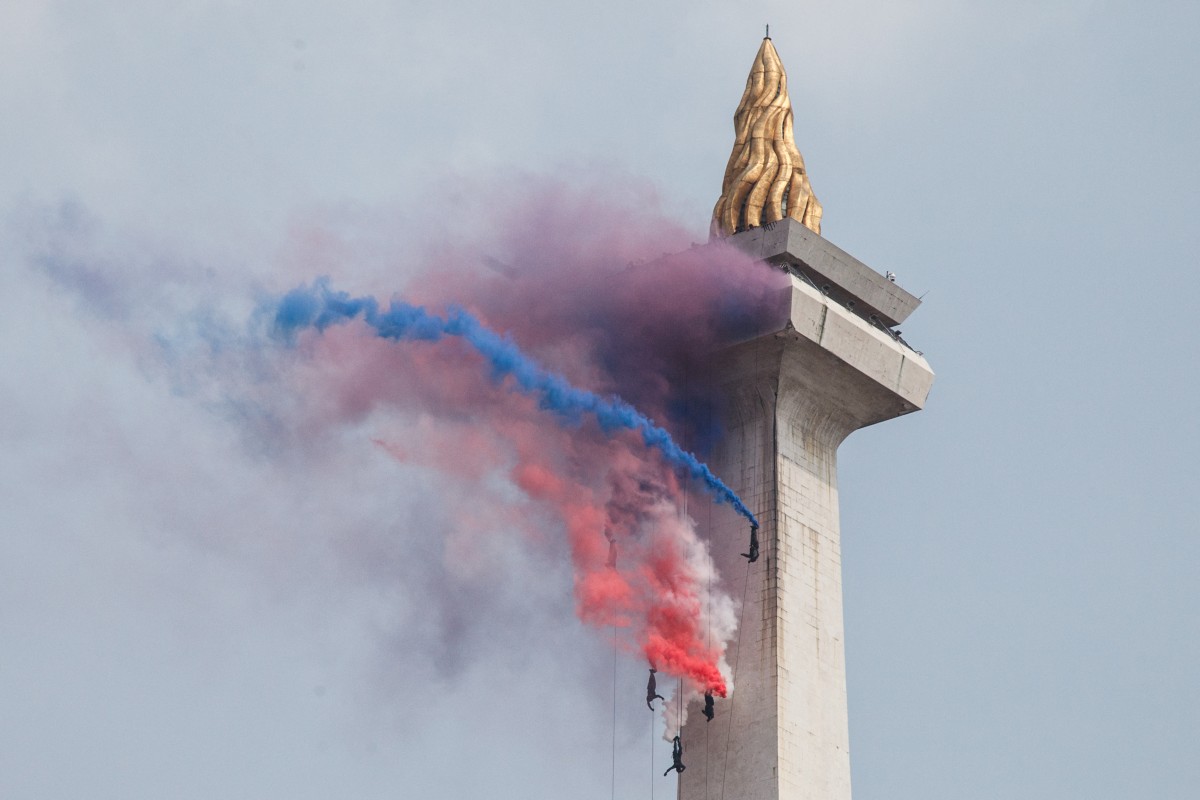
In the sixties, as the country’s economy was on the verge of collapse, and his anti-imperialist agenda faced serious pushback from Western powers, then president Sukarno perfected the ritual of holding a court, staging mass rallies and building massive monuments.
A charismatic orator, Sukarno would deliver lengthy speeches on multiple subjects but mostly on the theme of national unity and anti-colonialism.
In the late 1950s and early 1960s, scant economic resources were allocated for the erection of impressive buildings, monuments and statues that to this day become the landmarks of the capital city of Jakarta.
At the peak of his power, Sukarno concentrated so much power, yet he appeared to have less interest in governing the country and had only been interested in its spectacle.
Sukarno’s predecessor, General Soeharto may have begun his time in office as a benign and technocratic leader, but as soon as his authoritarian impulses started taking over, he began establishing rules and rituals that would soon serve as a foundation for his autocratic rule.
General elections were a five-year ritual with a predetermined outcome, whereas the convening of the People’s Consultative Assembly (MPR) would inevitably end with the renewal of Soeharto’s five-year terms.
New monuments, statues and rituals were set up mostly to shore up his regime’s anti-communist agenda.
Soeharto had also been a proper authoritarian leader, someone who ruthlessly and methodically used the power he concentrated to pursue a developmentalist agenda, with or without pomp and pageantry.
Indonesia’s post-New Order leaders have mostly been technocratic. Figures from early Reform Era period like B.J. Habibie, Megawati Soekarnoputri and even Joko “Jokowi” Widodo focussed on the pressing issues of the day, from enacting democratic reforms, salvaging Indonesia’s flagging economy and to handling the tedious task of building bridges and roads.
President Prabowo Subianto may have begun a break from the trend.
From his fixation on number “8” to his penchant for holding elaborate military parades, or delivering a speech in front of stacks of cash seized from graft suspects, we now know that pomp and symbolism is now back to full throttle.
And now, after one year of political crisis and natural disasters, we can now legitimately ask whether theater has now taken precedence over some technocratic approach to governing.
The first major test to Prabowo’s technocratic mettle came in March last year, when United States President Donald Trump slapped 32 percent tariffs on Indonesian exports to the country.
His response was theater.
Prabowo’s swift response to the economic threat had been to hold a televised court in which he touted Indonesia’s economic resilience in the face of global economic headwinds.
Yet, despite this pledge of economic nationalism, participants in the meeting came away with a pledge from the President that he would dismantle the local content rule (TKDN) that had become the country’s bone of contention with the US. Later, the President also made a commitment to purchase Boeing commercial aircraft from the US.
Fast-forward nine months, trade talks between Indonesia and the US are on the brink.
A threat from US trade officials that ongoing trade negotiations could collapse should be enough of an indication that public statements made by the President are not necessarily translated into action.
Again, in the response toward the overwhelming flooding in North Sumatra and Aceh, the President’s first instinct had been to resort to symbolism and rituals, from holding a series of meetings in which he developed ideas with key members of his cabinet to landing his presidential plane in Aceh en route to Pakistan as a show of solidarity to those perished and displaced by the natural disaster.
All the symbolism would certainly carry more meaning if the actual work of handling the natural disaster succeeds in supporting victims of the flooding and landslides.
But the anger and despair over the chaotic and slow pace of relief and reconstruction efforts in Aceh and North Sumatra may be the symptom of a larger problem of ineffectual governance.
We can certainly demand the administration of President Prabowo to do better in dealing with crisis, especially this year, which are expected to only worsen.
But judging from the performance so far, we can ask a more relevant question; what if all the pageantry, the talk show and televised ritual, is actually the point.