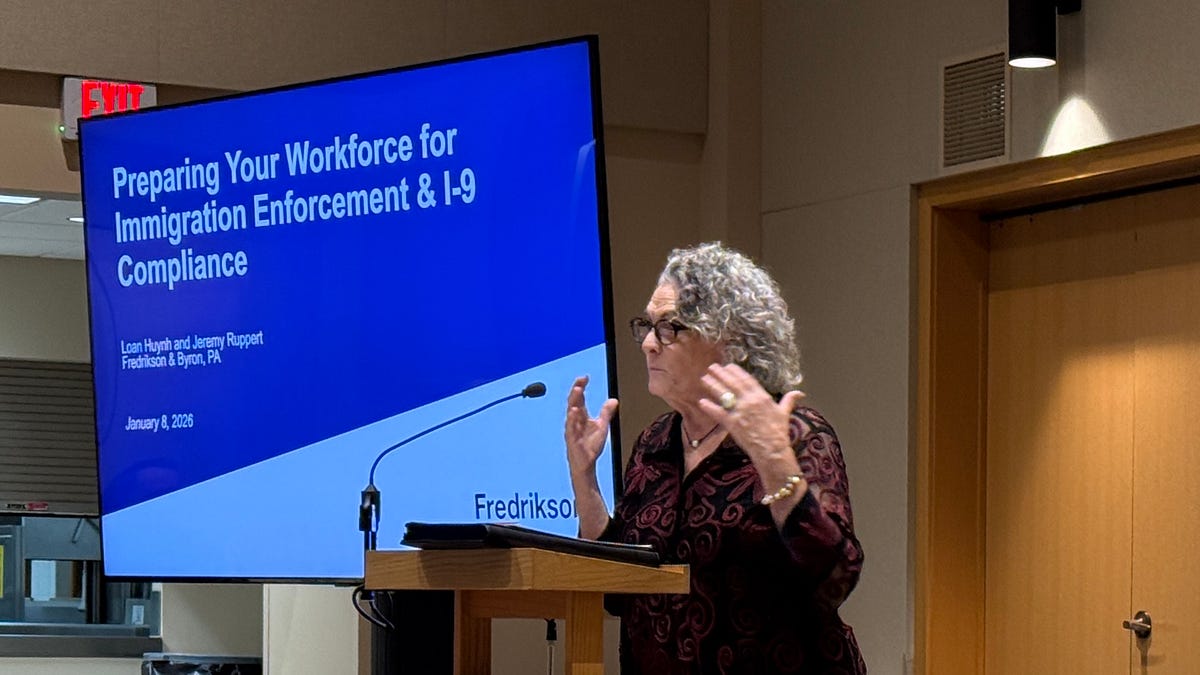
I attended last Thursday’s “Protecting Your Workforce from Immigration Enforcement” training at St. John’s Lutheran Church here in Northfield. About 75 people showed up, roughly a third of them small business owners.
The session, put together by the Northfield Chamber of Commerce, the Northfield Rotary Club, and the City of Northfield’s Human Rights Commission, featured immigration attorneys Loan Huynh and Jeremy Ruppert from Fredrikson & Byron, who walked attendees through the basics: what immigration enforcement actually looks like, how to prepare for it, and how to handle I-9 employment verification and inspections. Retired local attorney Gina Washburn moderated.
Below are the video and documents shared at the session, plus an AI-assisted topic outline to help guide you to the parts you need.
(Nothing here is legal advice; use it as a starting point and consult an attorney for guidance on your specific situation.)


 Moderator Gina Washburn with immigration attorneys Loan Huynh and Jeremy Ruppert at St. John’s Lutheran Church in Northfield
Note: This outline is meant as a navigation aid for the video. It paraphrases what was discussed and may miss nuance. It’s not legal advice.
Ground rules + format: Moderator Gina Washburn frames the session as intensive legal training and sets expectations about phone use and recording.
Why this was organized: The speakers connect the training to recent visits by Homeland Security agents to local businesses and the need for employers to be prepared—especially around I-9 employment verification.
Local support + alerting: The session mentions Northfield Supporting Neighbors (NSN) and its legal-fund/rapid-alert system for reporting ICE activity in town.
Who does what: A quick primer on DHS, ICE, USCIS, and CBP and how their roles differ.
More inter-agency coordination: The speakers describe a trend toward broader collaboration across agencies—including some that are usually benefits-focused (like USCIS).
Expedited removal: They discuss expedited removal and how it can be used in certain situations—highlighting the significance of documentation and proof of time in the U.S.
Recent enforcement activity: They point to increased federal activity in Minnesota, reference Operation Twin Shield, and note a rise in I-9 audits.
Build an “enforcement action plan”: Suggested steps include written policies, naming internal decision-makers, and a call tree that includes legal counsel.
Public vs. private spaces at work: The speakers emphasize clearly marking and physically defining private areas (e.g., offices, kitchens) so staff know what areas are restricted.
Warrants: They distinguish administrative warrants from judicial warrants, and discuss why that difference matters for access to private areas.
Frontline scripts: They share practical “first contact” language for reception/frontline staff—verify identity/credentials, direct agents to a designated point person, and request that counsel be present.
“Harboring” discussion: They describe what can cross the line into harboring/shielding—focusing on affirmative acts meant to prevent someone from being found.
Stops and questioning: They talk about standards used during stops, including a “totality of circumstances” approach (their phrasing).
Documentation to have available: They mention the value of having key status/identity documentation accessible in case of an encounter.
Family planning: They encourage families to have contingency plans (communication plans, guardianship arrangements) in case someone is detained.
Form I-9 basics: Employer obligations for verifying identity and work eligibility for new hires.
Notice of Inspection: What an audit can look like and what employers may be asked to produce (including the common “three business days” timeline discussed).
Internal audits + corrections: Suggested compliance practices, including how to correct forms in a way that shows good-faith effort.
Document retention: Pros/cons of keeping copies of supporting documents, including how copies may help address technical violations.

Official Slidedeck Preparing Your Workforce For Immigration Enforcement Ensuring I 9 Compliance City Of Northfield Presentation (01
2.17MB ∙ PDF file
Other event-related documents on the City of Northfield Immigration event page:
Thanks to the Northfield Chamber of Commerce and Tourism, the Rotary Club of Northfield, and the City of Northfield Human Rights Commission for sponsoring this training and making the materials publicly available. Also thanks to St. John’s Lutheran Church for hosting it and to retired local attorney Gina Washburn for her organizing and moderating.
Thanks for reading Northfield.org! This post is public. Please share it with others who might be interested.
See the latest Northfield.org posts in the archive.