Posted on December, 10 2025
European central banks are among the leaders in tackling climate-related financial risks, but key drivers of nature-related risk remain insufficiently addressed in financial regulation and supervision, according to a new WWF assessment.
With only five years to deliver on global 2030 climate, nature, and development goals, decisive regulatory action is essential to guide the financial sector toward a net-zero, nature-positive, and socially equitable future.
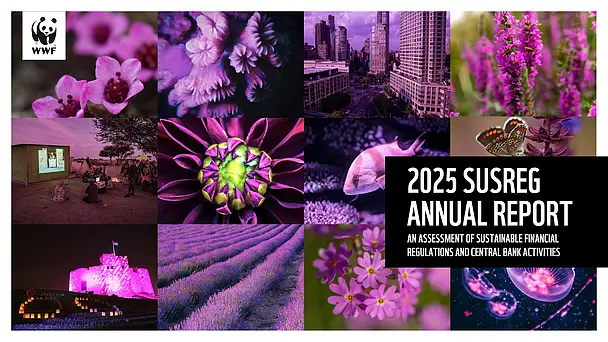
The fifth edition of WWF´s Sustainable Financial Regulations and Central Bank Activities Assessment 2025 (SUSREG 2025) evaluates how climate, nature and social risks are being integrated into central banking, financial regulation and supervision.
Siti Kholifatul Rizkiah, WWF SUSREG Lead, said: “We must take a genuinely precautionary approach to climate and nature risks. The consequences of inaction will far outweigh the costs of early intervention. The financial system can no longer pretend that environmentally harmful assets are low risk when the evidence proves otherwise. Taking decisive action now is not only a strategic business imperative but also a key to unlocking the emerging green opportunities and safeguarding future economic prosperity.”
SUSREG 2025 clearly demonstrates that progress is possible and already happening. In Europe, some central banks and financial regulators are leading examples of strong supervisory follow-up and notable progress in aligning industries with their expectations.
“With a 59% alignment score on the climate assessment, the EU stands out, thanks to the ECB’s new progressive initiatives, such as the introduction of the climate factor in its collateral framework. In addition, within the last year, the ECB published its first-ever nature loss indicator in its financial disclosures. These are critical steps towards addressing systemic risks,” said Dominyka Nachajute, Sustainable Finance Policy Officer at WWF European Policy Office.
The Hungarian Central Bank (MNB) has also expanded its climate-related financial disclosures to cover ecosystem and biodiversity risks, using the WWF’s Risk Filter Suite to assess such risks.
The report also identifies several important areas where further action is needed. Major drivers of nature risk, such as land, freshwater and sea use change; climate change; and the direct exploitation and pollution of terrestrial, freshwater and marine ecosystems, remain largely absent from financial regulation, leaving systemic vulnerabilities unaddressed. Integration of climate and nature risks into both monetary and macroprudential frameworks remains weak.
To address these gaps, the report outlines clear, actionable steps for financial authorities:
Strengthen the integration of nature into central banking and financial supervision by embedding it in monetary policy tools and setting concrete expectations for financial institutions;
Deploy the macro-prudential toolkit, including stress tests, capital buffers and exposure limits to prevent and monitor system-wide climate and nature risks;
Reinforce disclosure and transition plans for companies and financial institutions to ensure transparency and accountability;
Make environmentally harmful assets more expensive in capital rules to reflect their true risks;
Mobilise green and transition finance, framing sustainable finance as a core opportunity for the financial sector; and
Improve national and international coordination by creating green finance committees and cross-border platforms for knowledge-sharing and capacity-building.
Read the report here and the executive summary here.
Notes to the editor
WWF SUSREG Assessment
In 2021, WWF launched the first Sustainable Financial Regulations and Central Bank Activities (SUSREG) assessment to evaluate how environmental and social risks are integrated in regulatory and supervisory practices, as well as in central banking and other financial activities that support the redirection of financial flows towards more sustainable practices. The aim of the assessment is to help central banks and financial supervisors benchmark their policies against emerging regional and global good practices with the overall goal of redirecting financial flows toward sustainable practices, and moving away lending, underwriting and investment from the most environmentally harmful businesses and sectors, in support of a net zero, nature positive economy. Countries assessed are mostly members and observers of the Basel Committee on Banking Supervision (BCBS), the International Association of Insurance Supervisors (IAIS), and the Network of Central Banks and Supervisors for Greening the Financial System (NGFS). Assessments are published on a yearly basis, with an accompanying annual report.
This year’s assessment covers 50 jurisdictions for central banking, 46 for insurance, and 12 for capital markets – representing over 89% of global GDP and 75% of global emissions. It broadens its scope, adding capital markets to the assessment and introducing a new thematic focus on deforestation, freshwater, and ocean health, underscoring the increasing relevance of nature-related risks and the threat of nearing ecosystem tipping point collapse for financial stability.
Please visit WWF´s SUSREG Tracker online platform for individual country results: http://susreg.panda.org/
WWF´s Greening Financial Regulation Initiative (GFRI)
WWF´s Greening Financial Regulation Initiative seeks to put climate and environmental risk at the heart of the financial system. Through this initiative, WWF wants to evidence the link between financial risks and environmental risks like climate change, water scarcity and biodiversity decline, and engage policy makers, central banks and financial supervisors on the need to integrate those risks into their mandates and operations. In doing so, WWF provides the necessary tools, scientific research, assessments, and assistance to help enhance ambitions on the sustainable finance global policy agenda.
More information: www.panda.org/gfr