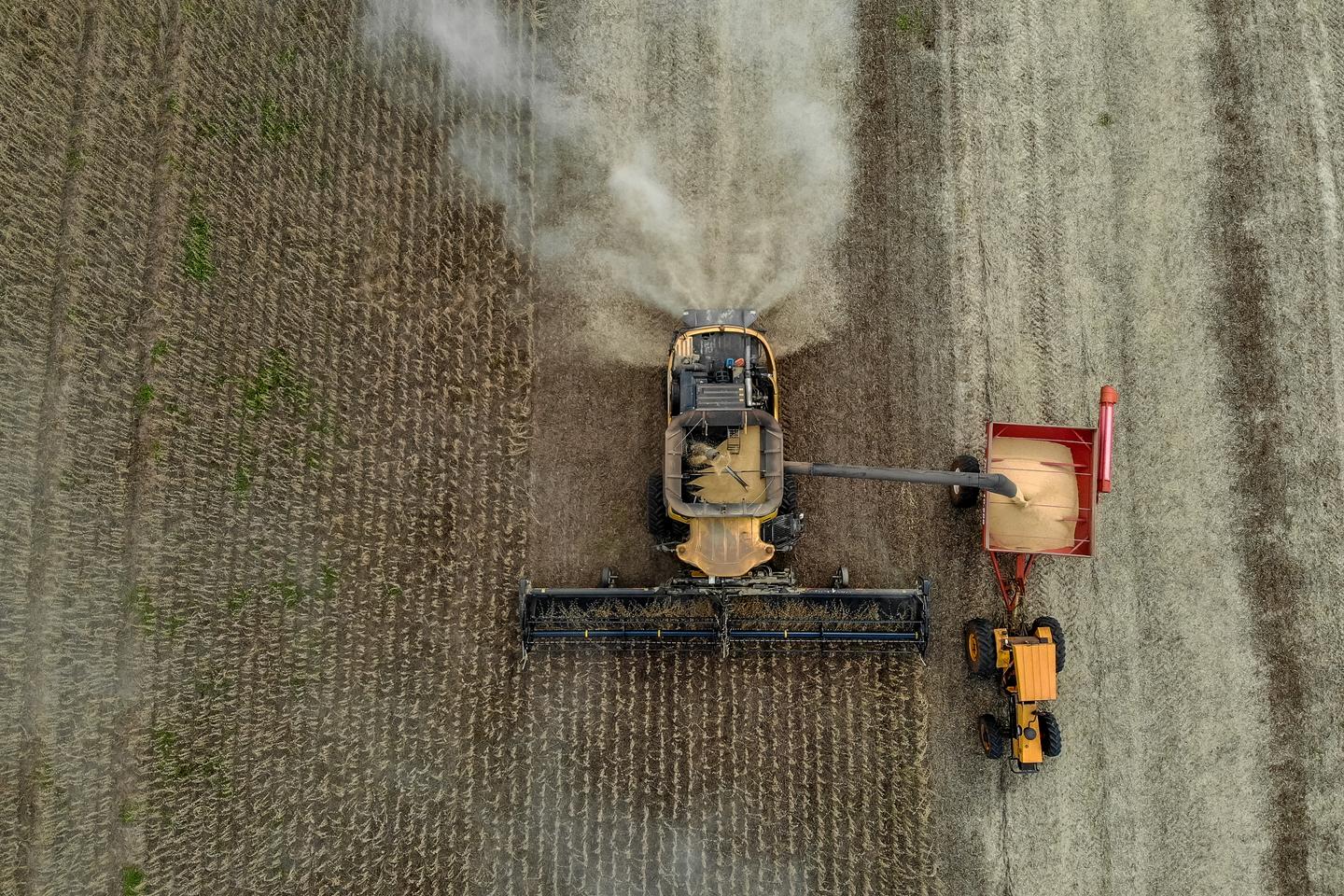
 A combine harvester gathers soybeans in Salto do Jacuí, Brazil, on April 5, 2021. SILVIO AVILA/AFP
As the world’s leading exporter of soybeans, orange juice and beef, representing 56%, 76% and 24% of total global exports respectively, since the 2000s Brazil has established itself as an agricultural superpower. Yet these figures have come more as a result of technical solutions than of the country’s abundant natural resources.
In the early 1970s, Brazil was a net food importer, with more than 60% of Brazilian families experiencing a calorie deficit. In 1973, the country’s military regime, which was determined to make the agricultural sector into a cornerstone of its “economic miracle,” created the Brazilian Agricultural Research Corporation (Embrapa), which is still active. Embrapa was tasked with developing plant species adapted to tropical climates, to enable large-scale food production. This led Brazil’s to gain globally recognized expertise in the development of genetically modified organisms (GMOs), ranging from corn to livestock.
“Today, in the field of tropical cattle genetics, we are the undisputed leaders. We are the only country in this part of the world producing food on such a large scale,” said Bento Mineiro, international relations director for the Brazilian Zebu Breeders Association (ABCZ).
You have 72.45% of this article left to read. The rest is for subscribers only.