
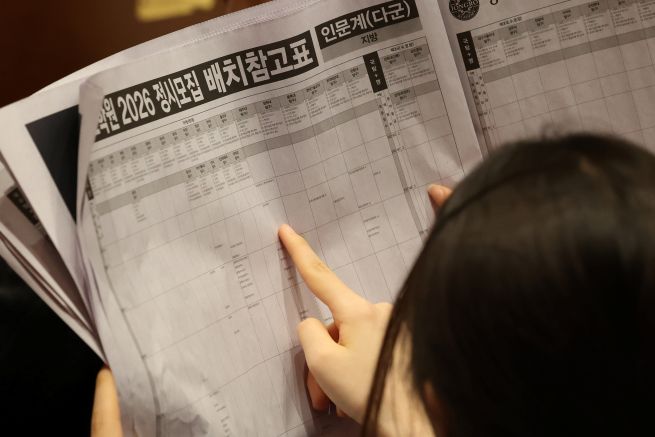
A student looks over a placement reference chart for regular admissions. The chart summarizes, at a glance, universities and majors where admission is likely based on CSAT score ranges. (Yonhap)
SEOUL, Jan. 12 (Korea Bizwire) — Applications to artificial intelligence–related majors surged in South Korea’s 2026 regular university admissions cycle, underscoring the growing perception of AI as a gateway to future employment and industrial relevance.
According to an analysis released Monday by Jongro Academy, the number of applicants to AI-related departments at 20 leading universities rose 16 percent from a year earlier, reaching 4,896 students.
Demand increased across both science and humanities tracks, with applications from science-track students climbing 17.3 percent and those from humanities-track applicants up 7.7 percent.
Competition was especially fierce at top institutions. Sogang University’s AI-Based Liberal Engineering program saw the largest numerical increase, with 185 more applicants than last year.
The program attracted 1,000 applicants for just 35 seats, yielding a competition ratio of 28.6 to 1. The highest overall competition rate was recorded at the University of Seoul’s Advanced Artificial Intelligence major, where 108 students applied for three openings, a ratio of 36 to 1.

Demand for AI Programs Jumps as Students Bet on Future Jobs (Yonhap)
Other highly competitive programs included Sejong University’s AI-Converged Electronic Engineering, Kookmin University’s AI and Big Data Convergence Management, and Hankuk University of Foreign Studies’ Language and AI Convergence division.
Among humanities-focused programs, Ewha Womans University’s Artificial Intelligence Data Science division posted the highest competition rate, at 15.8 to 1.
The surge was not limited to Seoul. Applications rose 12.6 percent at universities in the capital, nearly 50 percent in the greater Seoul metropolitan area, and close to 30 percent at regional universities.
Kyungpook National University’s AI-focused electronic engineering program recorded the highest competition rate outside the capital and the largest year-on-year increase in applicants among regional schools.
Education analysts attributed the trend to students’ belief that AI-related degrees offer a strategic advantage in the job market, amid sustained government support for the sector and intensifying global competition in artificial intelligence.
With universities continuing to expand enrollment in AI disciplines, competition among institutions — and among applicants — is expected to grow even sharper in the coming years.
Lina Jang (linajang@koreabizwire.com)