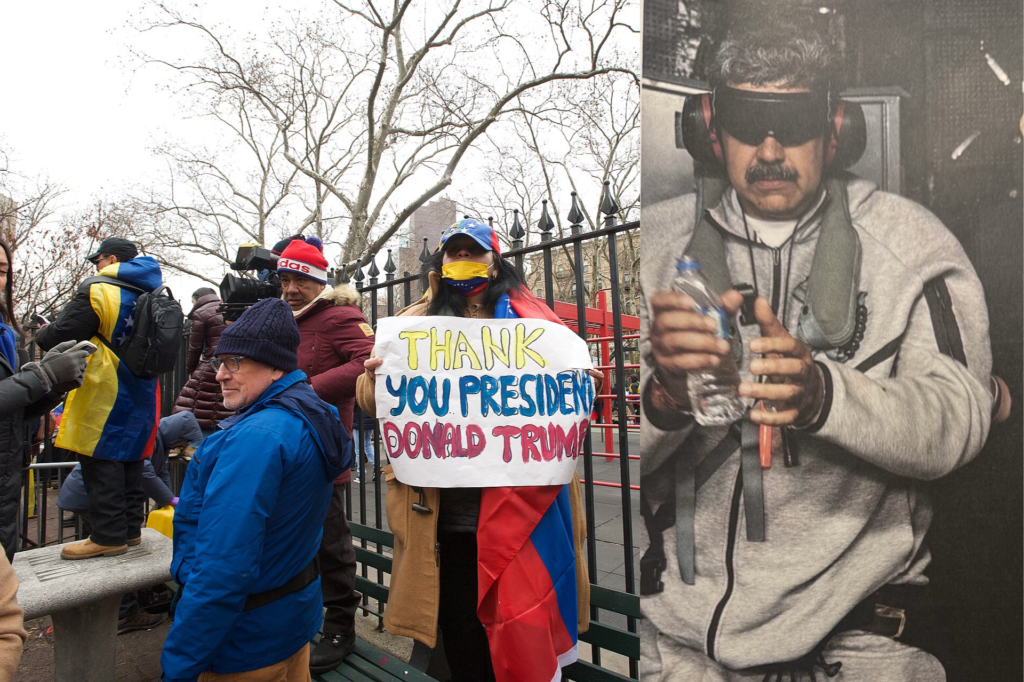
It’s been just over a week since U.S. President Donald Trump ordered the military capture and trial of Venezuelan dictator Nicolás Maduro and his wife. The stunning late-night operation on Jan. 3 was welcome news to millions of Venezuelans who have fled their home country over the last two decades, leaving it to descend into corruption and impoverishment, despite controlling the biggest oil reserves on the planet.
Among the estimated eight million Venezeulans who left, tens of thousands are Jewish. They faced additional pressure to escape: the regime was strongly anti-Israel, supporting Iran and Hezbollah, which led to the harassment of the local Jewish community. It’s a stance first adopted by Maduro’s predecessor, the late former president Hugo Chavez, in 2006.
While Maduro now faces drug and racketeering charges in New York City, the uncertainty about what happens next has kept Venezuelans confined to their homes, with schools temporarily closed and paramilitary forces patrolling the streets. Some political prisoners are being released, in a gesture of goodwill by Maduro’s replacement, while President Trump is vowing to bring billions in investment to revamp Venezuela’s oil production. While some Venezuelans say they have great hope now that Maduro is gone, others think restoring democracy is still a long way off.
On today’s episode of The CJN’s flagship North Star podcast, we hear reaction and analysis from three Venezuelan Jews who have made their homes in Canada. Jonathan Rosemberg Kort and Rebecca Sarfatti join from Toronto, while Daniel Topel joins from Ladner, B.C., south of Vancouver.
Transcript
Ellin Bessner: The sound of Venezuelans living in Canada singing their native country’s patriotic songs this past week during rallies in Montreal to welcome the news that American troops captured dictator Nicolas Maduro and his wife on January 3rd in a series of early morning raids in Caracas, where he was bundled onto a waiting U.S. warship, then flown to New York City to face drug and racketeering charges.
The US President, Donald Trump, says America will be running Venezuela for a while, while he tries to convince oil companies to invest billions to reboot Venezuela’s oil patch. But there’s so much uncertainty with Maduro gone. His deputies are still in power. Paramilitaries were seen roaming the streets, rounding up journalists and foreigners. And it’s unclear whether Trump’s operation was even legal under international law.
But what happened brought some hope for the country’s 30 million people, and especially to the 8 million more Venezuelans who fled their country since Maduro took power, and before him, Hugo Chavez, who turned the once flourishing democratic Latin American powerhouse into a dictatorship, with an estimated 6,000 people murdered, double that in jail as political prisoners, and starvation. Along with that came the far-left regime’s total vilification of Israel and the warm embrace of Iran and Hezbollah, and the resulting anti-Semitic targeting of Venezuela’s once-thriving Jewish community, which at one time numbered about 30,000 Jews, but has shrunk to a rump 90% have left for other neighboring countries, Florida, Israel, and Canada, which is where Jewish Venezuelan expats have been glued to their phones and TV, reading WhatsApp updates from their family and friends still back home, and trying to predict whether what happened was strictly a business deal for the US to seize Venezuelan oil, or the start of the road back to democracy, which they’ve been longing for over 25 years.
Daniel Topel: We’re seeing a light at the end of the tunnel. I think there’s hope. We’re definitely, it feels like there’s, we’re closer to a democracy than we were on t December 31st, and we will see what happens.
Ellin Bessner: I’m Ellin Bessner, and this is what Jewish Canada sounds like for Monday, January 12th, 2026. Welcome to Northstar, the flagship podcast of The Canadian Jewish News, and made possible thanks to the generous support of the Ira Gluskin and Maxine Granovsky Gluskin Charitable Foundation.
Canada closed its embassy in Venezuela 7 years ago in 2019 due to grave human rights abuses by the Maduro regime. Canada has never recognized him as leader and has economic sanctions placed on over 140 people connected to his government.
Our guests on today’s show have deep roots in Venezuela.
Rebecca Sarfatti’s been in Canada the longest. She’s a Toronto event planner. Her grandfather founded Venezuela’s main Jewish political advocacy group.
Jonathan Rosemberg Kort came next to Toronto. He also comes from a prominent Caracas family, descendants of a Holocaust survivor from Austria who found safe haven. One of his late grandfather’s murals is in the B’nai B’rith headquarters in Caracas. Jonathan fled Venezuela when his business partner was murdered. He’s a business transformation coach. His new book just came out, outlining his corporate coaching philosophy.
Daniel Topel is the newest arrival on Canadian soil, but he actually left Venezuela in 2006, stopping in Israel first, then to Canada in 2014. He’s an aquaculture specialist. He works on the B.C. coast. He lives in Ladner, a fishing village in Delta, south of Vancouver.
Maybe we could start off by if you could explain to our listeners a little bit about how you ended up here in Canada and when you left and why you left? Anyone can start.
Rebecca Sarfatti: Well, I believe I’m the longest standing Venezuelan here. I arrived in 2001. Not particularly fleeing anything other than looking for opportunities at that point in time, even though Chavez was already in power and it started to feel uncomfortable, but in general, not particularly so specific to Jews. But so I’ve been here almost 26 years.
Jonathan Rosemberg Kort: I came in 2009 and I did come as a result of a difficult situation in Venezuela. One of my business partners was in an armed robbery and he was killed. So I had recently gotten married. So my wife, Adriana, and I decided to sell everything we owned and we moved here. It was untenable, the situation by then.
Ellin Bessner: And your family had a candy business or something? I’m not sure if I have.
Jonathan Rosemberg Kort: We were in the Schmatta business. My family was in the Schmatta business, but I’ve done many other things since. So it’s been an interesting journey for sure. And I actually, I came to Canada in ‘95 for boarding school. I did boarding school here in Toronto, and then I did my undergrad at McGill. And then I went back to Venezuela and spent about 8 years there.
Ellin Bessner And Daniel, tell us how you got out of Venezuela.
Daniel Topel I did in 2006, and I lived in Israel till 2014 when I came, we came. My wife, my son, who was born in Israel. At the time he was two, we went to Vancouver Island, to Nanaimo. So yeah, I’ve been here since 2014.
Ellin Bessner And Rebecca, you’ve been very involved in raising medical supplies for doctors back home. Tell us a little bit about what you’ve been doing for Venezuela as an activist here in Canada.
Rebecca Sarfatti When I arrived in 2001, since day one, I’ve been an activist for democracy in Venezuela. In 2014, I believe, I got together with different leaders from different provinces. And we said, “You know what, we need to have like a legal entity to work with, to continue with lobbying and everything.” One of those items was the medical supplies. And what started as, you know, sending one box per time, ended being sending a container, organizing bigger collections of medication. My basement at my house was packed of whatever medical item you can picture. I got those from Canadian doctors. One time I had a limb at home, like a leg, for example.
Ellin Bessner Like a prosthetic?
Rebecca Sarfatti: like a prosthetic!
Ellin Bessner: Now, I had you together because the stunning news that happened with Donald Trump moving Maduro and his wife to face racketeering and narcotics charges. Can you tell us what your reaction was when you saw this news?
Rebecca Sarfatti We’ve been in an emotional roller coaster since Friday, Saturday. We’ve been in a, really, the only way to describe this is emotional roller coaster because of course, your first impression, like I was awake at 2:00 in the morning and I was going to bed and of a sudden my phone started blink, blink, blink, blink, blink, blink, blink, those WhatsApp groups. My cousin, “What is happening in Caracas?” See, oh, it’s Friday, might be fireworks or whatever. She said, “No, there’s planes”.
So immediately I went to X to see if we could find something. All those pictures, all those videos, live, showing you, it looked like Gaza, to be honest. It looked like war. So at that moment, I said, what is this? Because for me, it wasn’t as clear who was it. I said, “Okay, it could be a coup, it could be something else, it could be, I don’t know.”
So we waited till around 4 o’clock when President Trump finally said, “Okay, it was us, sorry.” So it has been like a roller coaster. And uncertainty, as I said, is the word of the week.
Jonathan Rosemberg Kort: Well, I got pictures from friends opening bottles of champagne. I think the first reaction was joy. And I think the reason why there was joy at first It’s because this is a huge catalyst for the Venezuelan people. Think about it. For 26 years, people have been trying to create an opposition to this government unsuccessfully. There hasn’t been checks and balances. So suddenly you see… the head of the government being pulled away in a helicopter, right? And he looks, I mean, for those of us who’ve ever watched the movie, we’re like, “Hey, they took away the bad guy, right?”
So, the initial reaction, at least for me, was, unadulterated joy. I was like, “Okay, so this is the beginning of the end of this regime, and there’s going to be a change.” Of course, that slowly started changing once we saw the press conference, and we saw the news release, and we saw.
There were, I think there were, two very telling things in that moment that kind of changed the mood, at least for me. One of them was Trump saying “We are now running the country,” which it was really hard to understand what he meant by that. And at no point did he explain what that meant or how they were doing that. So that was a big question mark for me. And that’s when the uncertainty, as Rebecca was saying, started to kick in.
And the second thing is when he kind of snubbed gently Maria Corina Machado, the leader of the opposition. And that was also kind of a little bit surprising. And, after the press conference, that joy that I had felt slowly started to dwindle away.
Ellin Bessner Let’s hear from Daniel, when you got, your phone started blowing up too, I guess?
Daniel Topel No, my wife woke me up and I told her, really, honestly, I told her that this is AI. Don’t [believe it], you know, don’t, at first. That was my first, because I couldn’t believe it. We have a big group of the family and the thing started, it was the reality. I was very excited, yes, very surprised and I felt really happy for the help of the United States doing this and to see they took Maduro. I wish they could have taken everybody, but it’s impossible.
But still, there’s a lot of blackout in the news. Nobody really knows anything. And it’s all, how do you say? Elujoabraciones.
Jonathan Rosemberg Kort: Speculation.
Daniel Topel: Like, it’s all speculation. Anything, whatever we can say, it’s speculations. I believe we’re seeing a light at the end of the tunnel. I think there’s hope. We’re definitely, it feels like there’s, we’re closer to a democracy than we were on the December 31st. And we will see what happens.
Ellin Bessner So back to what happens now? We’re having you because you have connections to the Jewish community. Tell us a bit of what is left there. What do we know about the community there?
Jonathan Rosemberg Kort So first, let’s kind of set it in context. There’s about 8 million Venezuelans who have left the country as a result of this government. And there’s about 30 million Venezuelans, so call it a third of the population has left. It’s a pretty significant and material number.
As it relates to the Jewish population, I think at its height, the Jewish community was close to 30,000 people. We don’t have the exact numbers. And now it’s somewhere between 3,000 and 4,000. That’s kind of what’s left.
And what we’re hearing is that, of course, there’s a lot of fear because the community is so small and because it doesn’t have the same resources that it used to have, it’s much harder to make sure that the community is integrated and protected and cared for. So initiatives like this one, bringing awareness to it, Ellin, which is what you’re doing with this podcast and what you’re reporting on, is important.
It’s important that people know that there’s a, I would call it a thriving Jewish community. There’s a Jewish school, there’s a Jewish club. I was just at the JCC recently here in Toronto and we have our own JCC, which is a beautiful place. So I think there’s a lot of fear right now in terms of what this is going to look like.
Daniel Topel: Yeah, I agree.
Rebecca Sarfatti And I want to stress out maybe to put people who don’t know the Jewish history in Venezuela in context. Before Chavez, Venezuelans were part of the social life of the country. We had politicians, prominent people.
Ellin Bessner Jewish Venezuelans?
Rebecca Sarfatti Jewish Venezuelans. They were part of what we were, we are. Jewish Venezuelan felt or feel, I’m pretty sure we still feel, like Venezuelans by heart. Like my family arrived at the end of the 1800s to Venezuela. There’s people who consider themselves Venezuelan who came 100 years later. So, the family…
Ellin Bessner Right, like Jonathan’s family. I think you were Holocaust survivors, were you not?
Jonathan Rosemberg Kort So, my family went from Austria. Well, my grandfather was in Bulgaria, actually, and he got a telegram saying, you can’t come back, right? And once they arrived in Caracas, you know, they were able to build a thriving life there. Jews were very much welcome. There’s lots of stories about boats that, you know, got denied entry, many other other places, and they were welcomed in Venezuela. So it was a safe haven for people who were escaping the Holocaust.
Rebecca Sarfatti Definitely.
Ellin Bessner Daniel, how did your family get to Venezuela?
Daniel Topel My grandfather arrived from Poland in ‘33 or ‘34 to the port of La Guaira. And on my mother’s side, they were already there, you know, since the Jews that were expelled from Spain during the Inquisition. And they ran from Amsterdam, Holland, then Curacao and Curacao to Venezuela.
Ellin Bessner Wow.
Daniel Topel So I probably like Rebecca. Yes. I never felt different for being Jewish and being Venezuela. Like for me it was I’m Venezuelan. I’m a Venezuelan Jew or Jew or Jewish Venezuelan, however you want to interchange those two.
Ellin Bessner When did things change for you and for your family?
Daniel Topel So, okay, so Chavez got elected in 98. In 99, he changed the constitution. So that’s one of the biggest problem there.
I did start to see antisemitism, like feel it. You could feel it when, people start leaving, not only Jews, but for example, in 2004, somebody screamed at me, a random person, a slur, because I was wearing a kippah when I was leaving the synagogue at night. So somebody, you know, screamed something really nasty at me, you know, and you could feel it, you could see, and then, you know, their ideology, this regime;s ideology is paired with the anti-Zionism. They tainted with anti-Zionism, anti-Israel, but at the end, we know where all this takes. It all ends in Jew hatred.
Rebecca Sarfatti And then they closed the Israel embassy. That’s another important episode, even though it might not necessarily relate to being Jewish, but yes, it’s part of us.
Daniel Topel Mhm. Chavez said something, you know, Maldigo. Chavez then the State of Israel.
[Sound of Hugo Chavez speech]
Jonathan Rosemberg Kort Ellin, I think it’s important to correctly represent the fact that Jews and Muslims and Christians and people were living in relative peace in Venezuela. I think what occurred is that when Chavez came into power as a demagogue, he started creating this difference between us and them. And that started on the social strata. Started, well, if you have money, then it’s a problem. And that’s kind of how it started.
And then it devolved into many different things. And of course, the Jews being the Jews, we became, we’re a visible minority and that became a problem.
But now from the Venezuelan perspective, what I would say is that, considering the fact that Iran, Russia, and Cuba have been
Ellin Bessner: And China.
Jonathan Rosemberg Kort: and China, yes. They are the ones who have interests and they’re the ones that are running the country. One of the things that I say to people who ask me, how do I feel about this? I often say, “Well, my values are much more aligned with the United States than they are with the countries that have been running the country, that have been immersed in the politics.”
So regardless of what happens, it seems as if this is a step in the right direction. Now, is it going to suddenly solve all the problems? It’s unlikely, but I think that’s a, it’s a really positive, there’s a positive movement here.
Ellin Bessner Okay, but let’s talk about this new vice president. Didn’t she mention that this is all like a Zionist plot or something? I heard that sort of slur.
Rebecca Sarfatti Probably.
[Sound of Delcy Rodriguez speaking]
Daniel Topel Like, it doesn’t surprise she says something like that, because, well, it’s, you know, it’s this ideology, it’s married to the anti-Zionist, but she also has to perform for her crowd, right? So she has to say something to make her people say, because what they’re saying is that she traded, she’s the traitor of Maduro. She gave Maduro. That’s the word. They gave up Maduro and now, you know, it’s like hungry dogs.
Jonathan Rosemberg Kort It was negotiated. Exactly. It was a negotiated export.
Ellin Bessner Guys, what does this mean for the Jewish community now? I heard that they’re staying quiet, they’re being told to not give interviews, to stay, the school was closed because there’s 600 kids that have to stay home, because they want to keep the community out of trouble and stay safe. Is that what you’re hearing?
Rebecca Sarfatti I believe not only the Jewish community, there’s a lot of people who are, for example, the university, it’s moved it opening date for two weeks. So I mean, it’s every Venezuelan are in that state of uncertainty and they’re just keeping calm, keeping it quiet. Because if you’re a person as a reporter or somebody from the press, you’re being in jail this week. So of course we are more careful and I believe our state of being more careful is just because the war is going on and this a lot. It’s like being careful here these days, to be honest.
So on top of it, all this is coming. So everybody’s trying to keep safe and with provisions and avoid what you don’t need to do or avoid to be too out loud, just to keep your family safe. I spoke with my family and they say, “Okay, what’s going on? We don’t know.” And if you’re able to stay home, you will stay home.
Ellin Bessner How many people on this call, you all have family back in Venezuela, close family? Can you say or do not want to talk about it because of safety reasons?
Daniel Topel My dad is there in Venezuela, and I have lots of cousins still.
Jonathan Rosemberg Kort My in-laws live there, and thankfully they were visiting us, so they’re here right now. They’re actually here in my house.
I just wanted to add something brief to Rebecca’s point around what’s happening in Venezuela right now, Ellin, because I think it’s important to paint a picture. So the government made a call out to the colectivos, which are like paramilitary, to be in the streets. So these are people who are on motorcycles and they’re carrying long guns and, you know. So, and part of the intention behind that is to make sure that they keep people in their homes. Now, there are reports, and you can fact check this later, but there are reports that people are being stopped by the colectivos and they’re being asked to unlock their phones to see exactly what kind of information they’re sharing. So, it is a state of terror that people are in right now, a state of shock and terror.
Ellin Bessner Sorry, didn’t they go into the Jewish community centre years ago and raid it?
Daniel Topel It was years ago, yes. Well, yeah, that’s a…
Jonathan Rosemberg Kort And the synagogues, the synagogues, they desecrated several synagogues too. Yeah. So, there is, because there’s an anti-Zionist rhetoric, Yes, if people are looking for a place, of course, there’s a heightened danger for the Jewish community, especially because it’s so small now.
Ellin Bessner Finally, what do you know about people who have been saying, analysts have been saying that, you know, it’s a hub, it was a hub for Iranian influence, for Iranian trade of drugs, and then Hezbollah support. So maybe this is good for Israel?
Jonathan Rosemberg Kort I have a friend of mine who said to me, “As a Venezuelan Jew, Trump has been incredible for me because of, some of the decisions, military decisions that he’s made”. Now, I’m not sure I would agree with him. I think there’s a, listen, Ellin, I think the problem here is that there’s so much complexity here. We’re looking for clean answers and there are no clean answers. And so I think that’s really important to keep in mind.
Daniel Topel That’s right.
Rebecca Sarfatti I want to bring to your attention that in the case of the Hezbollah, Hamas, and so on, one of the biggest problems besides financing and cleaning money is that during this 20-something years, Hamas or Hezbollah or whatever, they’ve been given Venezuelan passports. So that’s a very important security matter that we need to take in consideration. And that’s one point.
And the other point is that I, of course, I’m super happy that they took Maduro. He’s facing a specific case in court. I don’t want it to stay there. I need him to go to the International [Criminal] Court for human rights violations.
Drug dealing? Anybody can go for drug dealing!
Ellin Bessner : So in The Hague and Scheveningen and stay there until he dies for prison, right?
Rebecca Sarfatti I’m going to say, “Yes, that’s enough for me?”.No, because they could give him five years. They could give him 10 years. That, for me is not enough. I need to see him in The Hague. I have to see him there, dressed in orange, but over there. That’s one thing.
The other thing is that the whole Trump situation, It’s bothering me, to be honest. I know he was the one who did it and we’re happy and thank you so much. But what has happened after, it’s scary and very complex, very complex. Like I’m still processing when Trump said, “I am the one who’s ruling.”
Ellin Bessner The Nobel Peace Prize winner and the election winner, not being put in power, why did they leave the same regime there?
Daniel Topel The conditions are not given to for her to come back. She cannot come back yet.
Rebecca Sarfatti I agree with that, but we don’t, we are not as Venezuelans, we cannot allow.
Daniel Topel And she’s not the president either.
Rebecca Sarfatti Of course she’s not. We cannot allow to push 2024 under the carpet. Are we going to keep pushing for 2024 results as Venezuelans or are we going to take different paths? Like, we as Venezuelans, we are the ones who may have to make the decision or which path we want to take. And at this point, in that matter, we are divided, unfortunately, because there’s people who say “Trump is the best thing in the world, and he’s the saviour”, and there’s people like me that think politics should not be done that way.
Ellin Bessner Can you all go vote now or no?
Rebecca Sarfatti But first of all, if we’re here, there’s no consulate.
Jonathan Rosemberg Kort So we can’t vote. No.
Rebecca Sarfatti I voted since Day One. I’m in Canada. I actually organized the volunteering, people, for everybody to vote. for 20 years about till 2018 when they closed the consulate. So of course we want to vote. Venezuelans are voters. We are democratic people. That’s what we’ve been asking for so long.
Jonathan Rosemberg Kort You would expect from the leader of the free world is that this would be a political and social change on top of a financial transaction. What we’re seeing right now is purely a financial transaction based on the signals that we’re getting. And again, we don’t know enough about what’s going on. This is a purely a financial transaction. It’s basically, you know, you could very well interpret this as “I have put the president of the country in jail and holding this person hostage. So you give me the oil and then you use the money that I pay you in order to buy US products”, which is troublesome to say the least.
So it’s very problematic. This is a unique opportunity for tremendous change, not only in Venezuela, but in the entire Latin American region. And it’s kind of being wasted away, mainly by the way in which things are being communicated.
Daniel Topel: So yeah, definitely. I do think that Trump is not the best communicator. He has good ideas. He helped a lot. He helped the war with the Hamas. He was very useful. Baruch Hashem, Baruch Trump. Okay, I’m going to say it that way. Thanks to him, we got the hostages back, only one left. He did a great job.
I think he’s not the best communicator for sure.
I’m not happy to read what he wrote about the billions of dollars in oil that he’s going to, but let’s remember that also when Chavez nationalized the, took over power of Pedevesa of Venezuelan oil. He’s owing money to Conoco, for example, to the American oil companies. There’s no point about that. There’s no favorites for free, right?
Jonathan Rosemberg Kort : I’m not sure that’s right. So anyway, we’re now getting deep into history and politics.
Daniel Topel I forgot to mention also, you know, the greed from Iran and all the countries for our minerals. I wanted also to say about the all the uranium or the uranium that the Iranians have for the nuclear bombs. It’s coming from Venezuela. So Venezuela is not, it’s not that simple the situation. It’s not about oil. It’s only oil. It’s the resources and Venezuela is like the link between narco traffic from the region, you know, from Colombia, Ecuador, And it’s the link between that, those minerals, rare earth– they’re used for microprocessors and for all kind of devices, technology devices, they’re well needed.
Rebecca Sarfatti And I, as a Venezuelan, that have been fighting from my corner of the world for democracy, cannot stand the idea that we are not part of the discussion. If without us involved and without freeing the political prisoners, there’s nothing.
Ellin Bessner: So I want to know what the Jewish community in Venezuela needs from us. Now that, I mean, do they need stockpiles, like you used to send? Do they need anything?
Jonathan Rosemberg Kort: There are Jews in Venezuela who are suffering as a result of the current situation and for people to stay informed and to know what is happening. And there will be, I’m sure, many, many ways to help in the future. I think it’s unclear right now what exactly it is that the community is needing. And I’m pretty confident that the community will need things because I suspect this will impact the entry of products, and we’ve experienced this before, many times.
Rebecca Sarfatti I believe the community, thank God, our community has always been extremely organized as a community. We work together with the two sides, the Ashkenaz and the Sepharat. We have the schools, we have the community centre, there’s plenty of synagogues. They all work together. So yes, of course, they might have needs in the coming times. Our schools are amazing, our synagogues are amazing, but they are suffering probably for funding to maintain them. Till now, we have had the support of ourselves in Miami and for ourselves in Toronto, wherever we are. For example, my mom received medication from the community, from the community, from Yahat, basically. So they get medication from Yahat.
Ellin Bessner Wait your mother’s right there? And she’s listening? Put her on!
Rebecca Sarfatti Hello. She’s here. She actually managed to leave a month ago. Yeah, she is. She’s not moving per se, but we don’t know. She’s supposed to be leaving in March, but we don’t know.
Daniel Topel I want to say hi.
Mother: I am proud of my young people. I’m proud of my daughter and Daniel and Jonathan. Jonathan.
Daniel Topel Thank you. Thank you. Rebecca is doing a great job.
Ellin Bessner Are you going to stay in Canada now? You’re going to go stay permanently.
Rebecca Sarfatti Elderly stay behind, probably.
Daniel Topel Yeah, that’s the sad part. So you ask if the Jewish community should leave. I think that’s a decision, a very personal decision to each family and to each person. The fact that already, 2/3 of it left or even more tells you something. It’s very sad, the grandmothers that have to live away from their grandchildren, for example, my Mom.
Rebecca Sarfatti God bless WhatsApp.
Daniel Topel Yeah, those are the, Zoom Savtot, yeah, the, you know, the WhatsApp savtot. (Hebrew word for grandparents) So that’s a really, it’s a tragedy, tragedy for the Jewish community and the rest of Venezuelans, everybody. And yes, it’s very hard to go back even for a visit because you don’t have the passport to go inside, to arrive in Venezuela. You need your passport.
Ellin Bessner Rebecca, when was the last time you went home?
Rebecca Sarfatti 16 years ago, because usually she comes. And I am double national because I was born actually in Curacao, but I’m Dutch and I’m Venezuelan. And I denied myself my right to have a passport because I didn’t want to go and sponsor the government. I didn’t want to do it and pay for it. I like, I knew how the process was, so I didn’t want to do it.
Daniel Topel The last time I was in Venezuela was 2012. I went there specifically to vote. Those were the last elections when Chavez was alive, the presidential elections that the opposition won, but Chavez took power and we don’t really know what really happened.
Ellin Bessner I want to thank you for being with us on The Canadian Jewish News, explaining to us this really important, world-changing story. And we’ll be talking to you again, I hope, with only good news.
Rebecca Sarfatti: Oh, please. I really enjoyed it.
Ellin Bessner: And bye, Mami
Daniel Topel; Thank you.
Ellin Bessner :And that’s what Jewish Canada sounded like for this episode of North Star, brought to you by the Ira Gluskin and Maxine Granovsky Gluskin Charitable Foundation.
Special thanks to Sara Bandel at the Jewish Federation of Greater Vancouver, Jodi Block at JIAS, the Jewish Immigrant Aid Service of Toronto, and to Grace Zweig, The CJN’s longtime sales manager who was born in Caracas. They all helped us to find today’s guests.
You can find out more about Venezuela’s Jewish community at the links in our show notes and find a link to Jonathan Rosemberg Kort’s new book.
And you can watch the full video on our CJN YouTube channel.
Our show was produced by Zachary Judah Kauffman, Michael Fraiman’s the executive producer, Bret Higgins wrote the music, and Alicia Richler is The CJN’s editorial director. Thanks for listening.
Show Notes
Related stories
Learn more about Jonathan Rosemberg Kort’s new book A Guide to Thriving, published in November 2025.Read how Irwin Cotler and two other experts concluded that Venezuela was committing crimes against humanity in 2018, in The CJN archives.How Maduro’s predecessor, president Hugo Chavez, embraced Jew-hatred and hatred for Israel, in The CJN archives (2013).Montreal Rabbi Adam Scheier feared for the safety of Caracas’s Jews after a visit to the country in 2009, in The CJN.
Credits:
Host and writer: Ellin Bessner [email protected]Production team: Zachary Kauffman (senior producer), Michael Fraiman (executive producer)Music: Bret Higgins
Support our show