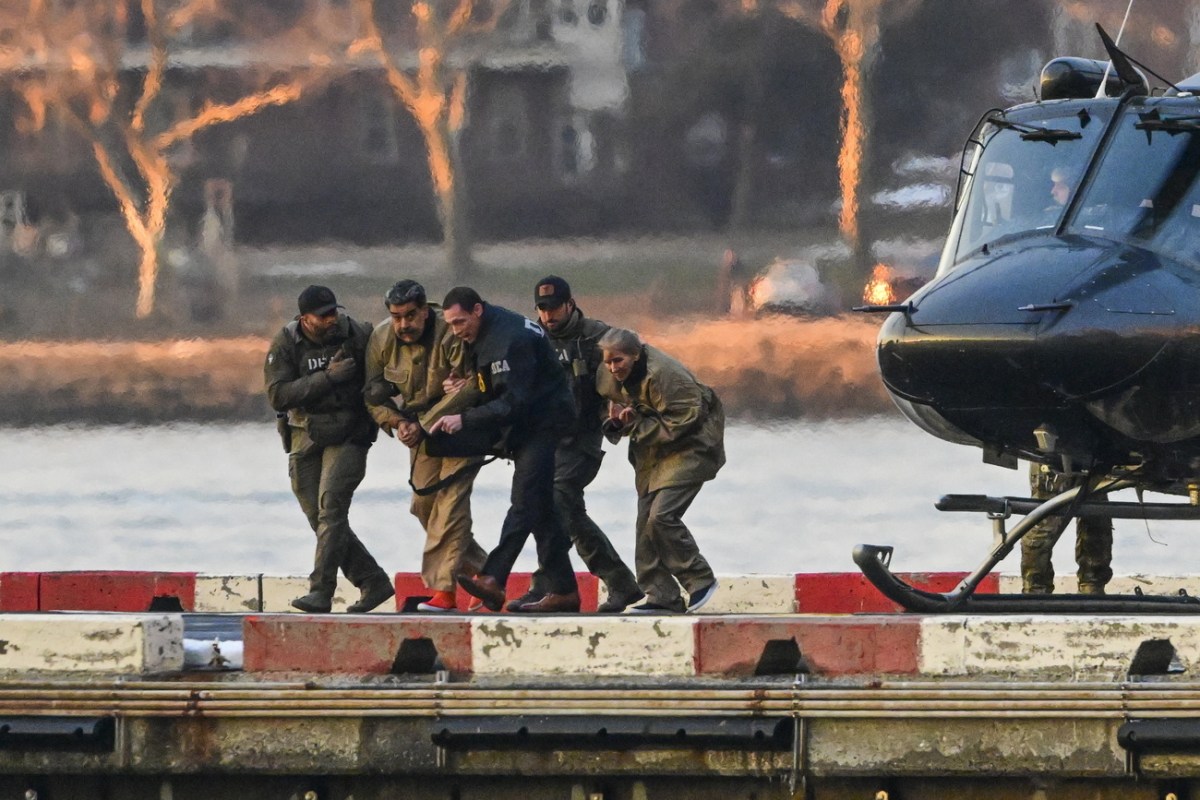
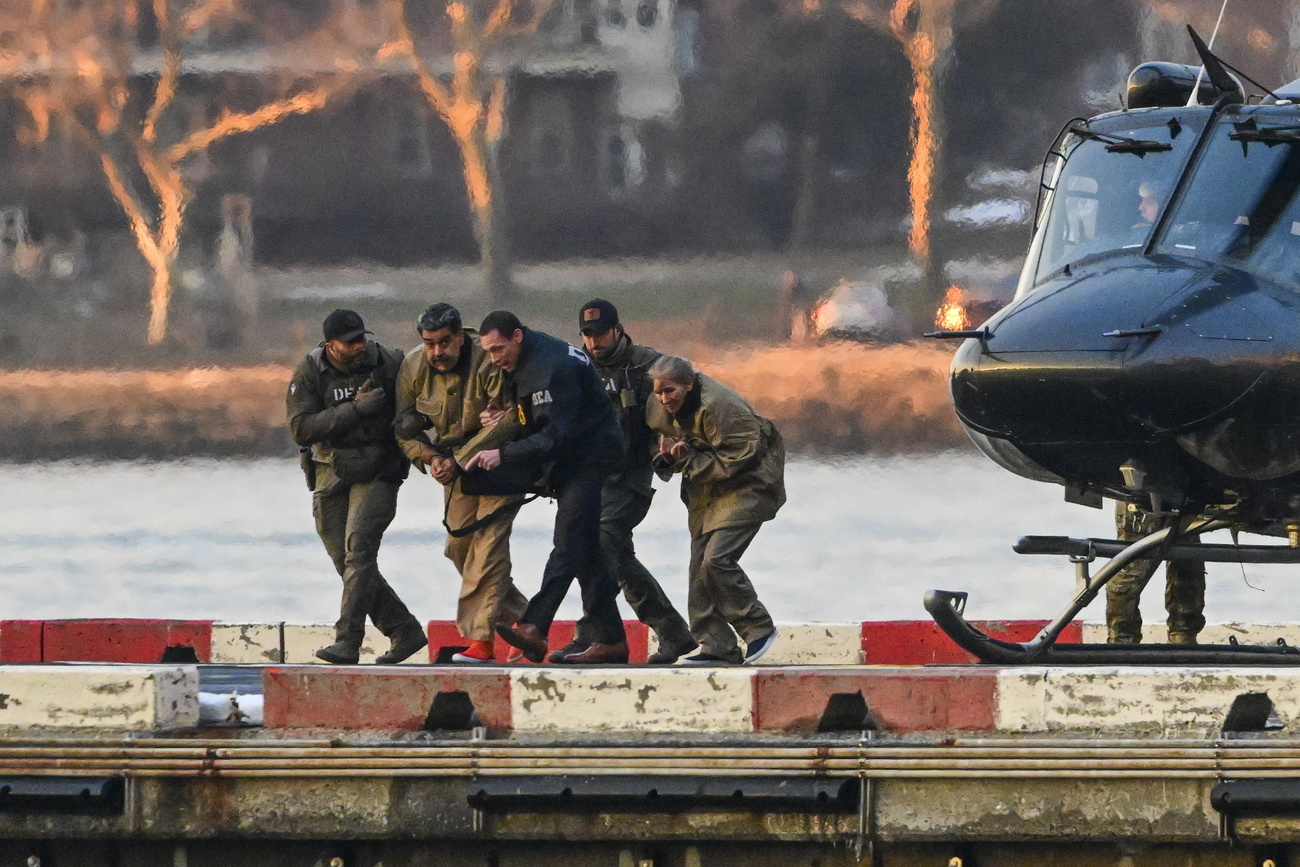
Venezuelan President Nicolás Maduro and his wife, Cilia Flores, arrive at the Wall Street heliport for their transfer to the federal court where they appeared on January 5, in New York.
KEYSTONE
Listen to the article
Listening the article
Toggle language selector
English (US)
English (British)
Generated with artificial intelligence.
The capture of Venezuelan president Nicolás Maduro by the United States signals a breaking point in the established world order. Does this mean that international law is now a thing of the past? A Geneva-based legal expert shares some insights.
This content was published on
January 12, 2026 – 10:44
“It is a flagrant breach of international law,” says Vincent Chetail, a professor at the Geneva Graduate Institute, when asked about the capture of Venezuelan president Nicolás Maduro and his wife, Cilia Flores, by the US military on the night of January 2-3 in Caracas. “It is an act of armed aggression that violates the United Nations Charter and customary international law.”
The UN Charter, the multilateral organisation’s founding document, prohibits the use of force except in the following three cases: if the state concerned requests it; if the UN Security Council authorises it; and in situations of self-defence. “Clearly, none of these apply here,” the international legal scholar says.
US President Donald Trump is presenting the capture of the Venezuelan leader as an act of defence against “narco-terrorism”. These narcotics, he adds, is claiming many victims in the United States, where the Venezuelan dictator, extradited to New York, now faces justice.
No legal argument

Vincent Chetail is Professor of International Law and Director of the Centre for Global Migration at the Geneva Graduate Institute.
Image fournie par la source
“What is worrying is that not only is the Trump administration flouting international law, but it is not even attempting to give its actions a veneer of legality,” Chetail says. “The concept of narco-terrorism is an argument aimed at justifying the intervention domestically, but it does not exist in international law. It is pure invention.”
This is not the first time that the United States has violated the UN Charter. The invasions of Afghanistan in 2001 and Iraq two years later were also in breach of international law. Nor is it unprecedented for the country to capture a sitting head of state, as it did in 1989 with Manuel Noriega, then the ruler of Panama.
“Until now, the United States developed a whole series of legal arguments, such as pre-emptive self-defence, which were certainly disputable, but at least reflected a desire to justify itself that is absent today,” Chetail adds.
An increasingly uncertain world
In an opinion piece published by the British daily The GuardianExternal link, the UN High Commissioner for Human Rights, Volker Türk, laments that the US military intervention in Venezuela “has made every other country less safe”. Above all, “it sends a signal that the powerful can do whatever they like, and weakens the only mechanism we have to prevent a third world war, namely the United Nations.”
In Chetail’s view, the intervention “creates a climate of widespread uncertainty” and can be seen as a continuation of the Monroe Doctrine of 1823, which places Latin America under the sphere of influence of the United States. “We therefore cannot rule out further interventions in this region,” he says.
Recently, Washington threatened to use force against several other countries in the “Western hemisphere”, in the words of the Trump administration, including Colombia and Cuba, but also Greenland, sparking serious concern in Europe.
An inspiration for others?
“If the United States, the leading world power and historic defender of the values on which the UN was built, flouts international law, then other countries are likely to follow suit,” says Chetail. “And the long-term implications are far-reaching, because you can no longer claim to oppose armed conquest in other countries if you are doing it yourself.”
Russia could thus interpret the US action in Venezuela as strengthening the legitimacy of its attack on Ukraine, or even as justifying an invasion of other states of the former Soviet Union. China, for its part, could be tempted to seize Taiwan.
However, the legal expert refuses to write off international law. “This body of law has been increasingly challenged in recent years, but it would be an exaggeration to say that it is dead. Breaches of the rules are always more visible than acts of compliance,” he says.
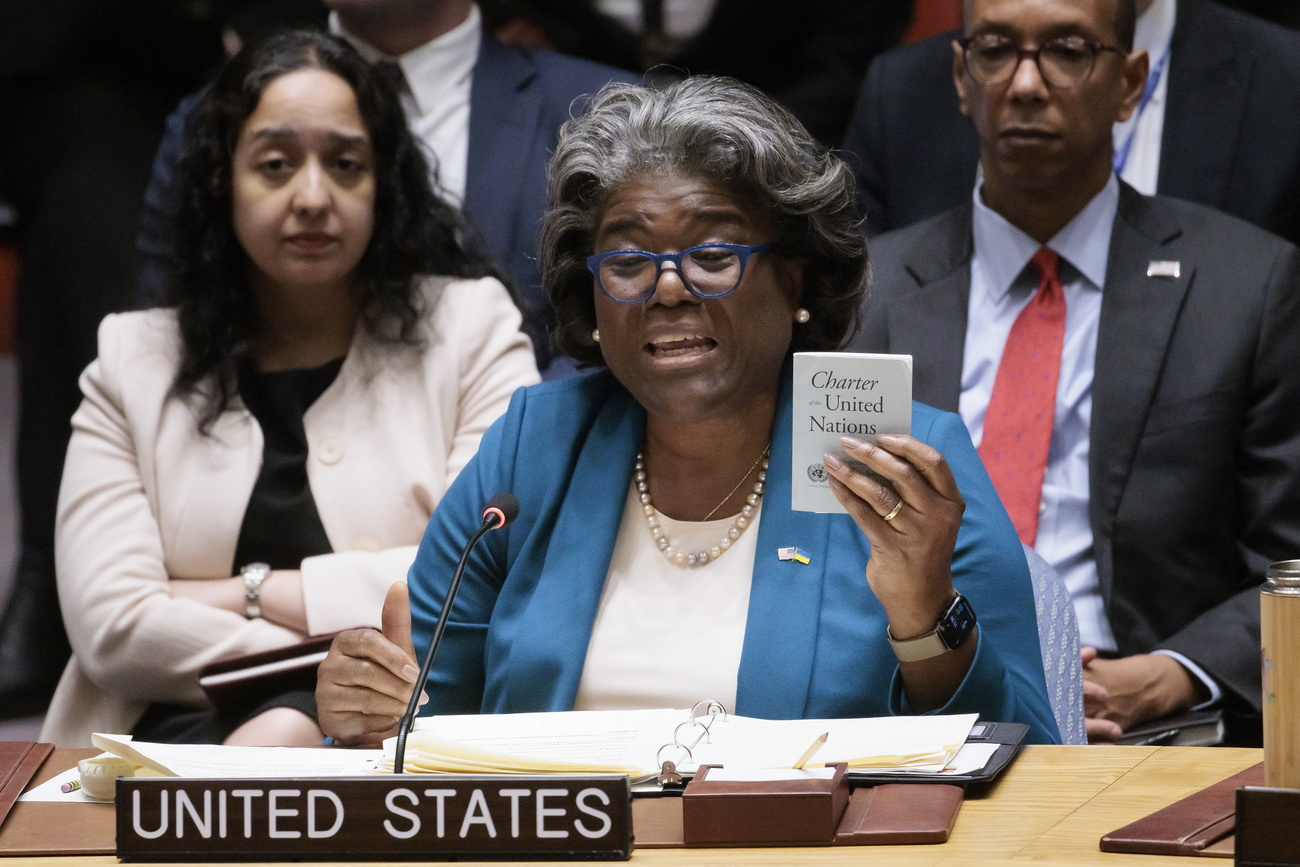
Our article explaining the UN Charter:
More
More
International Geneva
UN Charter turns 80 – but does it still matter?
This content was published on
Jul 2, 2025
The United Nations Charter turns 80 at a time when Israel, Iran and the US have been launching missile attacks and Russia is continuing its invasion of Ukraine.
Read more: UN Charter turns 80 – but does it still matter?
Timid reaction in Europe
In response to Maduro’s capture, most European countries have adopted a cautious stance towards the United States. In a statementExternal link supported by all member states except Hungary, the European Union on January 4 called for “respect for international law” but avoided condemning the US operation.
“If, faced with a clear violation of international law, Europe is unable to voice clear condemnation, this shows the weakness of the European countries, which are struggling to accept the loss of their historic ally,” Chetail says. It also gives fodder to critics who, especially since the war in Gaza, have denounced the double standards applied by European capitals.
Switzerland, meanwhile, calledExternal link in a post on X for “de-escalation, restraint and respect for international law, including the prohibition of the use of force and the principle of respect for territorial integrity”. This reaction was deemed too timid by some on the left of the political spectrum, who would have preferred strong condemnationExternal link.
For Chetail, Switzerland, as host state of the UN in Europe and the depositary of the Geneva Conventions, has “a greater responsibility” to make its voice heard, but it “cannot, on its own, take responsibility for issues that even the states of Europe are unable to address”. This is all the more true in the context of an ongoing trade war.
Support for investigations
The legal expert believes that Europe should find a balanced, common approach that condemns both the US aggression and the abuses committed by the Maduro regime. The UN has documented numerous cases of extrajudicial killings, arbitrary detention and torture in Venezuela, from which some 8 million people have fled.
The European countries should, Chetail concludes, also offer their support to the investigations being carried out by the International Criminal Court and the UN Human Rights Council’s Fact-Finding Mission. “My fear is that there will be no real regime change,” says the expert, “and that Maduro’s victims will not receive the justice they deserve for the violations of human rights.”
Edited by Virginie Mangin/sj. Adapted from French by Julia Bassam/gw.
More
More
Foreign Affairs
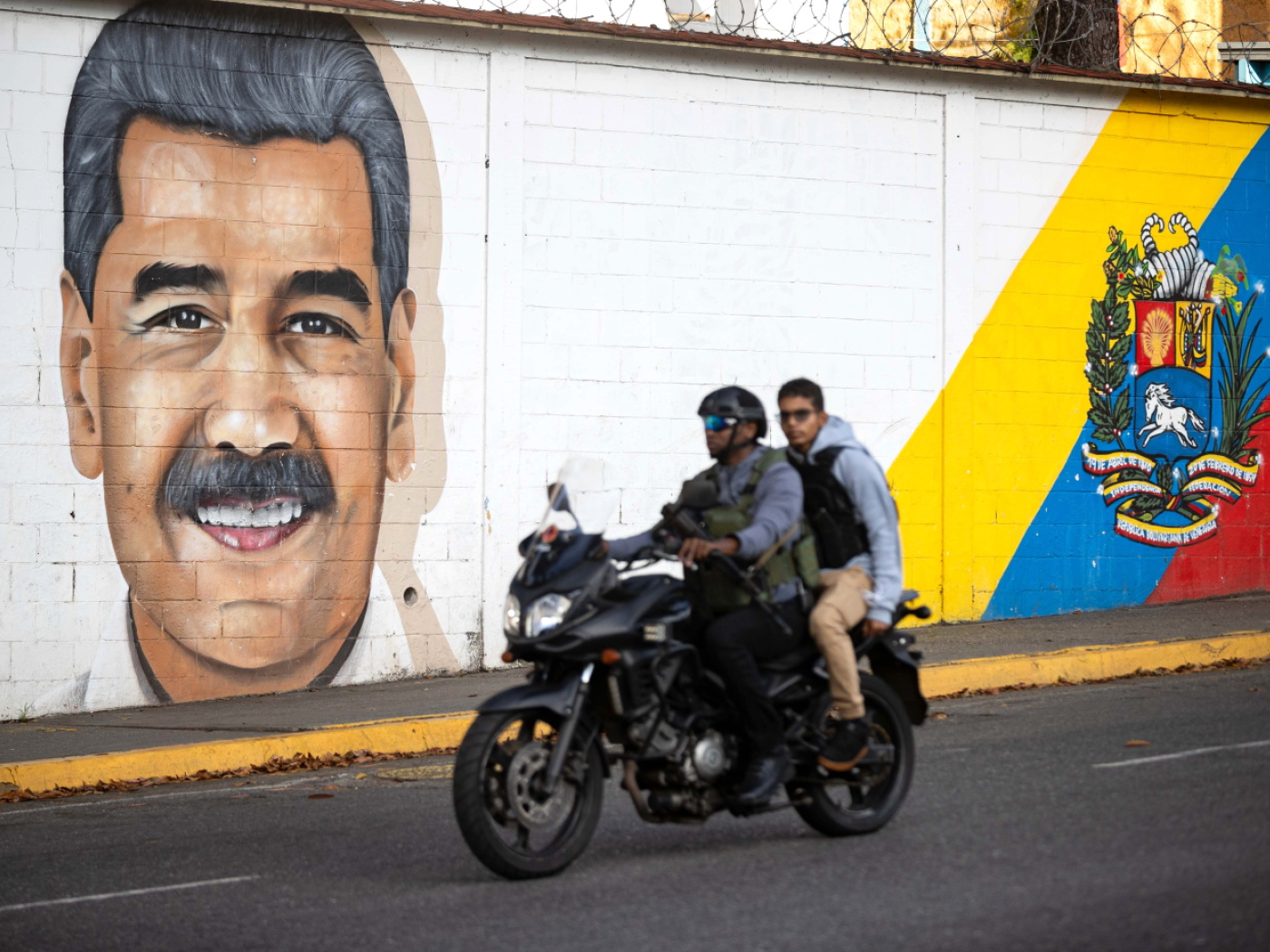
Swiss government freezes assets tied to Venezuela’s Maduro
This content was published on
Jan 5, 2026
Switzerland has frozen assets linked to Nicolás Maduro of Venezuela following arrest by the US.
Read more: Swiss government freezes assets tied to Venezuela’s Maduro
Articles in this story