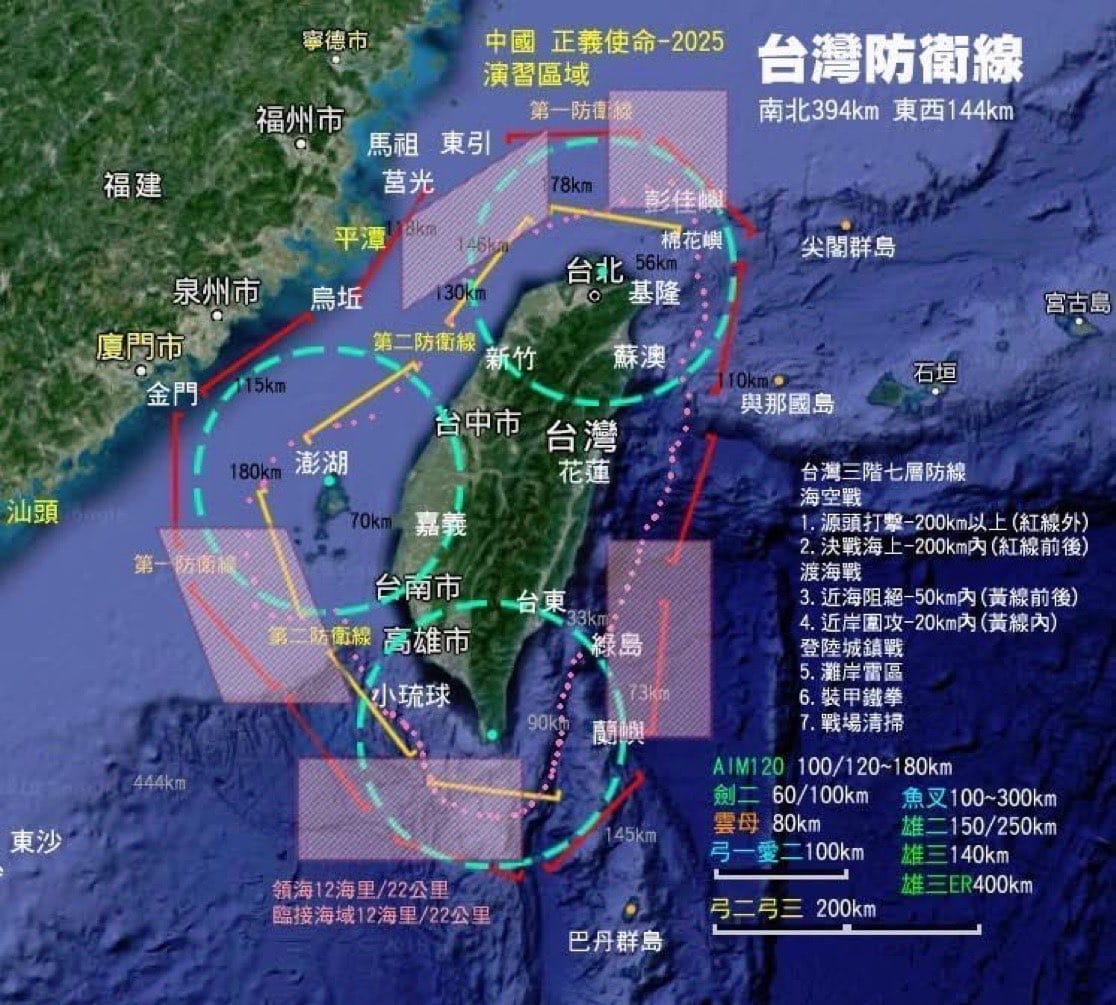
Taiwan highlighted its national defense plans against a Chinese invasion during the height of Beijing’s military drills around the island last month, revealing a map detailing potential defense lines and strategies against an attack from the mainland.
The Democratic People’s Party – Taiwan’s current ruling party – posted the graphic in response to China’s “Justice Mission” exercise. This exercise was the latest in a string of increasingly targeted military drills aimed against Taiwan and its partners.
According to Beijing and posters released from the People’s Liberation Army (PLA) Eastern Theater Command and China Coast Guard (CCG), one of the key focuses of Justice Mission 2025 involved the blocking and deterring of U.S. forces and arms shipments. Activities during the end-of-year exercise included port seizure operations and maritime strike missions carried out by H-6 bombers.
According to the “Taiwan Defense Line” graphic, Taipei plans to engage a Chinese invasion along a perimeter extending 200 kilometers from its shores composed of two defensive areas. These engagement zones are meant to delineate aspects of a seven-tiered defense strategy, which covers anti-invasion measures between blue water engagements to the ground forces defending Taiwanese coastal areas.
The graphic also showed Justice Mission 2025’s PLA and CCG exercises areas within the reach of various Taiwanese systems.
The first step of the described defense plan involved “targeting the source” and other threats beyond the designated first line of defense. During the leadup as well as throughout an invasion, PLA forces would stage and sortie from ports and other military infrastructure on the mainland. Taiwan has developed domestically-made cruise missiles capable of striking targets throughout China.
Recent acquisitions of High Mobility Rocket Artillery Systems and Army Tactical Missile Systems will also enable Republic of China Army batteries to strike mainland targets across the strait, which could disrupt embarkation and logistical activities from the onset of a conflict. At least one PLA long-range strike activity during Justice Mission 2025 was dedicated to the destruction of these American-made missile systems.
Lines of Defense
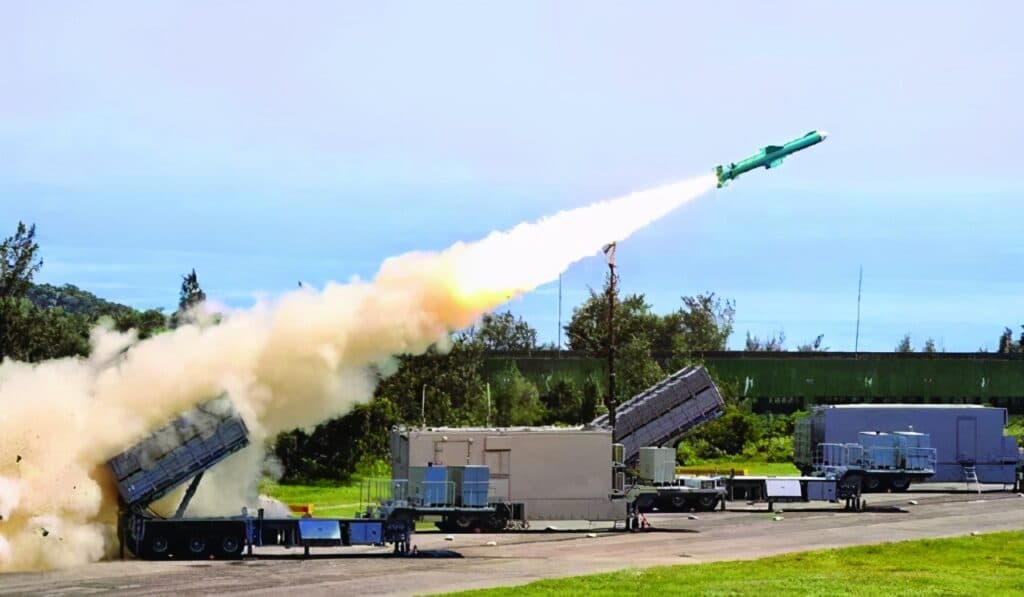
Hsiung Feng II anti-ship missile launched from a trailer by the Shore Based Anti-ship Missile Group. Taiwan MND picture.
Taiwanese forces also plan for a “decisive sea battle” before and after the 200 kilometer first line of defense. While the Republic of China Navy’s surface fleet pales in comparison to its mainland counterpart, the service is equipped with a number of heavily-ladened missile corvettes, small attack craft and several anti-ship batteries organized under the Haifeng Brigade – a dedicated ground-based maritime strike force. Taipei plans to increase the number of anti-ship missile units.
The graphic specifies three locations in Penghu, Pingtung and Northern Taiwan as locations for these area-denial units. Ranges for several air-to-air, surface-to-air and surface-to-surface missile systems were also highlighted in the graphic. Among these systems was an extended-range variant of the supersonic HF-3 anti-ship missile that can strike maritime targets up to 400 kilometers away.
At the second line of defense, Taiwanese forces plan to conduct “nearshore blocking” operations within a 100 kilometer-wide area. In 2024, the Taiwanese Navy announced plans to stand up a dedicated littoral defense force that will combine Marine Corps fast boats, Navy missile craft and land-based missile forces to defend the 24 nautical mile contiguous zone.
With an increasingly modernized PLA and renewed rhetoric from Beijing, Taiwanese forces have been bolstering their capabilities and defensive posture in recent years. Faced with a potential invasion, Taipei has shifted towards the procurement of asymmetric assets such as loitering munitions, sea drones and other distributed capabilities. While traditional capabilities are still being acquired, other procurements have been made to increase the island’s anti-ship missile stockpile and extend the reach of long-range fires.
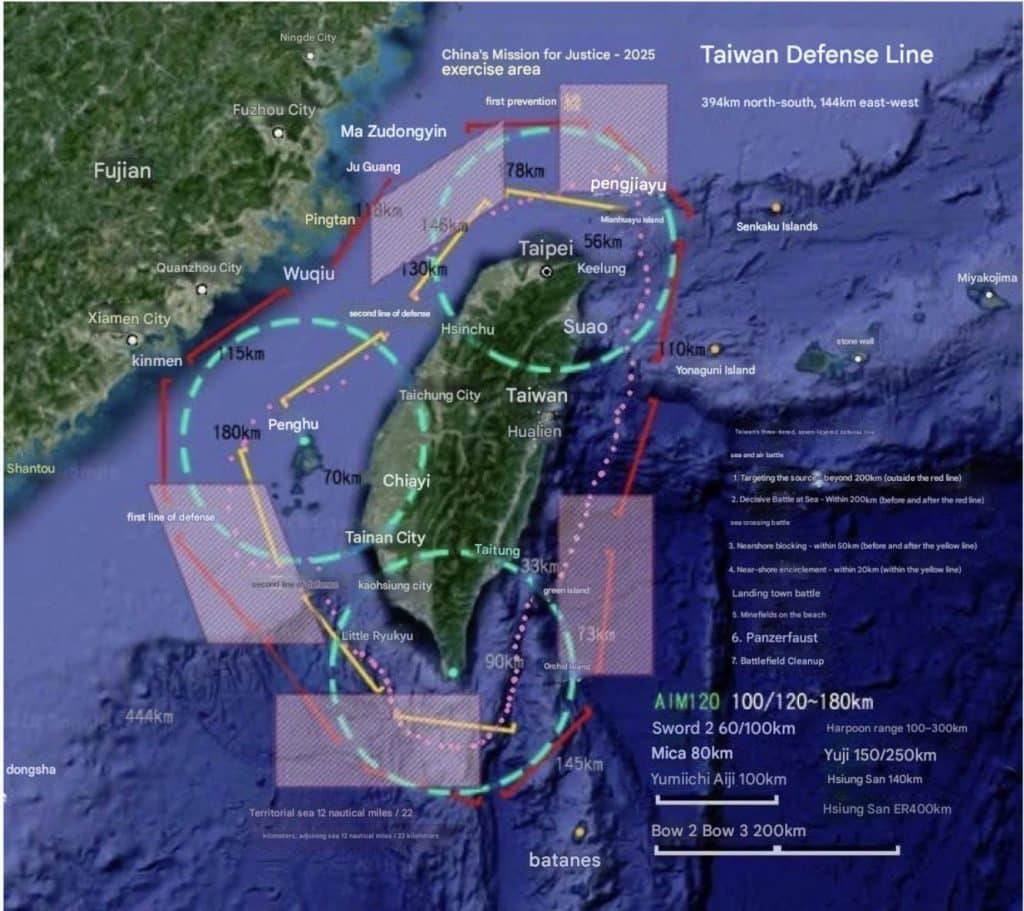
Taiwan Invasion Defense Lines (translated version)