
Listen to this article
Estimated 4 minutes
The audio version of this article is generated by AI-based technology. Mispronunciations can occur. We are working with our partners to continually review and improve the results.
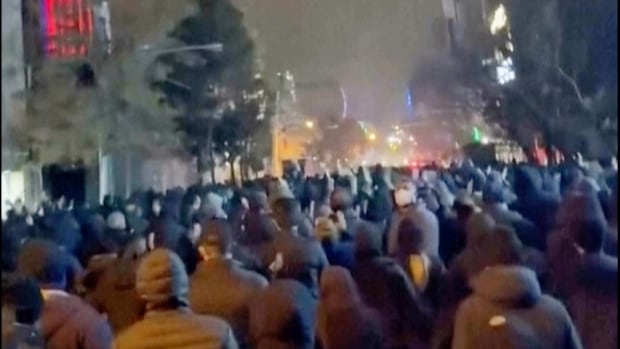
U.S. President Donald Trump said the United States may meet Iranian officials and was in contact with the opposition as he weighed a range of strong responses, including military options, to a violent crackdown on Iranian protests, which pose one of the biggest challenges to clerical rule since the 1979 Islamic Revolution.
“We are ready for war, but also for dialogue,” Iranian Foreign Minister Abbas Araqchi said on Monday in a briefing to foreign ambassadors in Tehran via English translation.
The situation in Iran is “under total control” after violence linked to protests spiked over the weekend, said Araqchi.
Foreign Ministry spokesperson Esmaeil Baghaei said that communications between Araqchi and U.S. special envoy Steve Witkoff remain open, and that contacts also remain open through traditional intermediary Switzerland.
WATCH | Compromises will be a tough sell, analyst says: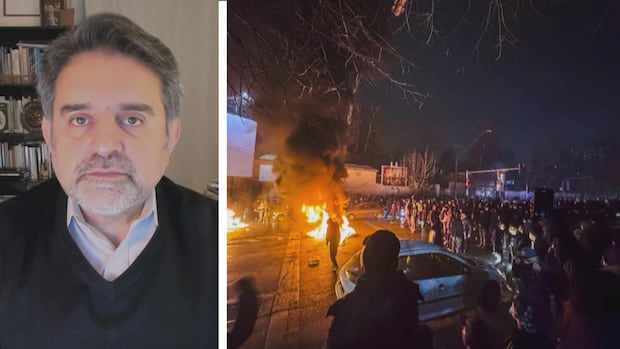
Is Iran willing to negotiate with U.S.? ‘There’s no other way,’ analyst says
Kamran Bokhari, a senior director at the New Lines Institute for Strategy and Policy, says Iran must negotiate as it faces nationwide public unrest and an increasingly dire economic situation. He noted that while public statements from Iranian officials may say one thing, ‘back channels don’t go silent.’
Trump has warned Iran’s leaders that the U.S. would attack if security forces open fire on protesters.
U.S.-based rights group HRANA said it had verified the deaths of 490 protesters and 48 security personnel, with more than 10,600 people arrested.
Iran has not given an official toll and Reuters was unable to independently verify the tallies. The flow of information from Iran has been hampered by an internet blackout since Thursday.
Regime officials call for counter-protests
Trump said on Sunday that Iran had called to negotiate its nuclear program, which Israel and the U.S. bombed in a 12-day war in June.
“Iran wants to negotiate, yes. We might meet with them. A meeting is being set up, but we may have to act because of what is happening before the meeting, but a meeting is being set up. Iran called, they want to negotiate,” Trump told reporters on Air Force One.
WATCH | Not clear regime could satisfy protesters with meaningful reform, says expert: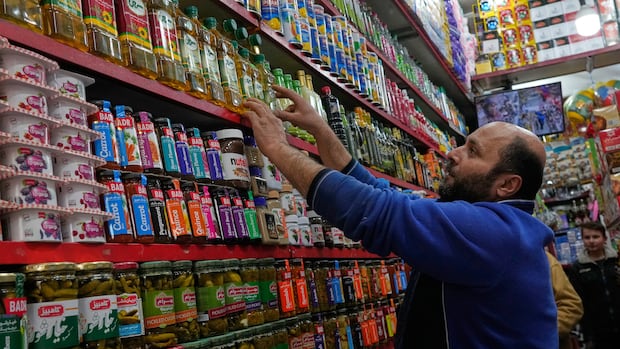
Florida International University Iran expert Eric Lob on the protests rocking that country
Get the latest on CBCNews.ca, the CBC News App, and CBC News Network for breaking news and analysis
Iranian authorities accused the U.S. and Israel of fomenting trouble and called for a nationwide rally on Monday.
State TV on Monday aired live footage of large crowds attending a funeral procession for security forces killed in Shahrud and pro-government demonstrations in cities such as Kerman, Zahedan and Birjand, held “in condemnation of recent terrorist events.”
Trump was to meet with senior advisers on Tuesday to discuss options for Iran, a U.S. official told Reuters on Sunday. The Wall Street Journal had reported that options included military strikes, using secret cyber weapons, widening sanctions and providing online help to anti-government sources.
“The military is looking at it, and we’re looking at some very strong options,” Trump told reporters on Sunday night.
Striking military installations could be highly risky. Some bases of elite military and security forces may be located in heavily populated areas, so any attack ordered by Trump could inflict large civilian casualties.
At least two U.S. senators sounded notes of caution during interviews on Sunday.
“I don’t know that bombing Iran will have the effect that is intended,” Republican Sen. Rand Paul told ABC News.
Democratic Sen. Mark Warner of Virginia, meanwhile, told Fox News that a military attack on Iran could rally the people against an outside enemy.
Iran prepared to retaliate militarily, speaker says
Mohammad Baqer Qalibaf, speaker of Iran’s parliament, warned Washington against “a miscalculation.”
“Let us be clear: in the case of an attack on Iran, the occupied territories [Israel] as well as all U.S. bases and ships will be our legitimate target,” said Qalibaf, a former commander in Iran’s elite Revolutionary Guards.
However, Tehran is still recovering from last year’s war, and its regional clout has been much weakened by blows to allies such as Lebanon’s Hezbollah since the Oct. 7, 2023, attacks led by militant group Hamas against Israel. Israel also killed top Iranian military commanders in the June war.
WATCH | Weekend rallies for Iran’s protesters take place across Canada: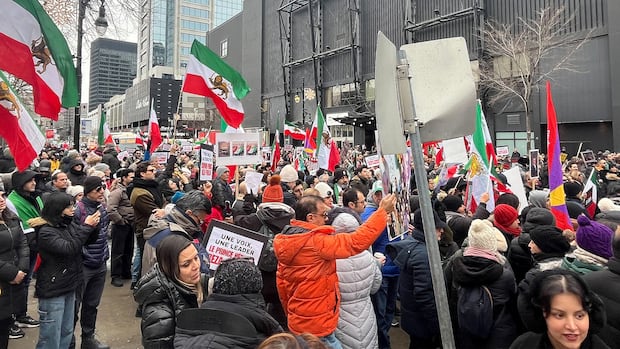
Iranians across Canada hold solidarity rallies
As Iran cracks down on protesters, the diaspora in Canada held solidarity rallies to push for regime change, though there are differing opinions on what that change should be.
The protests began on Dec. 28 in response to soaring prices, before turning against the clerical rulers who have governed since the 1979 Islamic Revolution.
Iranians, who are struggling to make ends meet, have grown increasing resentful of the powerful Revolutionary Guards, whose business interests, including in oil and gas, construction and telecommunications, are worth billions of dollars.
The flow of information from Iran has been hampered by an internet blackout since Thursday. Trump said on Sunday he would talk to Elon Musk about restoring internet access in Iran through his Starlink satellite service.
Araqchi said internet service will be resumed in co-ordination with security authorities.