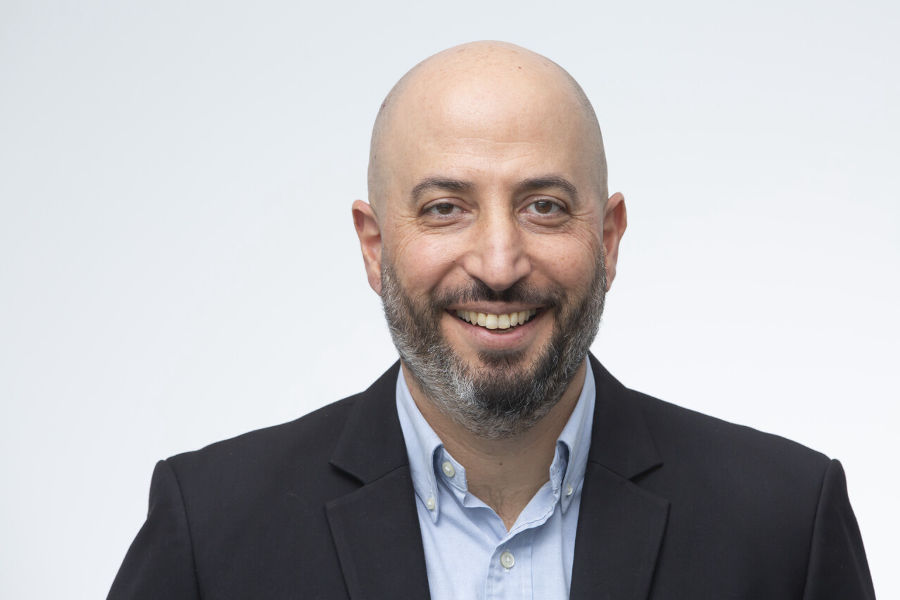
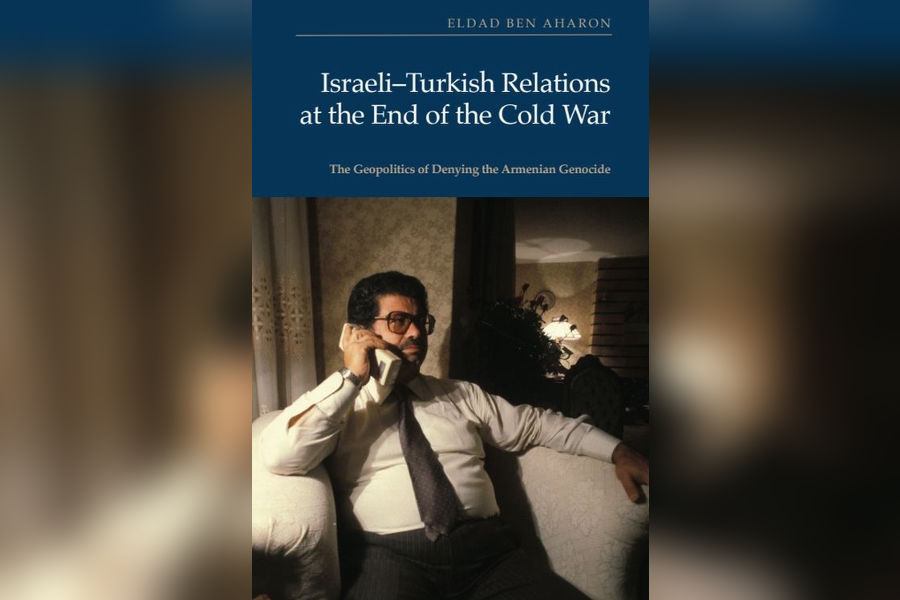
Edinburgh University Press has announced the publication of Dr. Eldad Ben Aharon’s book, Israeli–Turkish Relations at the End of the Cold War: The Geopolitics of Denying the Armenian Genocide. The book examines how covert cooperation between Ankara and Jerusalem in the 1980s was profoundly shaped by Turkey’s determination to block international recognition of the Armenian Genocide. Drawing on declassified American and Israeli archival materials alongside 30 original oral-history interviews, Eldad Ben Aharon reveals the hidden diplomatic calculations that underpinned this uneasy alignment.
Against the backdrop of Cold War geopolitics, Israel quietly accommodated Turkey’s denial policies, prioritizing strategic interests over historical justice. Ben Aharon demonstrates how Turkey’s military leadership played a decisive role in easing tensions with Israel following years of estrangement, while the rise of Turgut Özal marked a turning point in strengthening bilateral ties. At the same time, internal divisions within Israel’s diplomatic corps exposed deep moral and political dilemmas: how to safeguard Israel’s standing in Washington and Brussels while tacitly supporting Ankara’s position on the Armenian Genocide.
The book situates this clandestine diplomacy within a wider regional and global context, tracing Israel’s maneuvering through pivotal events such as Iran’s Islamic Revolution, the July 1980 Jerusalem Law, Turkey’s September 1980 military coup and the 1982 First Lebanon War. These developments unfolded alongside Turkey’s 1987 application to join the European Economic Community, the Reagan administration’s foreign policy agenda and the early contours of what would later be called the American “war on terror.”
Challenging conventional accounts that emphasize the role of American Jewish organizations or Turkish Jewish intermediaries, Ben Aharon instead highlights the influence of individual diplomats operating largely out of public view. Their calculated decisions and discreet negotiations forged an alliance that reshaped Israeli–Turkish relations for decades — at the cost of entangling Israel in a politics of denial that continues to reverberate today.
Ben Aharon commented on the book, saying, “I decided to work on this complex topic after encountering a newspaper article in Haaretz in 2003, a few years before I began my academic journey. That article sparked a lasting fascination with the complex relationship between Israel and Turkey, viewed through the lens of the Armenian Genocide. Over time, what began as an intuitive curiosity developed into a sustained research agenda, first through my MA research and later through an extensive Ph.D. project. This book is the result of more than a decade of engagement with the question of how strategic interests, memory politics and practices of denial became deeply intertwined in Israeli-Turkish relations.”
Reviews
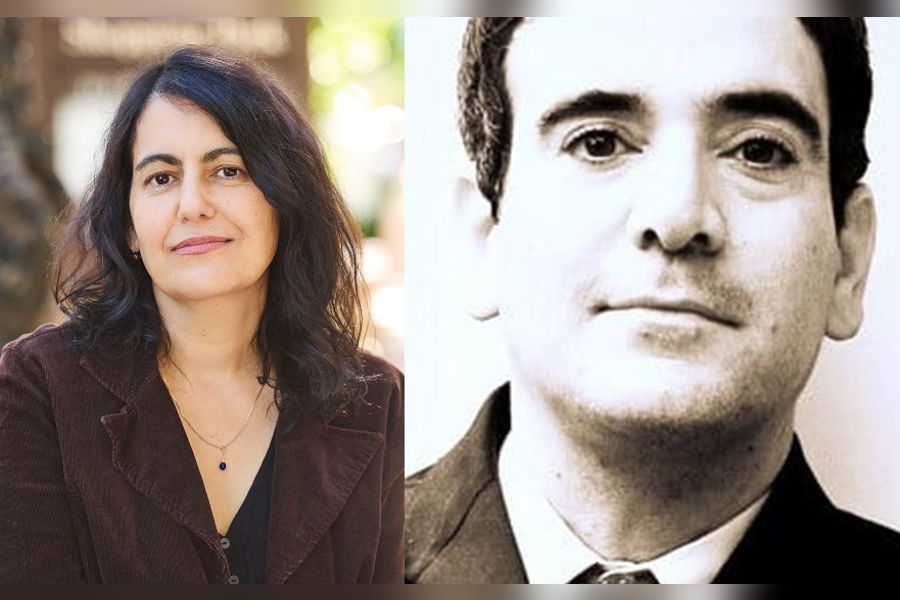
Eldad Ben Aharon’s book provides original and important insights into the first “global war on terror” under the Reagan administration in the 1980s. Drawing upon extensive archival research and interviews, this book examines how Cold War-era ontological fears of international terrorism shaped liaison efforts amongst the U.S., Israel and Turkey. This notably led to delays in the recognition of the Armenian Genocide of 1915 for several decades. This compelling work highlights the deep interconnections between security policy and historical memory. — Sarah Léonard, Dublin City University
This ground-breaking study examines the evolution of the Israeli-Turkish alliance in the late Cold War era, laying the foundation for a decades-long partnership. It meticulously explores how Israel seized Turkey’s denial of the Armenian Genocide in the 1970s as a launching point to build trust in a country that viewed Israel’s close ties with Washington as a means to shape policy. To the surprise of many, the foundations of the alliance endured major political shifts, with the rise of Erdogan and Netanyahu. It is essential reading for anyone interested in Israel-Turkish relations and their impact on the geopolitical dynamics of the Middle East. Unequivocally, this work positions Eldad Ben-Aharon as a leading authority on Israeli-Turkish ties, just as relations between the two countries have hit rock bottom in the wake of the events of Oct. 7th. In short, few can match Ben-Aharon’s ability to maneuver the political world of Israel, Turkey, the United States and the Middle East, crafting a compelling and very readable analysis. — Louis Fishman, City University of New York
In his carefully researched and argued book, Eldad Ben Aharon shows how the Israeli state’s comportment to the Armenian Genocide was the contingent outcome of regional geopolitics and Cold War contexts, ranging from the Iranian revolution in 1979 to Turkish domestic policy. Bridging multiple scales of analysis, Israeli–Turkish Relations at the End of the Cold War is a methodological tour de force on an unjustly neglected topic. — A. Dirk Moses, City College of New York (CUNY)
Eldad Ben Aharon’s ground-breaking study sheds new light on how Israeli diplomats, operating under Cold War pressure, worked in quiet coordination with Turkey to suppress international recognition of the Armenian Genocide. It reveals how a complex geopolitical climate, shaped by events such as the 1979 Islamic Revolution and Turkey’s 1980 military coup, prompted the Israeli Ministry of Foreign Affairs to leverage the Armenian issue as a shared concern, deepening ties with Ankara behind the scenes. Based on a rich array of primary sources, this book offers a compelling portrait of Israeli foreign policy in the final decade of the Cold War and of Middle Eastern diplomacy that paved the way for the ‘golden years’ of the 1990s. — Ofra Bengio, Tel Aviv University
About the author
Eldad Ben Aharon is a senior researcher at the Peace Research Institute Frankfurt and was previously an Irish Research Council (IRC) Postdoctoral Fellow in International Security at Dublin City University. His work explores the nexus of security, identity and memory, drawing on insights from securitization theory, foreign policy analysis and oral history. Ben Aharon has published widely on Israeli foreign policy and its intersections with broader regional conflict dynamics, with his research appearing in leading academic journals, including the European Journal of International Security, Intelligence and National Security, Studies in Conflict & Terrorism, Oral History Review, British Journal of Middle Eastern Studies, Journal of Genocide Research and Cold War History.
Copies of Israeli–Turkish Relations at the End of the Cold War: The Geopolitics of Denying the Armenian Genocide are available for purchase from the Edinburgh University Press website. Use code: NEW30 to receive a 30% discount.