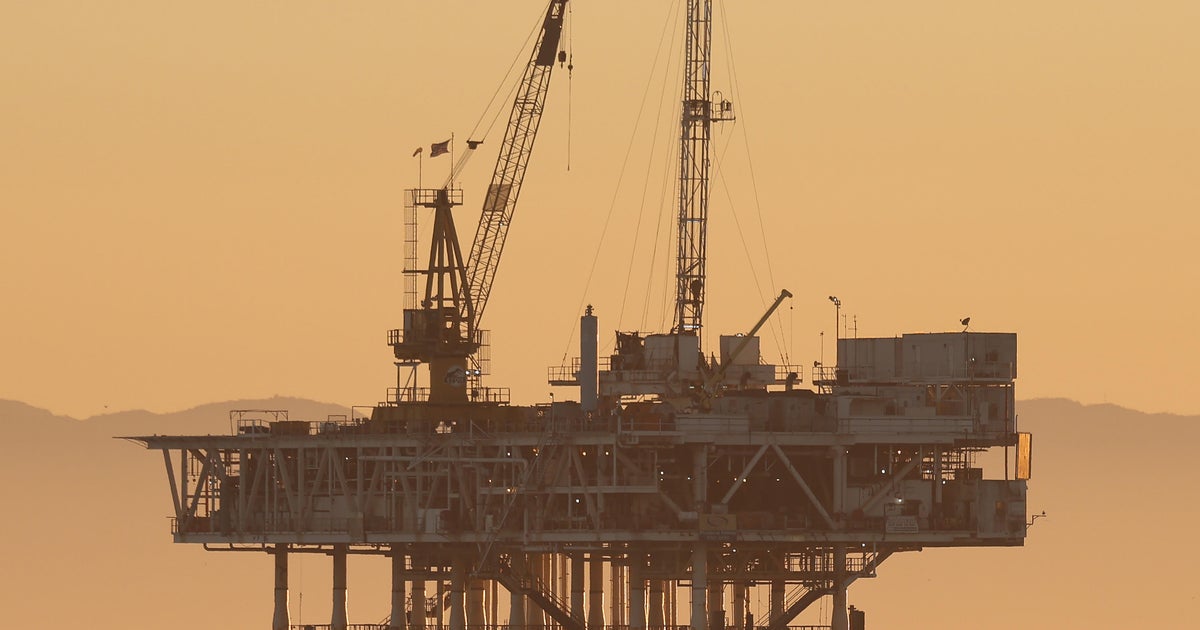
Idled oil rigs off the California coast could be back up and running soon if the federal government has its way.
The Trump administration recently proposed a plan to open up the entire coast to new offshore drilling. While that plan is still in draft form, the administration is now involved in a push to restart three existing oil rigs near Santa Barbara.
Houston, Texas-based Sable Offshore Corp. has been attempting to bring them back into production more than a decade after they were shut down, but has encountered environmental and legal roadblocks.
“If this project is allowed to restart off of California, it will be the biggest threat to the California coast in terms of risk of oil spills but also in terms of greenhouse gas emissions,” said Linda Krop, chief counsel for the Environmental Defense Center.
In 2024, Sable acquired the platforms, a nearby oil processing facility, and a 125-mile-long pipeline system from ExxonMobil. These assets were all shut down in 2015. The company says it wants to restart the rigs and eventually produce about 50,000 barrels of oil – or more than two million gallons – a day. The oil would travel over the pipeline system to refineries in Kern County.
Sable says it could stabilize California’s crude oil supply, bolstering in-state production by up to 20% and lowering gas prices. The company also estimates that it would create hundreds of well-paying jobs.
But there’s a problem, according to Alex Katz, Environmental Defense Center executive director.
“If they were to restart today, they would be violating the court’s injunction,” Katz said. “They’d be violating a number of state laws. But the important thing is that they have not made the repairs that the state told them they have to make.”
Much of the problem stems from the devastating 2015 Refugio oil spill near Santa Barbara’s Refugio Beach State Park along the Gaviota Coast in Santa Barbara County. A corroded pipeline that carried the oil along the Santa Barbara coast to Kern County ruptured, tarnishing beaches, killing wildlife, shutting down fisheries, and causing tremendous economic damage. The damaged pipeline system was then owned by Plains All American Pipeline. In 2022, Plains All American sold the assets to ExxonMobil.
While Sable declined a CBS News Bay Area request for an interview, the company said in published reports that it has decades of experience safely operating in California and has implemented enhanced safety measures as it seeks to develop the assets responsibly and sustainably in the offshore federal waters.
But the company faces significant legal challenges from state and local authorities as well as environmental groups. The California Coastal Commission has issued multiple cease-and-desist orders to Sable Offshore for allegedly conducting unlawful repair work. Last year, the commission fined the oil company a record $18 million, claiming that it repeatedly defied its orders. In February 2025, the company sued the Coastal Commission, claiming the agency had unlawfully halted its repair work.
In July 2025, Santa Barbara County Superior Court Judge Donna Geck issued an injunction requiring Sable Offshore to provide 10 days’ advance notice before restoring the pipeline operations, and that it confirms under penalty of perjury that the company has received all necessary approvals and permits for restarting the pipelines.
In October 2025, the Office of the State Fire Marshal (OSFM) advised Sable that it “must repair all immediate and 180-day repair conditions prior to restart.” One of these conditions involves any severe corrosion, dents, or cracks in the pipes. In 2024, OSFM issued state waivers to the company, specifying that these conditions must be met. But according to OSFM’s records, Sable has not satisfied these conditions. In a letter, OSFM told Sable that it needed to comply with specific requirements before it could restart. In response, Sable called OSFM’s conclusions in error and claimed that the company is in full compliance.
“This is not just a normal oil project,” Krop said. “This is about restarting old equipment that’s already failed and caused a catastrophe in our state.”
Now the Trump administration is involved. Late last year, Sable Offshore contacted the Pipeline and Hazardous Materials Safety Administration (PHMSA), an agency of the U.S. Department of Transportation, requesting that the pipeline be classified as interstate and no longer as intrastate.
Before the Refugio oil spill, the pipelines under All Plains were considered intrastate because the previous owner filed tariffs with the Federal Energy Regulatory Commission. Once the facilities, known as the Santa Ynez unit and the Las Flores Pipeline system, were shut down after the 2015 oil spill, the pipelines’ previous owner cancelled the tariffs with FERC.
PHMSA has notified Sable that, in situations where FERC tariffs are absent and generally considered intrastate, PHMSA can still consider the pipeline as interstate. PHMSA thus designated the Santa Ynez pipeline as interstate, placing the Sable pipeline under federal jurisdiction and allowing PHMSA to prescribe and enforce minimum safety standards for pipeline facilities.
On December 22, 2025, PHMSA approved the Sable restart plan. Two days later, the Trump administration approved Sable’s request for an emergency waiver from federal safety regulations. The approvals followed President Trump’s executive order declaring a national energy emergency, pointing to what he characterized as inadequate energy production on the West Coast, Northeast, and Alaska. In issuing the emergency permits, the DOT cited the President’s executive order.
In response, the Environmental Defense Center, the Center for Biological Diversity, and their clients filed an emergency Petition for Review as well as an Emergency Motion for Stay pending appeal with the Court of Appeals for the Ninth Circuit to halt the restart. The petitioners argued several reasons, including that the administration bypassed mandatory environmental reviews and public comment periods.
PHMSA filed a response, asking the Court to deny the motion, specifying that the federal requirements in issuing the permits include rigorous conditions to ensure pipeline safety and that the “current energy emergency, particularly inadequate oil supplies and high energy prices of the West Coast,” should weigh heavily against the request for an emergency stay.
Sable Offshore also filed a response, noting the company remains in compliance, that it is losing millions of dollars a day, and that if the emergency stay is granted, Californians will suffer irreparable harm “in the form of higher gasoline prices, lost jobs, lost tax revenues, lost royalty sharing, and increased regulatory uncertainty.”
On December 31, the two-judge panel rejected the emergency appeal to block the restart but set an expedited court date. The petitioners must file briefs by January 26. The Federal Government’s briefs are due on February 13, and Sable Offshore must file by March 3. The petitioners will then have a chance to respond by March 17th.
On Tuesday, Sable Offshore filed for an emergency hearing asking Judge Geck to lift her injunction. In court, the company’s legal counsel said he believed the injunction was moot because the pipeline is now under federal jurisdiction, adding that Sable was losing millions of dollars every day and that it could start pumping and producing oil immediately.
California Deputy Attorney General Michael Dorsi requested that the state needed more time to respond to the issues, saying the legal questions raised were far from settled. Adding to the complexity of the situation, a new California law, SB 237, now requires oil facilities idled for five years or more on January 1 to obtain a permit from the California Coastal Commission before restarting operations.
Sable had previously announced on May 19, 2025, that it had restarted operations at the Santa Ynez facility – ironically on the 10th anniversary of the Refugio oil spill – but state agencies say that’s not the case. Attorneys for the environmental groups asked Judge Geck to inquire if Sable had already begun flowing oil through the pipeline in violation of her injunction. After some back and forth, the Sable attorney responded with a clear “no,” meaning the restart is subject to SB 237 unless the decision on federal jurisdiction holds.
Judge Geck declined to immediately lift the injunction; her next hearing was set for Feb. 27.
Attorneys for the environmental groups warn that this pipeline battle is emblematic of a much bigger war brewing off the California coast: the sale of offshore oil leases. The Trump administration is seeking to sell six offshore leases between 2027 and 2030. The federal government must review public comments before it finalizes the draft plan, and Californians can submit comments by Jan. 23.
Meanwhile, the Marin County-based Surfrider Foundation, which opposes federal offshore drilling, is hosting a series of public meetings in cities across California.