By Su Yong-yao, Li Wen-hsin, Hollie Younger and Fion Khan / Staff reporters, with staff writers and CNA
The purpose of Taiwan People’s Party (TPP) Chairman Huang Kuo-chang’s (黃國昌) sudden visit to Washington this week was to reiterate in person that, under the current Indo-Pacific situation, improving Taiwan’s national defense capabilities is an “urgent and non-deferrable” priority, people familiar with the matter said.
The four-person TPP delegation, which also includes TPP legislative caucus director Chen Chih-han (陳智菡), former TPP International Department head Lin Tzu-yu (林子宇) and TPP member Wang An-hsiang (王安祥), left Taiwan on Sunday.
The delegation yesterday held meetings in Washington with officials from the US National Security Council (NSC) and the American Institute in Taiwan (AIT).
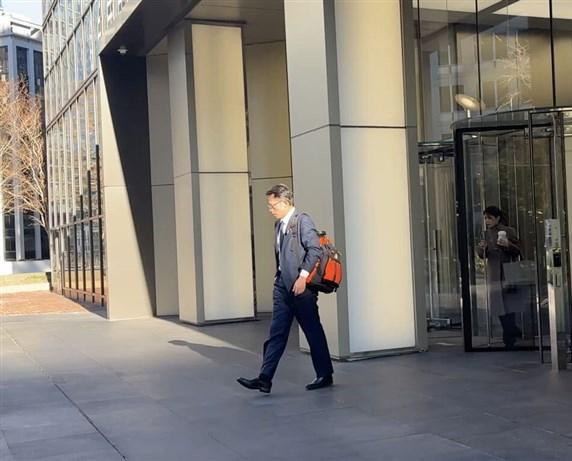
Photo: CNA
They arrived at the NSC’s headquarters in the Eisenhower Executive Office Building at 10am, accompanied by AIT Managing Director Ingrid Larson, and remained there for about an hour.
At 1pm, the group held a second meeting at AIT’s Washington headquarters in Arlington, Virginia, which was also attended by Jessica Drun, a China and Taiwan analyst at the US Department of State.
The US hopes that Huang and the TPP can set aside partisan differences and demonstrate a unified stance on defense and security issues, a Washington-based source, who is responsible for Taiwan-US policies, told the Liberty Times (the Taipei Times’ sister newspaper).
Unity would be a win-win outcome for the Indo-Pacific region, Taiwan and the TPP, the source added.
Huang had previously told US counterparts in Taiwan that his party would support major defense investments, including a special defense budget, though he had hoped to first gain on-the-ground understanding in the US to better inform subsequent decisions, the source said.
The government’s NT$1.25 trillion (US$39.46 billion) special defense budget bill has been repeatedly blocked in the legislature by the TPP and the Chinese Nationalist Party (KMT).
The US assisted in planning the delegation’s itinerary, including arranging meetings with key officials from the US National Security Council, the US Department of State and several defense-related agencies, the source said.
The US arranged meetings with officials from the Office of the US Trade Representative upon request, they said.
The hope was to provide Huang with a comprehensive and accurate understanding of US-Taiwan economic and trade relations, as well as strategic security considerations, the source said.
As the US and its Indo-Pacific allies are closely monitoring political developments in Taiwan, Washington hopes that Huang and the TPP will not allow domestic partisan disagreements to result in Taiwan being swayed by those who lean more closely to Beijing, particularly on critical national security issues, they said.
While countries in the first island chain are stepping up national defense efforts, there would be severe consequences if Taiwan lagged behind, the source said.
The US hopes that, after returning to Taiwan, Huang will lead his party to stand on the same side as all democratic allies on defense, security and foreign affairs, and to make choices that best serve Taiwan’s national interests, they added.
In response to the Liberty Times report, Huang said that the “Democratic Progressive Party’s (DPP) mouthpiece” was citing unnamed Washington sources to fabricate conversations that never took place, calling it an attempt to manipulate public opinion.
Before boarding his return flight to Taiwan yesterday, Huang said in a video that he had met intensively with senior officials from major US federal agencies for more than 10 hours to discuss tariffs and arms purchases, and to reflect public concerns in Taiwan.
The TPP consistently puts national interests above party interests, he said, adding that when Taiwan is under pressure domestically and internationally, the ruling DPP chooses inaction.
The opposition has a duty to shoulder responsibility for the nation, and the TPP would continue to uphold these beliefs and values and work together with the public, he said.