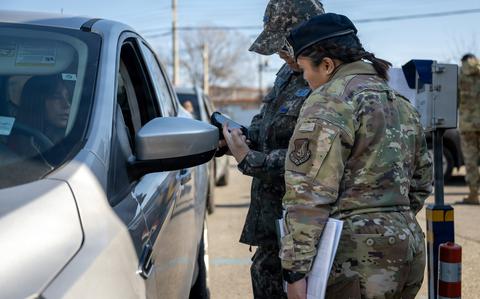
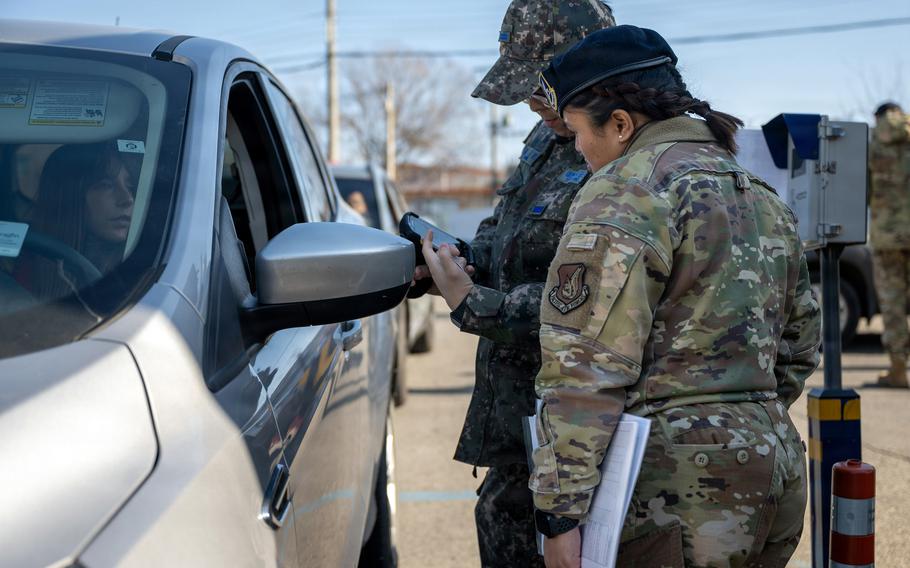
Airman 1st Class Kwon Jin, a South Korean military police officer, explains what to look for during entry procedures at Osan Air Base, South Korea, Jan. 5, 2026. (Sarah Williams/U.S. Air Force)
The Air Force has changed entry procedures at its largest base in South Korea following a search-and-seizure operation conducted there by South Korean officials last year.
Security guards at Osan Air Base, about 35 miles south of Seoul, now use the Defense Biometric Identification System to check in both U.S. and South Korean personnel, Capt. Kristina Strickland, a 51st Fighter Wing spokeswoman, said by email Friday.
The system uses barcodes and fingerprints to verify those authorized to access U.S. military installations.
Previously, South Korean personnel could enter the base, which also hosts South Korean air force facilities, using identification issued by their government, according to a report last month in the Korea JoongAng Daily.
The change followed U.S. military complaints after South Korean officials carried out a raid at the base in July as part of an investigation into former President Yoon Suk Yeol’s failed martial law bid in December 2024, the newspaper reported.
Investigators entered the installation under South Korean authority, prompting the Air Force to assume full control of gate access that had previously been jointly managed, according to reports by the Yonhap News Agency, most recently on Tuesday.
South Korea’s Ministry of National Defense declined to provide details about the operation.
“We cannot confirm the details for security reasons,” a spokesman said by text message Monday. Some South Korean government officials must speak to the press without providing their names.
Another fighter wing spokesman, Andy Ahn, referred questions about the raid to U.S. Forces Korea. Stars and Stripes has reached out to a command spokesperson for comment.
Strickland declined to provide a timeline for the changes to entry procedures, citing operational security.
“Changes followed a routine review of installation access requirements,” she said.
U.S. and South Korean military police continue to work together to protect Osan, including updating requirements and practices to ensure base security, Strickland said.
A Sunday wing news release said U.S. and South Korean airmen have conducted joint training and standardized procedures at entry control points.
“Operating on the same procedures improves clarity, trust, and interoperability,” Lt. Col. Daniel Evans, commander of the 51st Security Forces Squadron, said in the release. “Our defenders understand what their counterparts are doing and why, which allows them to support each other more effectively if an issue arises.”
Interoperability is a term the military often uses to describe the ability of a country’s armed forces to use another country’s training methods and military equipment.
The U.S. and South Korean air forces worked together to establish a unified set of entry procedures, the release said, adding that the changes were developed through coordination and negotiation between U.S. and South Korean leadership.
Stars and Stripes reporter Yoojin Lee contributed to this report.